
Following the previous post, I have compared the stresses in the Taq-i-Kisra assuming either a catenary or parabolic profile. I have also compared constant depth sections with sections increasing in depth towards the supports. The arch span was taken as 24 metres, with an arch height of 16.6 metres, supported on vertical faced buttress walls with a height of 11.1 metres. The section depth was taken as 0.85 metres, increasing to 1.7 metres at the supports for the variable depth profiles. The span was taken from the Wikipedia article, and all other dimensions were estimated by scaling from photographs. Four analyses were carried out:
Run 1: Catenary with varying section depth
Run 2: Catenary with constant section depth
Run 3: Parabola with varying section depth
Run 4: Parabola with constant section depth
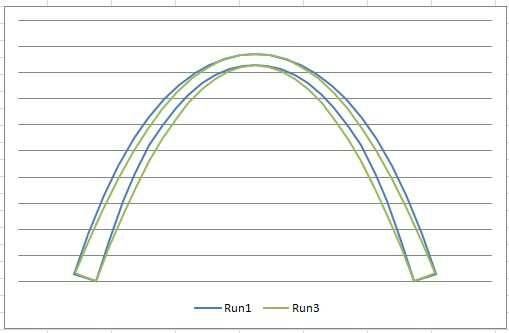
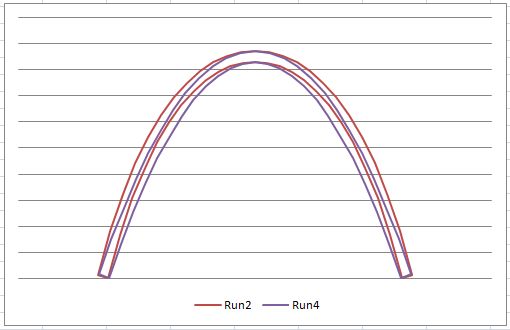
Bending moments and axial forces from these four runs are shown below:
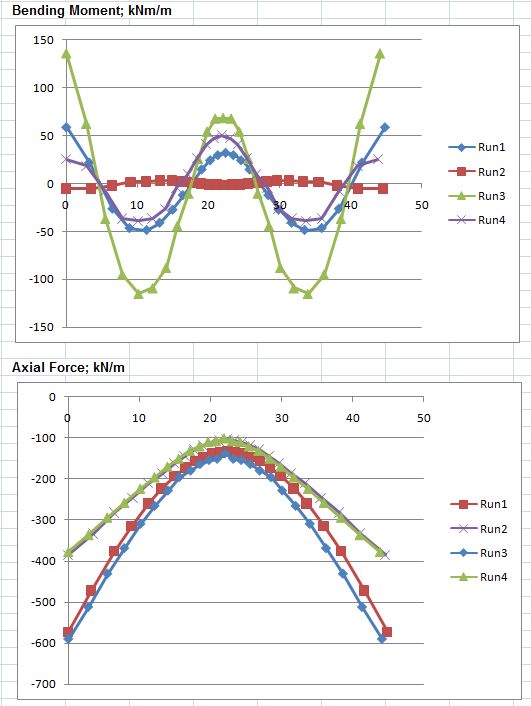
It can be seen that axial forces are similar, with the constant depth sections having a significantly smaller force, as would be expected.
Bending moments for the constant depth catenary (Run 2) are close to zero throughout. Bending moments for the constant depth parabola (Run 4) and the variable depth catenary (Run 1) are similar, with a maximum of 50 kNm/m. The variable depth parabola (Run 3) had bending moments more than twice as high.
Axial stresses for these four runs are shown below:
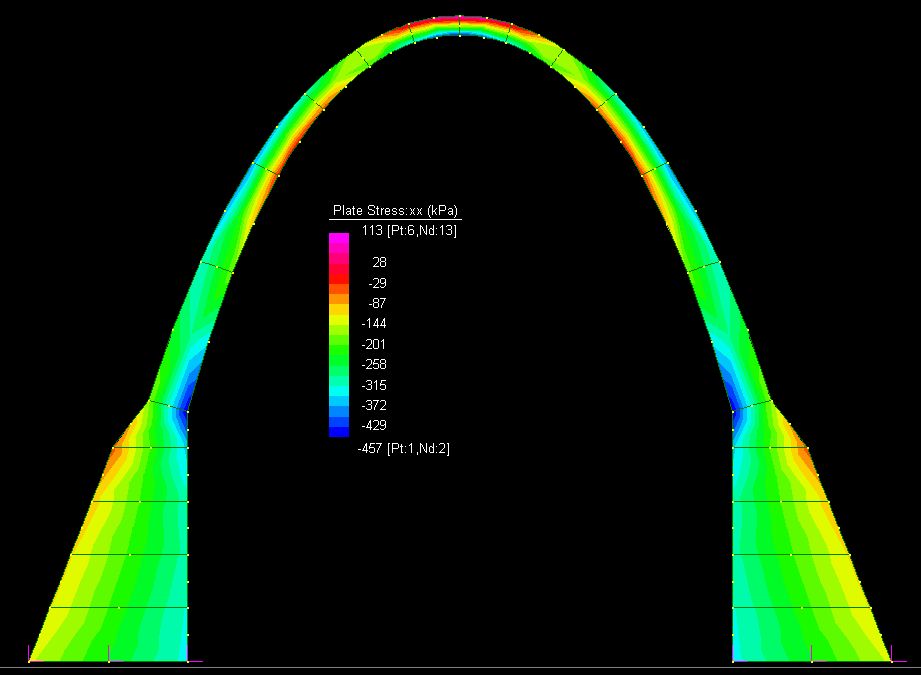
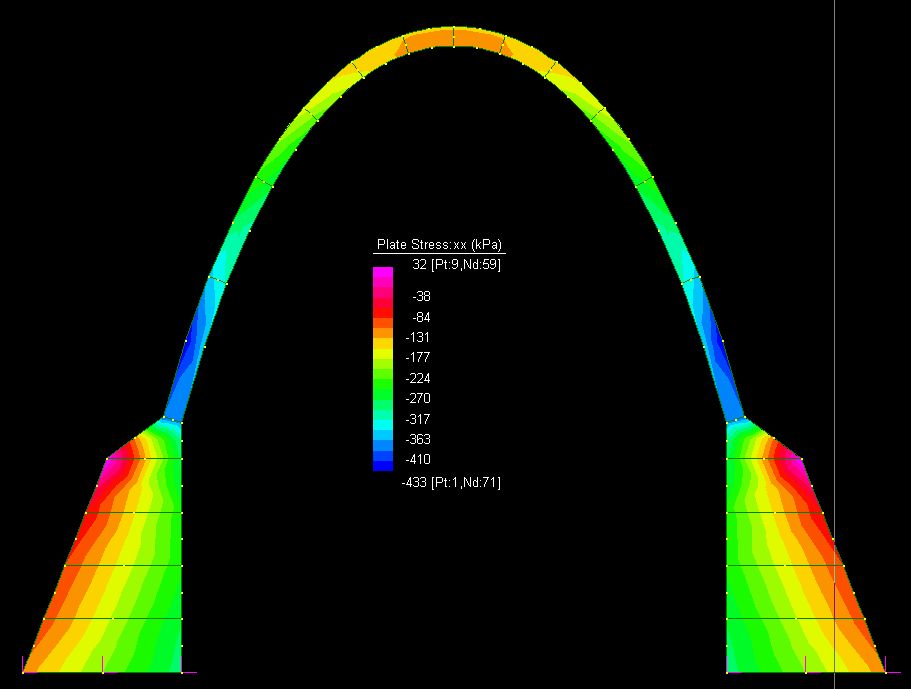
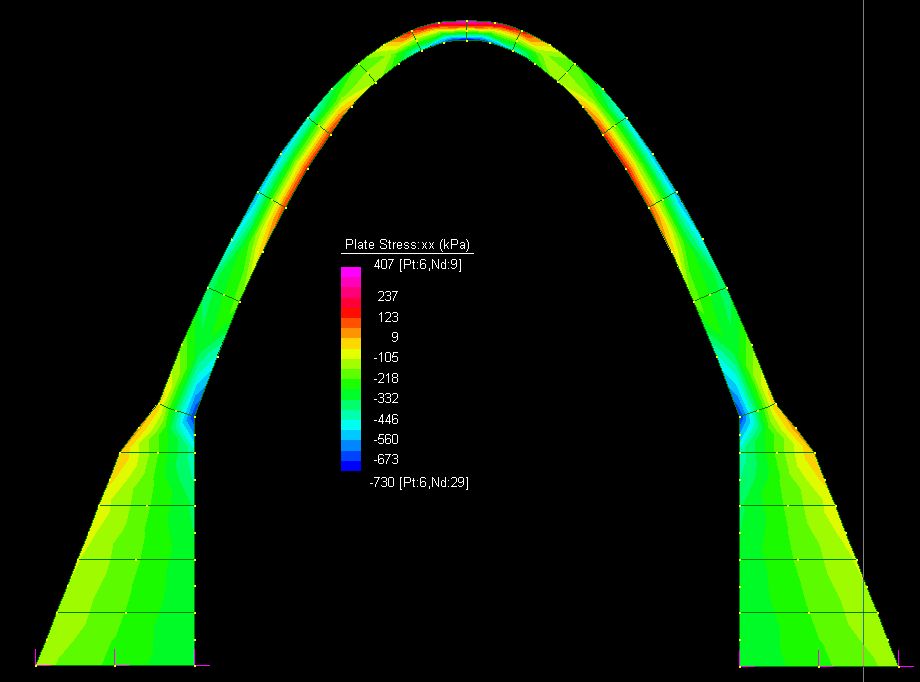
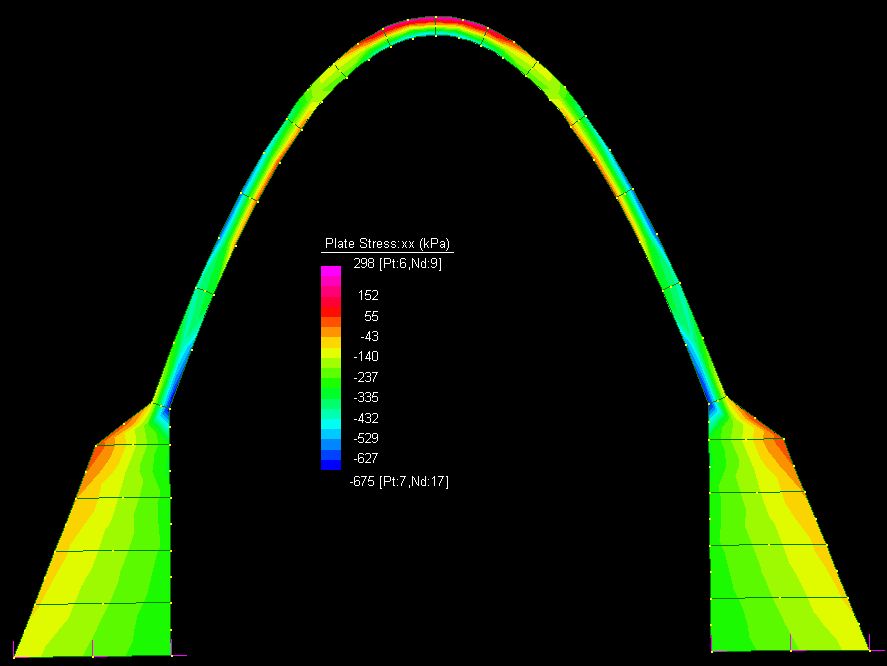
It can be seen that stresses were compressive throughout for Run 2, and tensile stresses increased progressively through Runs 1, 4 and 3 respectively. The maximum tensile stress from Run 3 was 400 kPa, which would leave little reserve capacity for wind or earthquake loads.
Since Runs 1 and 3 were intended to be the closest models to the actual structure the analyses show that the maximum tensile stress was about four times higher for the parabolic profile than the catenary profile.
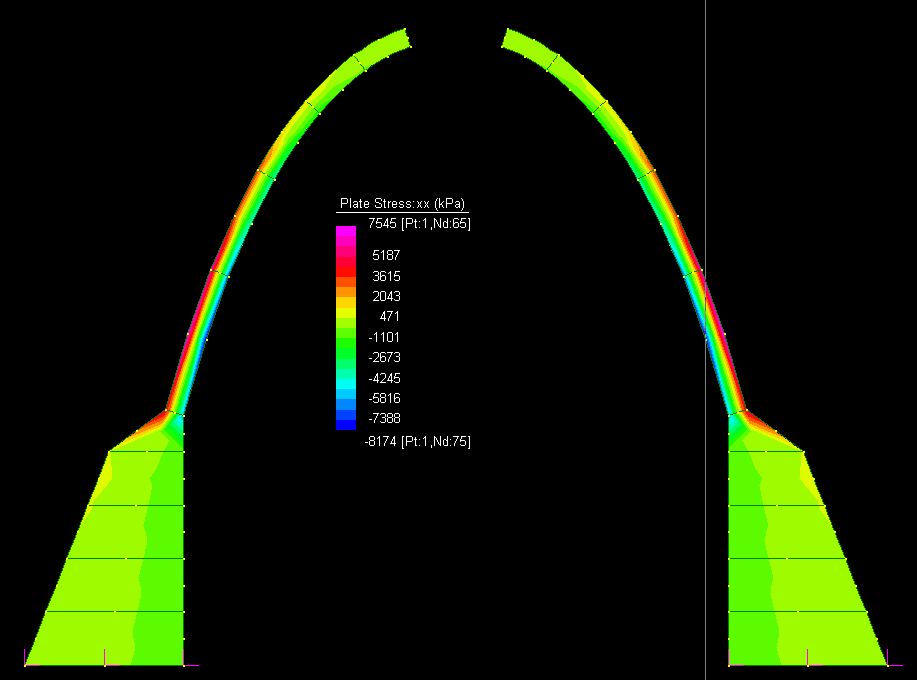
Finally, many sources on the ‘net suggest that the arch was constructed without centering, that is with no temporary supports before the closure of the arch. The analysis below shows that this results in tensile stresses of up to 7.5 MPa, which would be far in excess of the strength of the material, and construction of the arch without some form of temporary support would not be possible.


 Newton Excel Bach, not (just) an Excel Blog
It might have been built without formwork if it was constructed like a Nubian vault, meaning it started from a (buttressed) wall, and then starting from there.
LikeLike
Yes, good point. They could also have built starting from one end (supported by the wall as you suggested), with the top level sloping down along the length of the structure. That way it would be similar to the dome of Santa Maria del Fiore in Florence (https://newtonexcelbach.wordpress.com/2012/06/19/the-dome-of-santa-maria-del-fiore-in-florence/).
However they did it, it was an impressive achievement for the time.
LikeLike