
Previous posts have presented the theoretical background to finding stresses and strains in a reinforced concrete section built up of trapezoidal layers and subject to combined bending and axial loads. A spreadsheet with User Defined Functions (UDFs) and open source code was included in Reinforced Concrete Section Analysis 3. That post included an example analysing a circular section by dividing the circle into a number of trapezoidal layers. That analysis provides adequate accuracy, but requires considerable work to calculate the sizes of the layers and the positions of the reinforcement. A circular section is much more conveniently defined by a single parameter (the diameter) and the reinforcement may also be completely defined by the number and diameter of the bars and the depth of cover. The UDF Circe has been added to the spreadsheet RC design functions5.xls, which includes full open source code.
Input and output from Circe are shown in the screenshots below; further details of the application of the theory and the coding will be given in the next post:
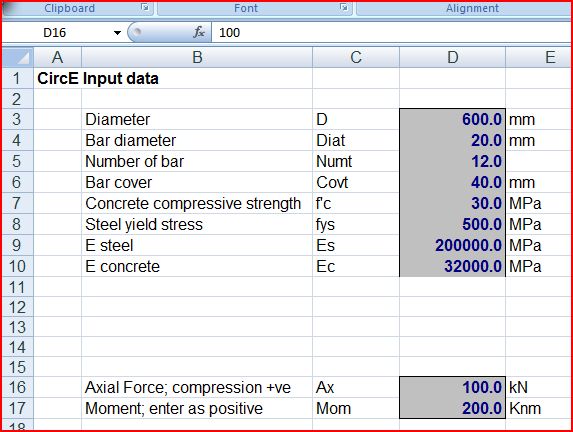
CircE Input
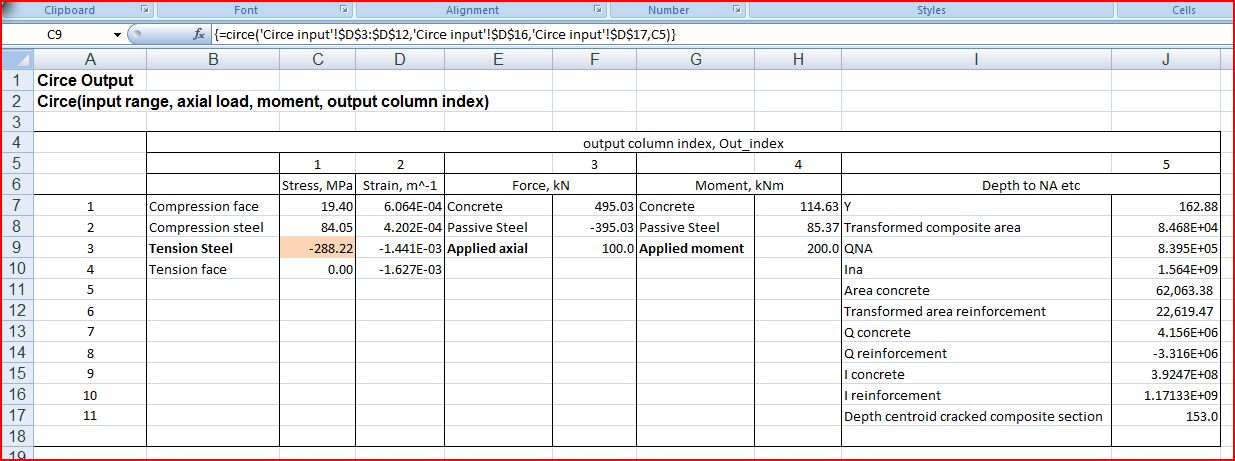
CircE output; click for full size view
Output from Circe for a range of axial loads is compared with results from the beam analysis program, using trapezoidal layers, in the screeshots below. It can be seen that the results are virtually identical:
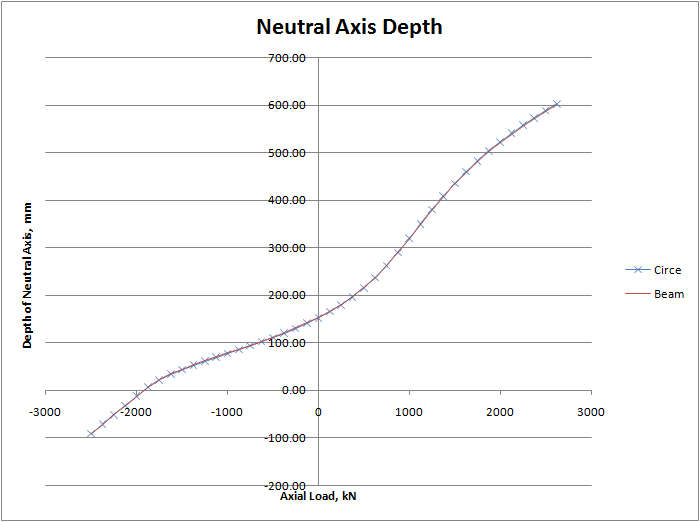
Depth of Neutral Axis
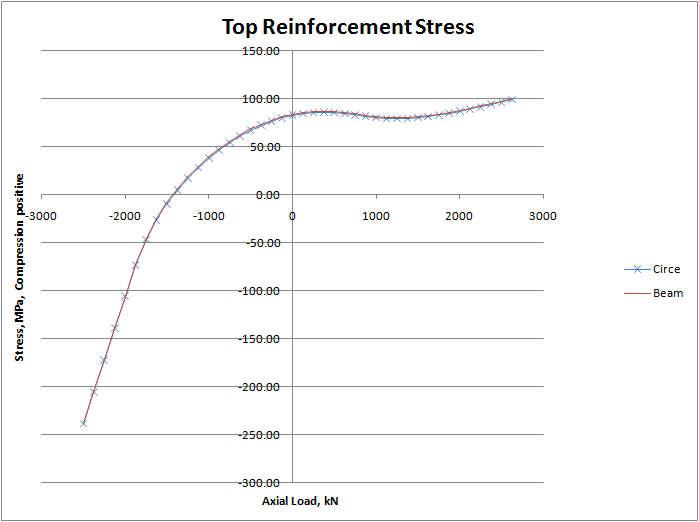
Top Reinforcement Stress
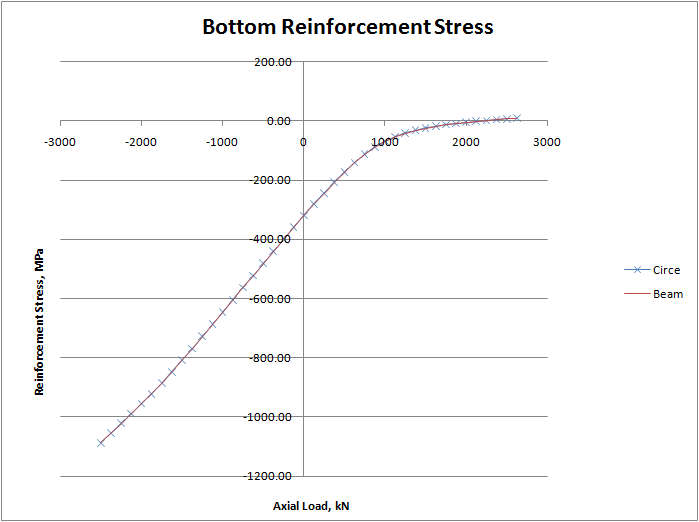
Bottom Reinforcement Stress


Pingback: Lateral pile analyis with PY curves … « Newton Excel Bach, not (just) an Excel Blog
For a 600mm column with the default reinforcement values, Circe Output shows depth to NA of 169mm, which is around one quarter of the column diameter; I would have expected closer to 220mm.
I tried the applied Axial at 0 and applied bending at 10, far below cracking moment, so I would have assumed the neutral axis would intersect near the centre of the column.
I even set the concrete tensile strength equal to the compressive strength, but that doesnt change the neutral axis calculation.
I compared with Momcurve, a 600×600 rectangular beam has NA calculations at 308.5mm, closer to what I’d expect at low moment values with zero axial force.
I don’t practice as a structural engineer so apologies if my intuition about RC concrete is wrong. It has been too long since I was educated in how to calculate these.
Would you also be able to explain why the Circe output worksheet formulas reference cells H2, C5 to L5? The VBA functions are too much for me to understand.
LikeLike
Hi Z,
I assume you downloaded the file from the downloads sheet, but I have now updated the link to https: and linked to the latest version, so the link on this page should work.
For design purposes, for checking stresses and deflections under maximum working load, it is standard practice with reinforced concrete to assume that the concrete is cracked and there is no tensile stress in the concrete. That is sometimes very conservative, but for sections with loads near their design limit it is a good approximation. The result is that the depth to the neutral axis will be much less than half the section depth, unless the section is very heavily reinforced.
The purpose of the Momcurve function is to find the actual curvature of the section under the specified load. For that purpose the full tensile stress in the concrete is included up to the cracking load, and after cracking a reduced tensile stress is included, that approximates the actual behaviour of the concrete. The result is the two functions will give very different depths to the neutral axis, especially for very low bending moments.
The value in Cell H2 is to specify a design code, and is only required for the crack width calculation, because different codes have different procedures for that calculation. See the Estress Input sheet for a list of codes.
The values in row 5 determine the output from the function, i.e. stress, strain, force etc.
LikeLike
Thanks Doug, I had assumed the E in Circe was elastic and that CircE calculated section properties below ultimate values.
If I wanted to find the depth to NA and I values for a RC concrete column for a specified load, similar to Momcurve, is there a way to do this with Circe or otherwise?
Use case is pile design and Plaxis inputs.
LikeLike
*RC circular column
(Meant to say this)
LikeLike
You can use the Circe output from the Crack Width column. The curvature output there takes account of the section cracking moment, and tension stiffening after cracking, using code specified procedures. For moments below the cracking moment the effective EI value is constant, then after cracking the effective EI reduces with increasing moment, but is significantly higher than from a calculation assuming zero tension in the concrete. You may want to set the Code number to 3 (Eurocode 2), rather than 1 (Australian AS 3600).
LikeLike
You might also like to look at:
Tension Stiffening | Newton Excel Bach, not (just) an Excel Blog
which gives background information on tension stiffening effects.
LikeLike
Thanks Doug. Is there a way to also get the neutral axis depth for a given load case?
LikeLike
I’m not sure why you want the depth of the neutral axis in this context. The curvature in the Circe output is based on an empirical code formula, which doesn’t involve the calculation of a modified NA depth.
The MomCurve function for rectangular sections has a different calculation method using a modified stress/strain curve for the concrete in tension, and this does return a neutral axis depth. This should not be used for calculation of steel stresses for design purposes, because all design codes require the concrete tensile stress to be taken as zero for strength or stress calculation purposes.
LikeLike
I’m not that familiar with typical values of bending moments and forces in reinforced concrete, so I thought a visualisation of how cracked the section is would guide some intuition about how relatively loaded a cross section is. Helpful to judge if a software input or output is not sensible. I think I can think in terms of I_eff if its not easy to calculate the extent of cracking for a given load case.
LikeLike