
Following the previous post, more detailed checking found that the code was returning an error for beams with a support at X = 0. This has now been fixed, and the revised code and spreadsheets can be downloaded from:
I have also added the files used for the detailed check, analysing 15 different span arrangements, each with 6 different support conditions, analysed in the file py_CBA-Check26-4.xlsb, and compared with Strand7 results for the same span arrangements and support conditions (Check Beam-pyCBA-all-Apr26.st7). The spreadsheet and Strand7 results are copied to Check py_CBA-4Apr26.xlsb, which is all numerical data and can be opened in Excel without Python.
The spreadsheet calculation of the 15 beams is shown below, with split-screen view (click image for full-screen view):
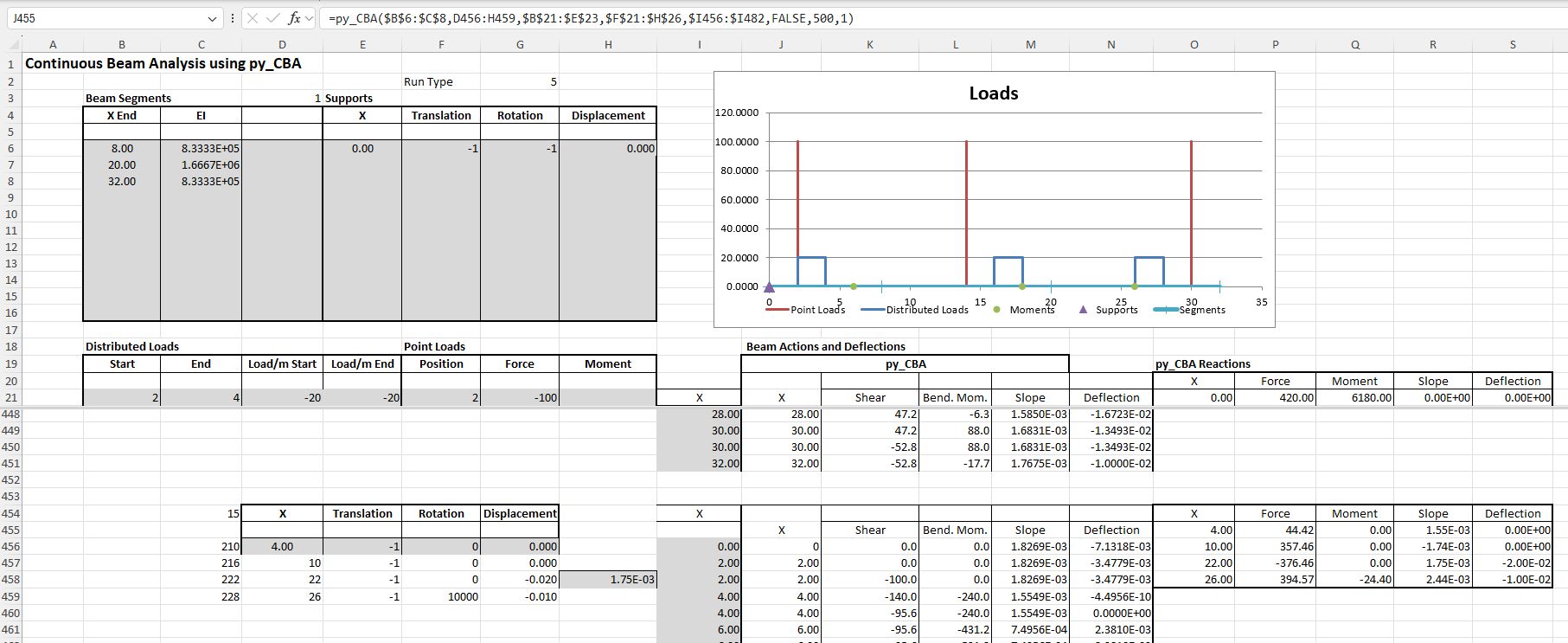
The segment definition, with a total beam length of 32 m, and the applied loading are the same for all cases, but the spreadsheet has 15 different ranges defining support locations, and each support has 6 different options for support type, including pinned, fixed, specified deflections and/or rotations or deflection and rotational stiffness. For each of the 6 support conditions the py_CBA function results for the 15 beams were copied to the summary spreadsheet:
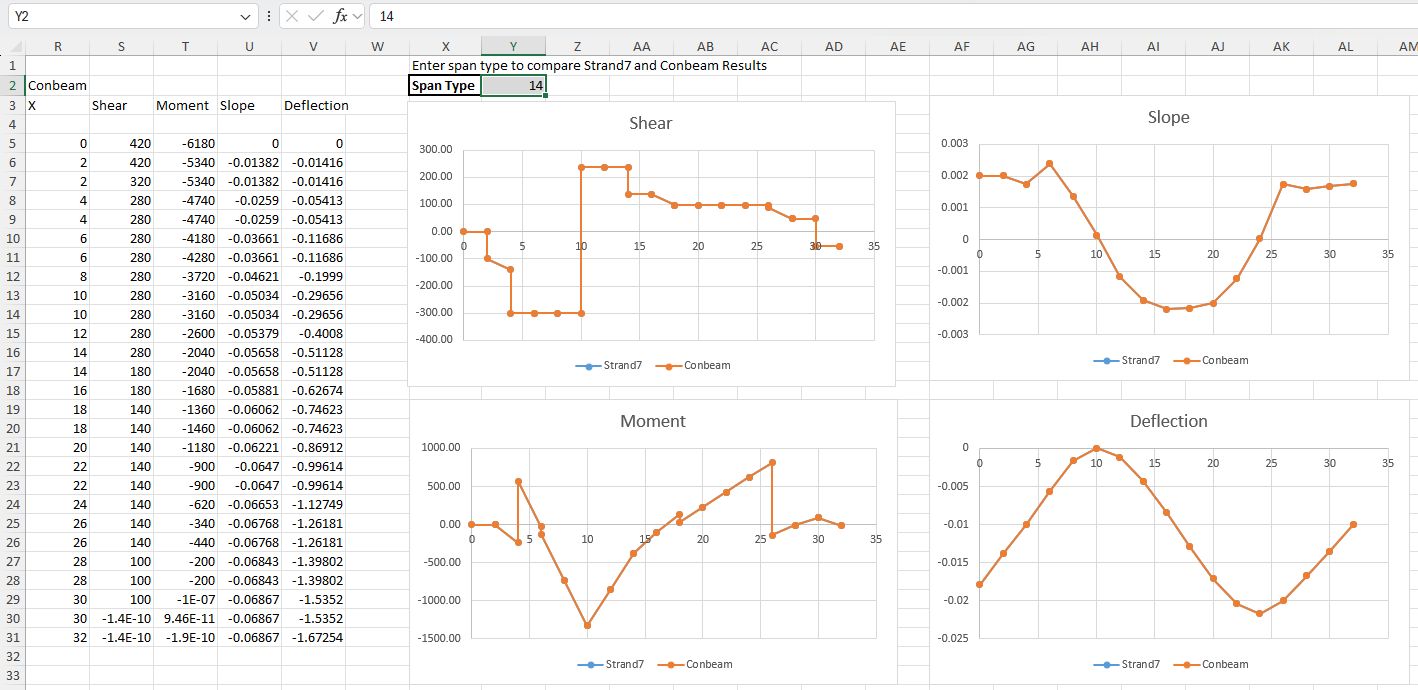
The Strand7 results are also copied to the summary spreadsheet, where the plots show near identical results, with both analyses appearing as a single line. The results for each of the 15 different support arrangement can be viewed by entering 1-15 in cell Y2.


 Newton Excel Bach, not (just) an Excel Blog