
The Python 3DFrame spreadsheet has been updated to allow for analysis including torsional warping effects. The new spreadsheet and associated Python files can be downloaded from:
The download file includes four sample spreadsheets comparing analysis results with output from Strand7 and Mastan2. The first analysis was the small concrete frame described in the Mastan2 post. This has been updated using steel I sections, as shown below.

The steel section properties were taken from the Mastan2 library, with units set to mm and Newtons, using the sections M318x18.5, M200x9.2, M250x11.2, and M250x13.4. The section properties generated in Mastan2 were copied to the spreadsheet as shown below:

The analysis in Strand7 (torsional warping not included) used m and kN units, with the results shown below:
Node deflections

Reactions

For the analysis including torsional warping the following changes were made to the model, to suit the default input options in Mastan2:
- The coordinates were modified so that the Y axis was the vertical direction, as described in the previous post.
- The I beam section properties were generated with the web parallel to the vertical (Y) axis.
- Applied loads were modified to constant loads over the full member length, with just one point moment load applied at a node.
- All section properties and loads were converted to mm and Newton units.
The spreadsheet and Mastan2 results with torsional warping effects included are shown below, with good agreement between the two results.


Changing the spreadsheet analysis to “Exclude Warping” differences from the Mastan2 reaction results are shown below:
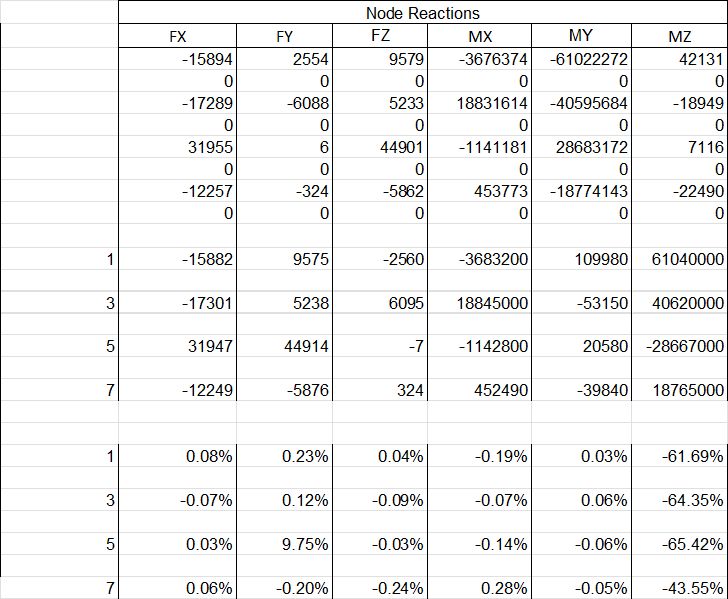
In this case there are significant differences in the Mz/My moments (i.e the torsion in the frame vertical members), but differences in other actions are small.


 Newton Excel Bach, not (just) an Excel Blog
Pingback: Python code updates – 3DFrame-py | Newton Excel Bach, not (just) an Excel Blog