The hole through the middle of the Earth – revised transit time

In the previous post in this series I produced a table of acceleration due to gravity against depth from surface, based on the four layers of the Earth (Crust, Mantle, Outer Core, Inner Core), assuming a constant density for each layer.  This showed that the variation of acceleration is far from linear, and that the maximum acceleration occurs not at the surface, but at the boundary between the Mantle and Outer Core. 

This table of accelerations can now be used as input to the ODE solver function to give a more accurate estimate of the time taken for a ball dropped down the Hole Through the Centre of the Earth to reach the centre (keeping all the other simplifying assumptions, such as perfect vacuum, no impact with the sides, etc).  The spreadsheet containing this calculation can be downloaded from ODESolver-Buckle.zip 

The revised function to be solved is shown in the screen shot below: 

Revised function for the ball through the centre of the Earth problem


Note that the CoeffA argument now contains an array of acceleration values at selected depths, rather than a single rate of change of acceleration value.  The CSpline function is used to return the slope of a cubic spline passing through these points, at the distance from the centre specified in Y(0). 

Input and part of the output results are shown below: 

ODE function input and output


The time to reach the centre of the Earth, taking account of the actual variation of acceleration with depth, has reduced from 1264.5 seconds to 1168.5 seconds (19 minutes 28.5 seconds), a reduction of about 7.6%. 

Graphs of distance from the centre, velocity, and acceleration against time are shown below, with the corresponding graph assuming linear variation of acceleration.  It can be seen that the maximum velocity has increased from 7,897 m/s to 9,636 m/s, and the acceleration at the Mantle/Outer Core boundary has increased from 5.4 m/s2 to 10.32 m/s2

Distance from Centre vs Time


Velocity vs Time


Acceleration vs Time

Posted in Differential Equations, Excel, Newton, UDFs, VBA | Tagged , , , , | 3 Comments

Update to CHSplineA Function

I have recently corrected the CHSplineA function included in the CSpline2 spreadsheet.  The earlier version was returning incorrect values for the slope and curvature of the spline (with output option 2), if the spacing of the points defining the spline was anything other than 1.

Posted in Excel, Maths, Newton, UDFs, VBA | Tagged , , , , , | Leave a comment

Office 2010; Installation problems and solutions

I installed Office 2010 a couple of weeks ago, and I have just succeeded in getting the help system to work.  After pressing F1, or clicking the Help icon, I was getting a screen saying that the help system was being installed, then eventually (after a couple of minutes maybe) a box saying that the computer needed to be re-booted (yes/no) and a blank help screen in the background.  After re-booting and restarting Office, the whole installation process started again, and if interrupted showed a screen saying there was no help available on this topic.  After much searching, and eventually e-mails to Microsoft support, this is the process that fixed the problem:

  1. Run MS Config, and disable all  start-up programs and all non-Microsoft services.
  2. Re-boot, then find all “Microsoft Help” folders, and rename them “Microsoft Help.Old”
  3. Run a repair installation from the Control Panel “Uninstall a program” tab
  4. Re-boot; – didn’t work.
  5. Disable Microsoft Firewall
  6. Delete new “Microsoft Help” folders (which were all empty this time)
  7. Set up a new user account (as administrator)
  8. Log in under the new account, start Office, and press F1.
  9. Same “installing help” message as before, then the re-start required box.
  10. Rebooted the computer, restarted Office, and the Help works!
  11. Log in to my original account, and that has help as well!

Having gone through all that I find that Microsoft in their wisdom have made on-line help the default, so we get an annoying wait for help (even with a fast cable connection), rather than the instant help we used to get 20 years ago, on machines about 1000 times slower.  Fortunately I remembered a post from Ron de Bruin at Daily Dose of Excel on this very issue.  Click on the box in the bottom right hand corner, showing
“Connected to Office.com” and you can select “Show content only on this computer”, which then becomes the default.  If you really want the on-line help you can click on the same box any time, and select it.

Just what was going on in the mind of whoever decided to make on-line help the default, and why they hid the local option away instead of putting it under the help menu, I can’t imagine, but never mind, it’s easily fixed thanks to Ron de Bruin.

So now I’m back to being as productive as I was 3 weeks ago.

Posted in Excel | Tagged , , , | 3 Comments

Beam on Elastic Foundations Analysis

A previous post on laterally loaded piles used a finite difference analysis to analyse the deflections and forces in a vertical pile subject to a lateral load at the top.  An alternative approach to the same problem is presented in “Programming the Finite Element Method” by I.M. Smith and D.V. Griffiths, including Fortran code.  The main advantage of their approach is that the pile and soil stiffness values are treated as varying linearly between each node, rather than being constant over each segment.  Also the code provides for up to 6 integration points in each segment, allowing a smooth transition between elements with different properties.

I have converted the Fortran code to VBA, and incorporated it into the LatPile function presented previously.  The spreadsheet also includes a new function, BoEFA, with additional flexibility for specifying node constraints and variable segment lengths, and with sign conventions better suited to horizontal beams.  The spreadsheet, including full open source code, may be downloaded from LatPileB.zip

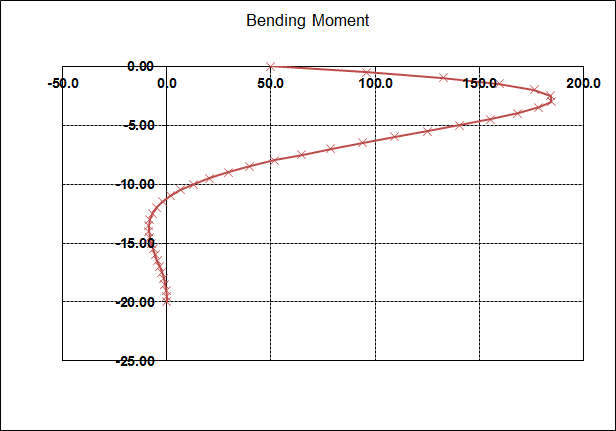
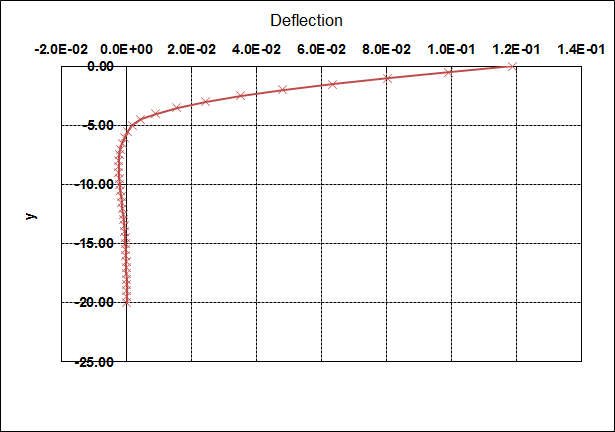
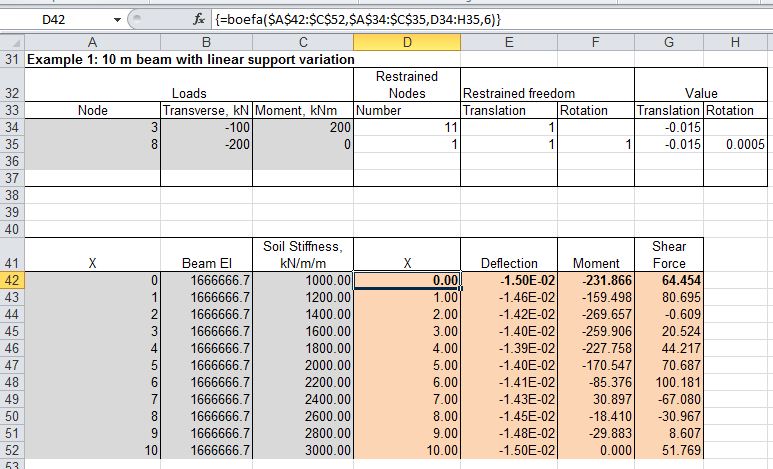
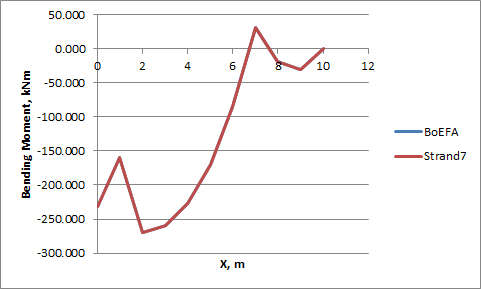
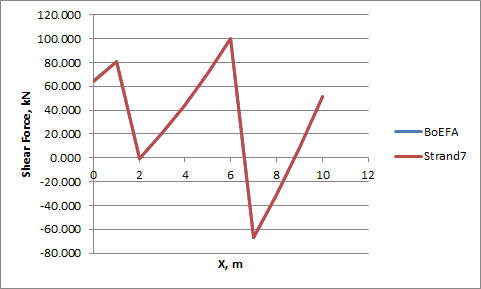
Screenshots below show typical input and output, including comparison of results of the same analysis in Strand7 FEA software.  Click on any image for a full size view.

LatPileB input and output

LatpileB Bending Moments

LatPileB Shear Forces

LatPileB Deflections

BoEFA Input and Output

BoEFA and Strand7 Deflections

BoEFA and Strand7 Bending Moments

BoEFA and Strand7 Shear Forces

Posted in Excel, Finite Element Analysis, Geotechnical Engineering, Newton, UDFs, VBA | Tagged , , , , | 6 Comments

AlgLib Spline function update

Following a question at the AlgLib Forum I have added the Hermite spline fit function to the AL-Spline-Matrix collection.

The revised spreadsheet, with full open source code is available for download in 2007/20010 version and pre-2007 version.

Typical output of the Hermite spline fit function (together with the two previous spline fitting functions) is shown in the screen shot below:

HSplineFit Function; click for full size view

Posted in Excel, Maths, Newton, UDFs, VBA | Tagged , , , | 5 Comments