The flexural curvature of any beam composed of material with linear elastic behaviour, subject to a bending moment, M, is given by:
C = M / EI
where E is the elastic modulus of the beam, and I is its second moment of area.
Unfortunately the behaviour of reinforced concrete is far from linear-elastic, even with loads within working stress limits, and it is therefore necessary to adjust either E or I depending on the magnitude of the applied moment. In addition concrete is subject to significant long term strains due to creep and shrinkage, which will affect the curvature of a reinforced concrete beam subject to a flexural load.
This and the following posts will describe how the curvature of a reinforced concrete section may be simply calculated, taking account of all significant factors, using Excel based User Defined Functions (UDFs) presented in previous posts (see RC Design Functions for rectangular sections with two layers of reinforcement, or Beam Design Functions for beams with complex sections and/or more than two reinforcement layers). The functions assume that both the reinforcement and the compressive concrete are in the elastic range, which will normally be the case for beams at working loads. Spreadsheets with full open source code may be downloaded from:
RC Design Functions6
Beam Design Functions
The basic calculation in the UDF Estress() finds the depth of the neutral axis and the concrete strain at the compressive face, for any combination of applied bending moment and axial load. This calculation ignores the concrete in tension; i.e. the concrete is assumed to have zero tensile strength. The section curvature ignoring concrete tensile strength is then given by:
Curvature = Strain / Depth to Neutral Axis.
This curvature is output along with the strain at the concrete faces and the reinforcement levels.

Estress output for strains and fully cracked curvature
In reality the concrete tensile strength contributes significantly to the flexural stiffness of the section:
- If the maximum tensile stress in the concrete is below its tensile strength then the section will remain uncracked, and the stiffness will be very much greater than indicated by the calculation assuming zero tensile strength.
- After cracking there is a transfer of stress from the reinforcement to the concrete between the cracks, and this results in a significant increase in stiffness.
The graph below shows typical behaviour of a reinforced concrete section under increasing bending moment, with a transition from uncracked stiffness towards fully cracked stiffness.
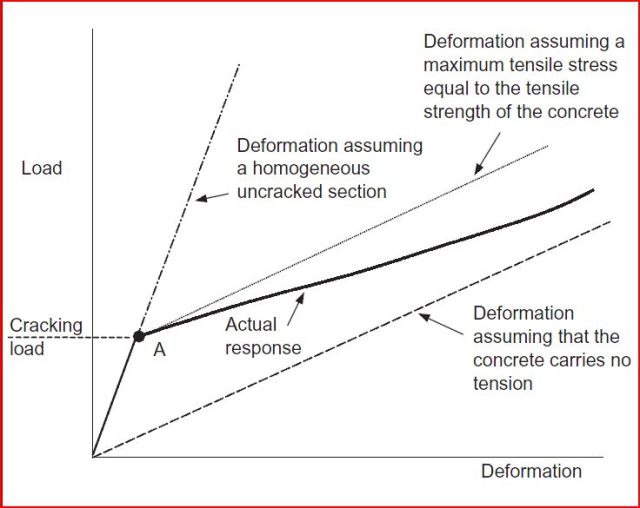
Reinforced Concrete Deflection v Moment
Different design codes provide many different methods to estimate the effect of tensioning stiffening, all being empirical relationships based largely on experimental results. The provisions in the Eurocode, EC2, have been found to provide reliable results, including for lightly reinforced sections just after cracking (1),(2). A convenient formulation of these provisions has been independently derived by Bischoff and Gilbert (3):
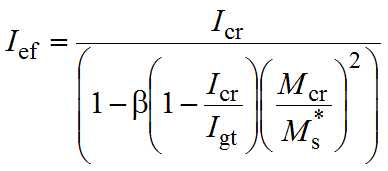
Effective Stiffness including tension stiffening effects
Where:
Ief = Effective Transformed second moment of area of the section, subject to the moment Ms*
Icr = Second moment of area of the fully cracked section
Igt = Second moment of area of the gross concrete section
Mcr = Bending moment causing first cracking at the section
β = 1 for short-term calculations and β = 0.5 for long-term calculations.
The Estress output provides an estimate of the section curvature allowing for tension stiffening to the EC2 provisions, along with crack widths.
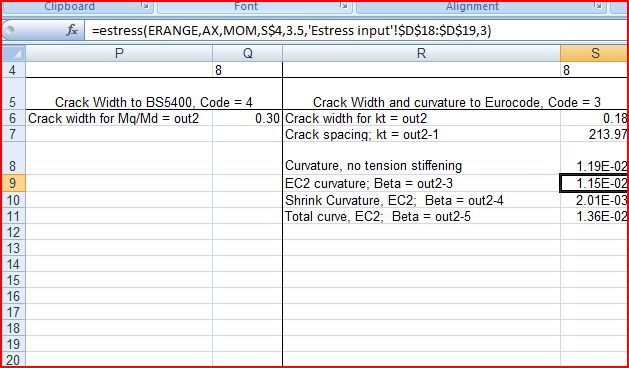
Estress output for curvature to EC2
Creep strains are proportional to the applied stress, so creep may be conveniently taken into account by the use of an age adjusted elastic modulus for the concrete, in accordance with the provisions of the applicable code. It should be noted that the adjusted modulus should only be used for permanent loads. Curvature and deflections due to short term loads should use the short-term modulus regardless of the age of the concrete.
The next post will cover allowance for the effect of concrete shrinkage strains and differential temperature strains.
References:
- Gilbert R.I., “Gilbert R.I., “Tension Stiffening in Lightly Reinforced Concrete Slabs”, Australian Journal of Structural Engineering, Institution of Engineers Australia, Vol 8 No 3, 2008, pp 189-196.
- Eurocode 2, “Design of concrete structures Part 1-1: General rules for buildings”, British Standard BS EN 1992-1-1:2004, European Committee for Standardisation (CEN).
- Bischoff P.H., “Reevaluation of Deflection Prediction for Concrete Beams Reinforced with Steel and Fiber Reinforced Polymer Bars”, Journal of Structural Engineering,





 Newton Excel Bach, not (just) an Excel Blog