Elegant proofs 4 – The optimum shape of an arch

Large span arch structures have been constructed for well over two thousand years, but the first recorded analytical treatment was given by Robert Hooke in 1675 who at the end of his treatise on helioscopes added the following statement “to fill up the vacancy”:

“The true mathematical and mechanical form of all manner of arches for building, with the true butment necessary to each of them. A problem which no architectonick writer hath ever yet attemted, much less performed. abcccddeeeeefggiiiiiiiillmmmmnnnnnooprrsssttttttuuuuuuuvx” *

The solution to this anagram (no doubt written as such to annoy Newton) was published in 1705, after Hooke’s death as:
“Ut pendet continuum flexile, sic stabit contiguum rigidum inversum”
which translates as:
“As hangs the flexible line, so but inverted will stand the rigid arch”

In other words, the shape of a flexible line, a catenary, which is in pure tension, will if inverted be in pure compression, and hence the ideal shape for an arch. The same realisation was apparently used by the builders of the The Roof of the Taq-i-Kisra some 1000 years earlier, but in general the shape of large span arch structures is not a catenary, circular or elliptical shapes being almost universally used for masonry arch bridges, and parabolic shapes for free standing arches.  It is often suggested that these alternative shapes are used as convenient approximations to a catenary, but in fact there are two additional factors which change the optimum shape for arch structures:

  1. The catenary is the optimum shape for a free standing arch of constant cross section, but in a typical arch bridge the majority of the weight will be in the bridge deck, and the optimum supporting shape will tend towards a parabola.
  2. For arch structures in which the roadway is supported on fill (such as typical masonry bridges) the fill applies horizontal loads to the arch, as well as vertical, and the optimum supporting shape will tend towards a circular or elliptical arc for very high fills, or some more complex shape for shallower fills.
Arch bridge at Totnes, Devon

Arch bridge at Totnes, Devon

More details can be found at: Arch Structures

* Interestingly, all transcriptions of the anagram I have found on the Internet insert an additional e, but the reproduction of the original publication here clearly shows that there are only 5 e’s, and this is consistent with the solution of the anagram.  This appears to be an example of Stephen Jay Gould’s “Fox-terrier fallacy” where an erroneous statement becomes accepted through repeated copying.
Posted in Arch structures, Newton | 10 Comments

Applied Mechanics of Solids

Applied Mechanics of Solids is a free text on finite element analysis by Allan F Bower, who seems to have a gift for clear explanation of the topic combined with a wry sense of humour; not a combination you see every day in this field:

“This electronic text summarizes the physical laws, mathematical methods, and computer algorithms that are used to predict the response of materials and structures to mechanical or thermal loading.

Topics include: the mathematical descriptions of deformation and forces in solids; constitutive laws; analytical techniques and solutions to linear elastic and elastic-plastic boundary value problems; the use and theory of finite element analysis; fracture mechanics; and the theory of deformable rods, plates and shells.

Over 400 practice problems are provided, as well as demonstration finite element codes in MAPLE and MATLAB.

The text is intended for advanced undergraduate or graduate students, as well as practicing engineers and scientists. It will be particularly useful to readers who wish to learn enough about solid mechanics to impress their teachers, colleagues, research advisors, or managers, but who would prefer not to study the subject in depth.”

Posted in Finite Element Analysis, Newton | Tagged | Leave a comment

Adding Function Categories and Descriptions

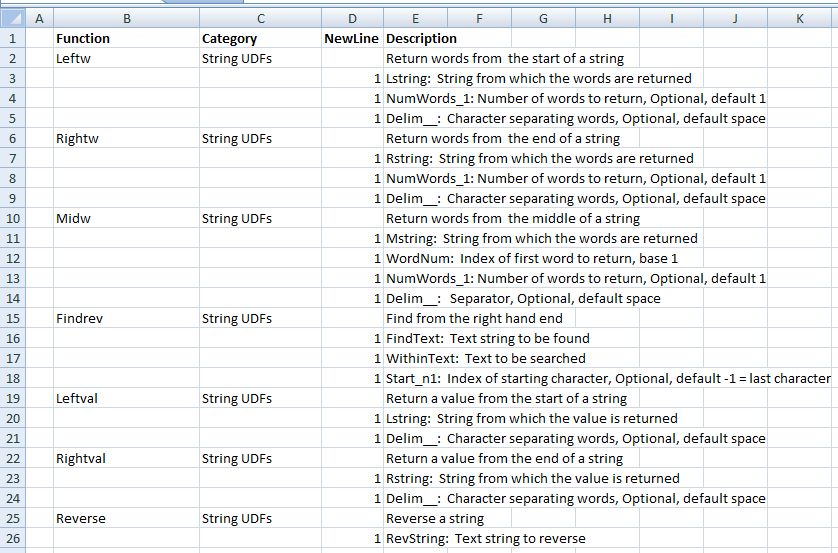
User defined functions (UDF’s) are by default added to the “User Defined” category in the function list, and when a UDF is selected the words “no help available” appear, rather than a description of the function and it’s parameters.  A rather complex way of getting the full functionality of the built-in function descriptions is given at:  Registering a User Defined Function with Excel.  In this post I will describe a much simpler method to achieve the same end, but with the restriction that the total number of characters in the description must be less than 256.

The simple method uses a four column table in the workbook containing the functions as shown below:

Click for full-size view

Click for full-size view

The columns are:

  1. The function name
  2. The category name
  3. A 1 on any continuation lines
  4. The function description, with descriptions of each parameter on a separate line

Assign the range name “functionlist” to the list, excluding the column headings.

The macro listed below will create the category names and add the function descriptions to the function list:

Sub FuncDescriptions()
Dim FunctionA As Variant, NumRows As Long, NL As Long
Dim FuncName As String
Dim Descript As String
Dim Cat As Variant
Dim i As Long, j As Long
FunctionA = Range("functionlist").Value
NumRows = UBound(FunctionA)
On Error Resume Next
With Application
i = 1
Do While i <= NumRows
If NL = 0 Then
FuncName = FunctionA(i, 1)
Cat = FunctionA(i, 2)
Descript = FunctionA(i, 4)
Else
Descript = Descript & vbCrLf & FunctionA(i, 4)
End If
If i < NumRows Then NL = FunctionA(i + 1, 3)
If NL = 0 Or i = NumRows Then
.MacroOptions Macro:=FuncName, Description:=Descript, Category:=Cat
End If
i = i + 1
Loop
End With
End Sub

To run the macro automatically add:

Private Sub Workbook_Open()
FuncDescriptions
End Sub

under “ThisWorkbook”

Example code has been added to the String Functions worksheet here: StringFunctions.zip

Posted in Excel, UDFs, VBA | Tagged , , , | 3 Comments

Bert Jansch – Acoustic Routes

Just appeared on YouTube; the first part of a documentary about the music, life and times of Bert Jansch, made in 1992, including a rare appearance from Anne Briggs and commentary from a very youthful looking Billy Connolly.

Great Stuff!

Posted in Bach | 1 Comment

Is light a wave or a particle?

This clever ambigram from Douglas Hofstadfter provides the answer:

Is light a wave or particle?

Is light a wave or particle?

Posted in Newton | 4 Comments