Continuous beam analysis with cubic splines

The last example in the previous post illustrated the use of cubic splines to find the bending moments in a continuous beam subject to prescribed lateral displacements.  A similar technique can be used to find bending moments, shear forces, reactions, and displacements in a continuous beam subject to lateral forces.  The spreadsheet SplineBeam.zip contains a description of this technique and a User Defined Function (UDF) to perform the analysis.

In outline, the procedure is:

For each loaded point:

  1. Apply unit deflection
  2. Fit cubic spline and find the curvature and bending moment in the segments either side of the loaded point
  3. Load = change of bending moment gradient at the point load
  4. Scale bending moments by Applied Load / Load for unit deflection

Sum bending moments for each loaded point

Calculate shear forces and reactions from bending moment diagram

This procedure is illustrated in this example for a single point load on a three span beam (click on any image below for a full size view):

SplineBeam1

Calculation of beam actions and deflections for a single point load on a 3 span beam

The beam support positions are specified with a Y value of zero in column B, and a deflection of -1 is entered for the load at X = 17.5.  The beam slope and curvature at each node and the load location are generated by the UDF CSPLINEA() (see previous post).

The bending moment in column G is simply the curvature multiplied by the beam flexural stiffness, EI; where E is the Young’s Modulus and I is the second moment of area of the beam cross section.

The force in column H is the force required to generate the prescribed unit deflection, and is equal to the change in slope of the bending moment diagram at the load position.   Dividing the specified applied load (100 kN) by the force for unit deflection gives the factor to be applied to the calculated bending moments; in this case -5.67E-04.  The beam actions and deflections in Columns I to K are found by multiplying the corresponding action under unit deflection by this factor.
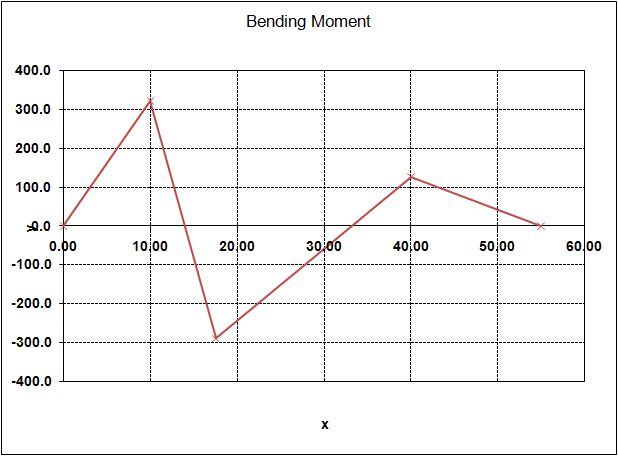
SplineBeam2

Bending moments for a single point load on a 3 span beam

This procedure has been incorporated in the UDF SPLINEBEAM() which can be used to analyse continuous beams with any numbers of spans and any number of point loads:
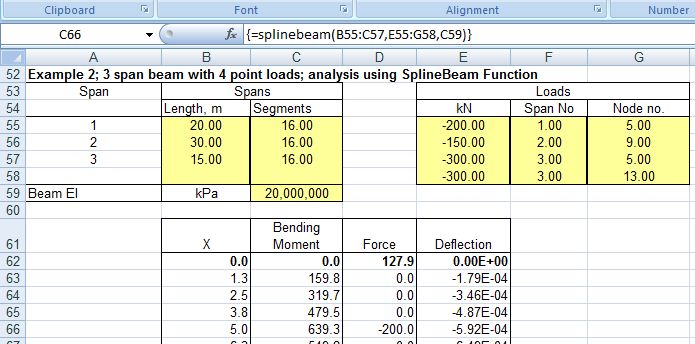
SplineBeam3

SplineBeam input and top of output for a 3 span beam with 4 point loads

Note that loads can only be applied at node positions, and nodes are generated by dividing each beam into a specified number of equal length segments.  Nodes are numbered from 1 to number of segments + 1 from left to right for each beam.
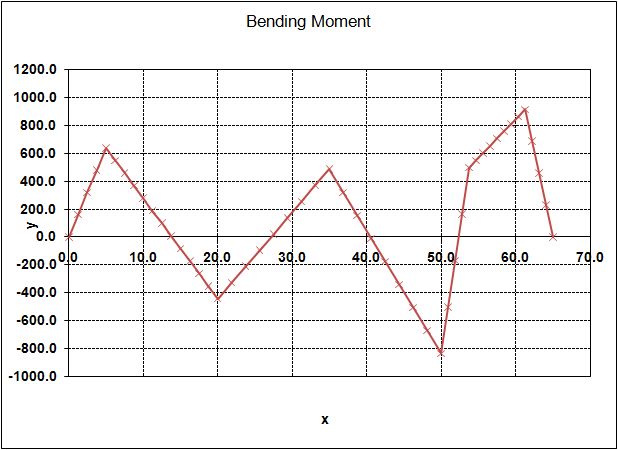
SplineBeam4

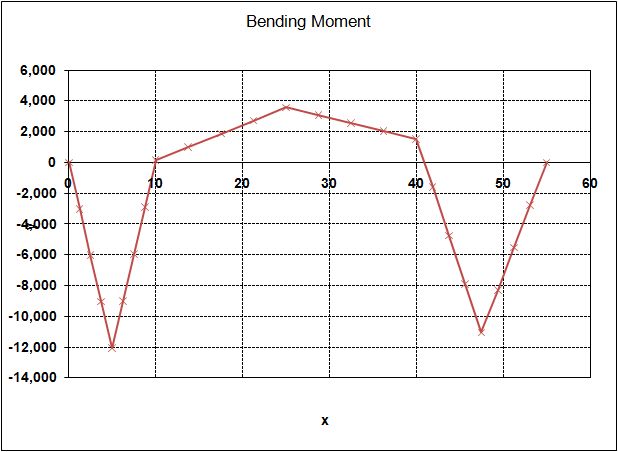
Bending Moments for 3 span beam with 4 point loads
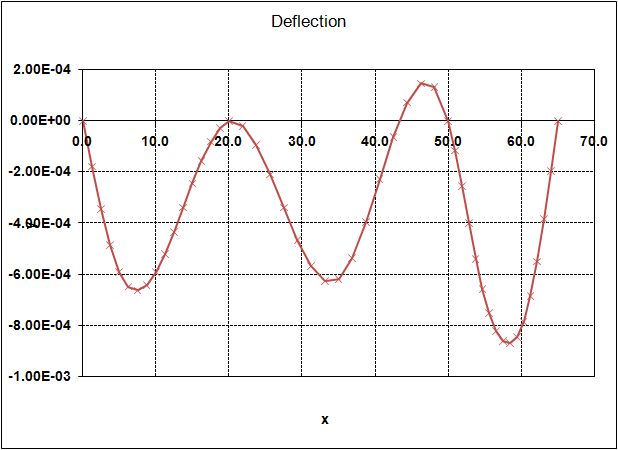
SplineBeam5

Deflections for 3 span beam with 4 point loads

SplineBeam6

Bending Moment output from the same analysis in Strand7

The same analysis performed in Strand7 gives identical results.

Posted in Arrays, Beam Bending, Excel, Finite Element Analysis, Frame Analysis, Maths, Newton, UDFs, VBA | Tagged , , , , , , , | 9 Comments

Cubic Splines

Cubic splines are used to fit a smooth curve to a series of points with a piecewise series of cubic polynomial curves.  In addition to their use in interpolation, they are of particular interest to engineers because the spline is defined as the shape that a thin flexible beam (of constant flexural stiffness) would take up if it was constrained to pass through the defined points.  This post will present an Excel User Defined Function (UDF) to generate a “natural” cubic spline for any series of 3 or more points.  Later posts will look at alternative spline formulations, and applications of the cubic spline to structural analysis.

A cubic spline is defined as the curve that for any two adjacent internal points:

  1. The curve passes exactly through both points
  2. The slope of the curve at the end points is equal to the slope of the adjacent segments
  3. The curvature of the curve at the end points is equal to the curvature of the adjacent segments

Alternative provisions for the end segments will generate different spline curves over the full extent of the curve.  The most common provision for the ends is that the curvature is zero at both ends.  This is known as a “natural cubic spline”.  In a structural analysis context this corresponds to a beam that is free to rotate at both ends, but is constrained in position at the ends and a number of internal points.

Further details of the theory of cubic splines, and an algorithm for generating natural cubic splines are given in this Wikipedia article.

An excel spreadsheet with a UDF for generating cubic splines, based on the algorithm in the Wikipedia article, can be downloaded from: CSpline2.zip

The download is open source, and full VBA code for the UDF is freely accessible.

Example screen shots from this file are shown below:

Csplinea Function

Csplinea Function

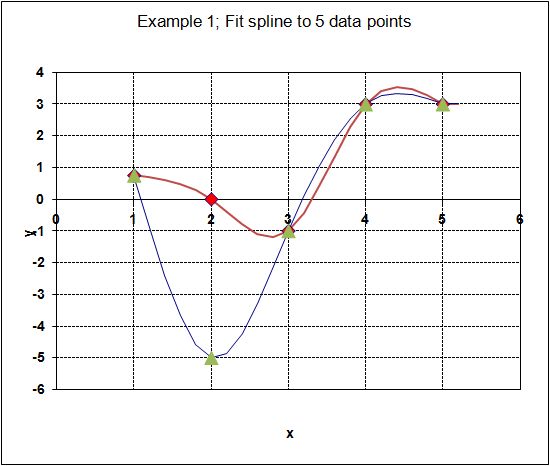
Example 1; Fit spline to 5 data points

Example 1; Fit spline to 5 data points

Example 1; Fit spline to 5 data points

Example 1; Fit spline to 5 data points

Example 2; Fit spline to 9 data points on a circular arc

Example 2; Fit spline to 9 data points on a circular arc

Example 2; Fit spline to 9 data points on a circular arc

Example 2; Fit spline to 9 data points on a circular arc

“Dummy” data points at each end allow the curvature at the start and end points to be adjusted to the required value.

Example 2; Fit spline to 9 data points on a circular arc

Example 2; Fit spline to 9 data points on a circular arc

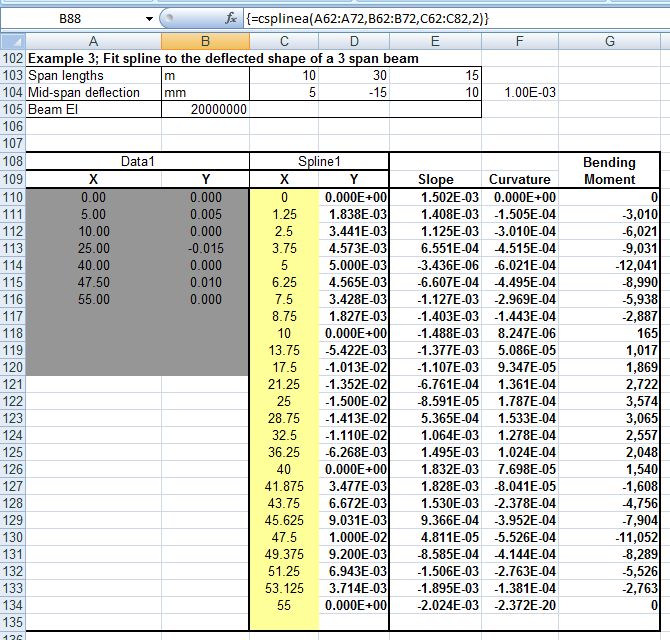
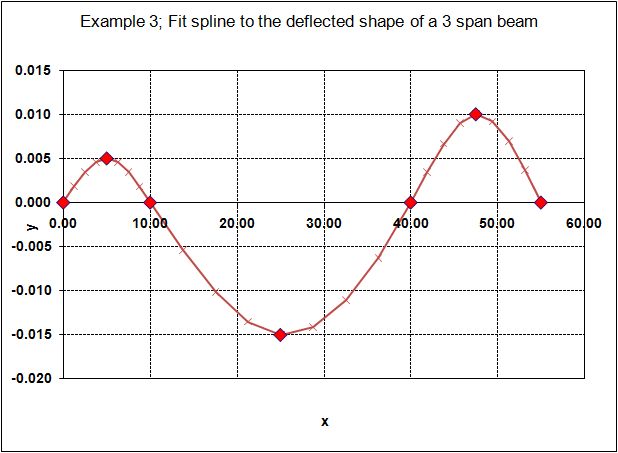
Example 3; Fit spline to the deflected shape of a 3 span beam

Example 3; Fit spline to the deflected shape of a 3 span beam

Example 3; Fit spline to the deflected shape of a 3 span beam

Example 3; Fit spline to the deflected shape of a 3 span beam

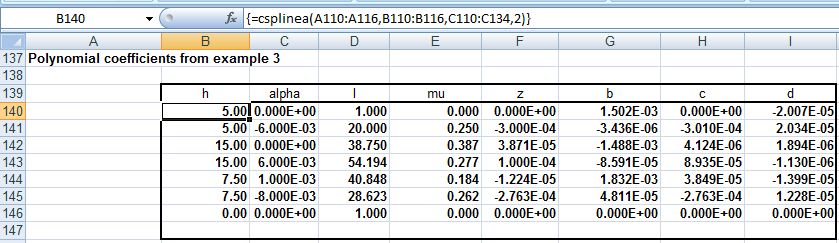
Polynomial coefficients from example 3

Polynomial coefficients from example 3

Example 3; Bending Moments

Example 3; Bending Moments

Bending moments are calculated by multiplying the curvature at each point by the beam flexural stiffness, EI.

Posted in Beam Bending, Excel, Newton, UDFs, VBA | Tagged , , , , | 73 Comments

Long Hair in Newquay

Talking of 1960’s UK folkies, I think this is hilarious.  Wizz Jones stars in the battle of the long-haired beatnicks v Newquay Town Council:

Posted in Bach | Leave a comment

More Acoustic Routes

Parts 2-8 of Acoustic Routes have now been uploaded to Youtube.

Part 2:

Double click on the link above to go to Youtube and find the remaining 6 parts.

Posted in Bach | Leave a comment

A catenary function

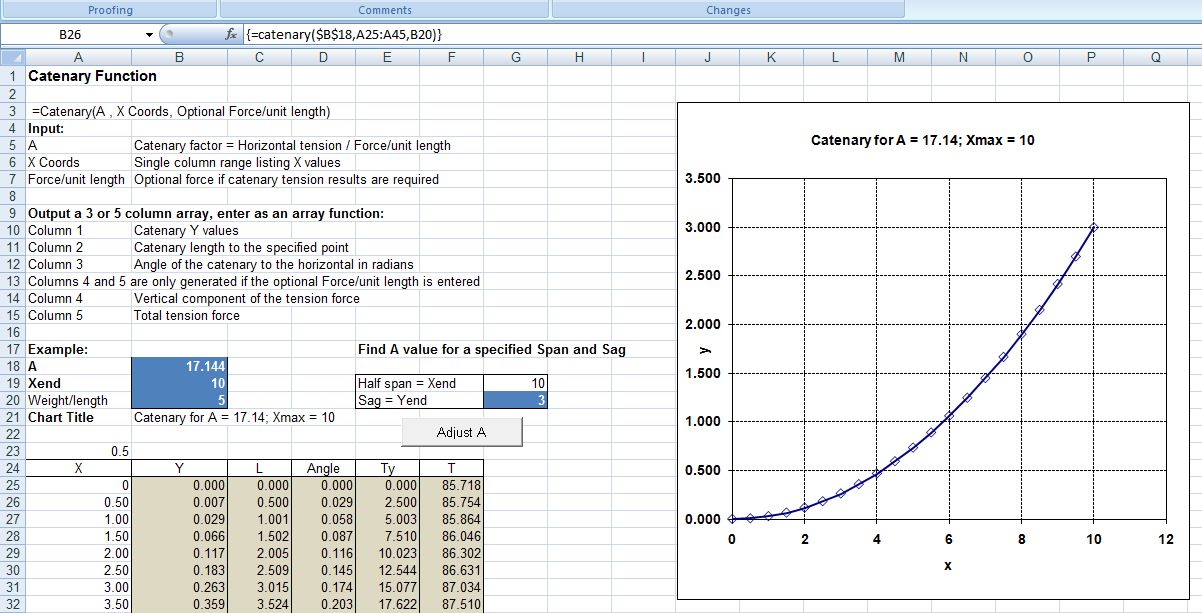
Following on from the previous post, here is an Excel User Defined Function (UDF) to calculate the coordinates of any specified catenary, with the option of also finding the tension force at any point.

Download from: Catenary.zip

The download file includes full open source code.  To view the results of the function it must be entered as an array function, i.e.:

  1. Enter the function in the top left cell of the output range.
  2. Select the entire output range.
  3. Press F2
  4. Press Ctrl-Shift-Enter

See screen shot below for typical input and output (click on the image for a full size view):

Catenary UDF

Catenary UDF

Posted in Arch structures, Excel, Maths, Newton, UDFs, VBA | 3 Comments