Talking of 1960’s UK folkies, I think this is hilarious. Wizz Jones stars in the battle of the long-haired beatnicks v Newquay Town Council:
Recent Comments

Talking of 1960’s UK folkies, I think this is hilarious. Wizz Jones stars in the battle of the long-haired beatnicks v Newquay Town Council:
Parts 2-8 of Acoustic Routes have now been uploaded to Youtube.
Part 2:
Double click on the link above to go to Youtube and find the remaining 6 parts.
Following on from the previous post, here is an Excel User Defined Function (UDF) to calculate the coordinates of any specified catenary, with the option of also finding the tension force at any point.
Download from: Catenary.zip
The download file includes full open source code. To view the results of the function it must be entered as an array function, i.e.:
See screen shot below for typical input and output (click on the image for a full size view):
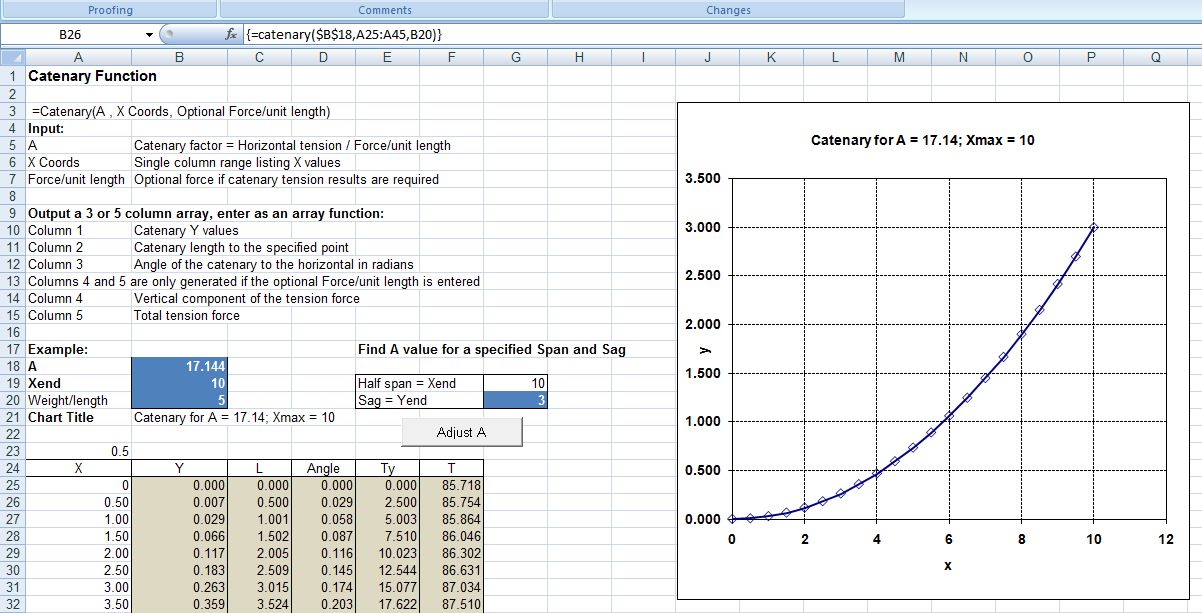
Catenary UDF
Large span arch structures have been constructed for well over two thousand years, but the first recorded analytical treatment was given by Robert Hooke in 1675 who at the end of his treatise on helioscopes added the following statement “to fill up the vacancy”:
“The true mathematical and mechanical form of all manner of arches for building, with the true butment necessary to each of them. A problem which no architectonick writer hath ever yet attemted, much less performed. abcccddeeeeefggiiiiiiiillmmmmnnnnnooprrsssttttttuuuuuuuvx” *
The solution to this anagram (no doubt written as such to annoy Newton) was published in 1705, after Hooke’s death as:
“Ut pendet continuum flexile, sic stabit contiguum rigidum inversum”
which translates as:
“As hangs the flexible line, so but inverted will stand the rigid arch”
In other words, the shape of a flexible line, a catenary, which is in pure tension, will if inverted be in pure compression, and hence the ideal shape for an arch. The same realisation was apparently used by the builders of the The Roof of the Taq-i-Kisra some 1000 years earlier, but in general the shape of large span arch structures is not a catenary, circular or elliptical shapes being almost universally used for masonry arch bridges, and parabolic shapes for free standing arches. It is often suggested that these alternative shapes are used as convenient approximations to a catenary, but in fact there are two additional factors which change the optimum shape for arch structures:

Arch bridge at Totnes, Devon
More details can be found at: Arch Structures
* Interestingly, all transcriptions of the anagram I have found on the Internet insert an additional e, but the reproduction of the original publication here clearly shows that there are only 5 e’s, and this is consistent with the solution of the anagram. This appears to be an example of Stephen Jay Gould’s “Fox-terrier fallacy” where an erroneous statement becomes accepted through repeated copying.
Applied Mechanics of Solids is a free text on finite element analysis by Allan F Bower, who seems to have a gift for clear explanation of the topic combined with a wry sense of humour; not a combination you see every day in this field:
“This electronic text summarizes the physical laws, mathematical methods, and computer algorithms that are used to predict the response of materials and structures to mechanical or thermal loading.
Topics include: the mathematical descriptions of deformation and forces in solids; constitutive laws; analytical techniques and solutions to linear elastic and elastic-plastic boundary value problems; the use and theory of finite element analysis; fracture mechanics; and the theory of deformable rods, plates and shells.
Over 400 practice problems are provided, as well as demonstration finite element codes in MAPLE and MATLAB.
The text is intended for advanced undergraduate or graduate students, as well as practicing engineers and scientists. It will be particularly useful to readers who wish to learn enough about solid mechanics to impress their teachers, colleagues, research advisors, or managers, but who would prefer not to study the subject in depth.”


 Newton Excel Bach, not (just) an Excel Blog