Various routes to and from Nottamun Town

Recently reading the words to Bob Dylan’s “A Hard Rain’s Gonna Fall” I was struck by the similarity to the English folk song “Nottamun Town”.  Searching the Internet I found very few references to this connection (although plenty to the rather more obvious connection to “Masters of War”).  This is surprising, because Dylan himself added a note to his hand written final lyrics for his song:
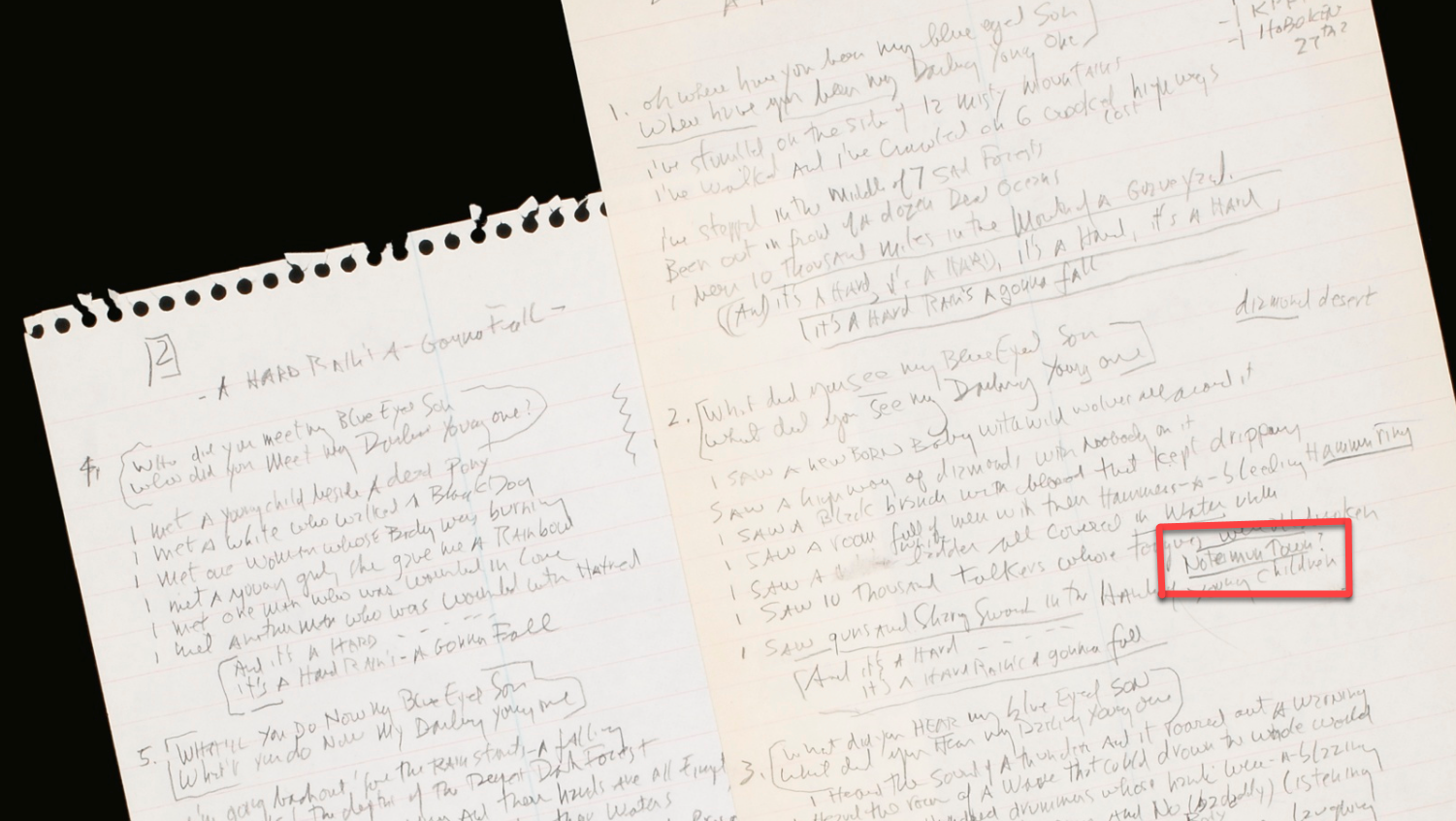
Nottamun Town

In the auction notes for this document, which sold for US$485,000, it says:

 Clinton Heylin, after examining this draft provides some interpretation of Dylan’s notes:
“The reference to ‘Betsy – Cambridge’ is fairly straightforward, Betsy Siggins being the owner of the Club 47 in Cambridge, also referred to above in reference to Joan Baez’s recording of ‘Black Is The Colour’, from which Dylan evidently took one of the images in the final verse (‘black is the colour and none is the number’). Slightly more cryptic is the song-title – ‘Notamun Town’(sic) – Dylan has jotted down below the line, ‘I saw ten thousand talkers whose tongues were all broken’….. Ten thousand stood round me but I was alone is the line from ‘Nottamun Town’ that Dylan has adapted in sentiment and tone, though why this should prompt him to highlight his debt in the manuscript is more of a mystery. It is certainly a first.”

But where did Dylan hear this song?  Although probably of English origin, by the early 20th Century it had apparently been forgotten in it’s homeland, and had moved home to Kentucky, where it was adopted by the Ritchie family, including Jean Ritchie, who recorded a version of the song in 1950:

Jean Ritchie writes:

Dear Roger McGuinn,

This is Jean Ritchie here; I loved listening to your music on the web, and  appreciate your interest in folk music. Your singing of ‘Fair Nottamun Town’  was especially fine and I felt I must write to give you my history with the  song. The version you perform is the Ritchie Family (Kentucky) version. I  have never heard JJ Niles sing it, nor has anyone else I know- I knew him quite well; he visited and got songs from the family in his early days, and
it was there he saw his first dulcimer, but to my knowledge he never  performed, ‘Nottamun Town.’ The time you heard him must have been the only one, and he certainly learned it from the Ritchies. The song has been in our family back many generations, and was collected at the Hindman Settlement School in Knott County, KY by Cecil Sharp around 1917
from the singing of my sister Una who was a student there (Una was 4th in our family of 14; I’m ‘the baby one,’ and am 77 now). Our family ancestors came over from England, Scotland, Ireland, the earliest ones we know of arrived in  1768. Our family still cherishes and sings the songs they brought with them.

If you will check in Sharp’s book of Appalachian songs he collected, you will  find the Ritchie version- the one you sing- as notated from the singing of Una and Sabrina Ritchie (Sabrina was our cousin). I added the ‘mule roany mare’ phrase, instead of ‘that was called a grey mare.’ Also, it always bothered me that one-half of one of the verses was missing- just filled in
with dots…. then the last two lines are the ones beginning, ‘I bought me a quart…’ For years, I sang, ‘la,la,la,’ for those missing lines, but finally just put in two of my own, ‘They laughed and they smiled, not a soul did look gay; they talked all the while, not a word did they say…’

In the sixties, when the Kingston Trio and others began performing and copywriting (as writers) our family songs, I applied for several copyrights for the family. A copyright for ‘Fair Nottamun Town’ was approved in 1964, based on the changes I had made in the lyrics. I have contributed much of
the royalties (from Bob Dylan and others) to Kentucky charities over the years.

Your suggestion that the song may have been inspired by the English Civil Wars of 1642-51 is most interesting. I had heard another suggestion of it’s possible origins, years ago, saying that it may have been composed during the Great Plague! When I did my Fulbright year, searching for sources of  our family songs, in 1952, I spent time researching in Nottingham, and could find not a mention of it in the libraries, nor could any scholar tell me anything. Douglas Kennedy said that it was most likely the ‘magic song’ used in an early Nottingham mummrs’ play. This could not be confirmed, because I couldn’t find in any historical account any news of mummers’ plays in that city. Douglas said that even though it was not now remembered, that
of course there HAD been a mummers’ play, as every city had one… This seemed to me to be the most likely explanation, as the words do go along with the ‘topsy-turvy’ nature of the plays (clothing exchanged & turned inside out to hide identities, etc). One old mummer in Marshfield, when I asked him what the song might mean, said, ‘…why, lass, if the meaning’s found out- the magic is lost!’

Another interesting thing is that there is not another similar variant of  ‘Nottamun Town’ in this country, or in England. An English group recorded it years ago, but they had learned it from me, at Newport I think. Can’t remember the group’s name, but it had Martin Carthy in it, and maybe Peter Bellamy. Many folk scholars have noticed and commended our family on our
unique preservation of several old and rare ballads- one is our, ‘Fair Annie of the Lochroyan,’ a mixing-up of the words, ‘The Lass of Roch Royal.’

All the best,

Jean Ritchie

It is quite possible that Dylan learned of the song from Jean Ritchie, but the reference to Martin Carthy is interesting.  Dylan made his first visit to England in 1963, where he performed in London folk clubs and met Carthy and others.  English recordings of Nottamun Town from this era (and shortly after) include:

Davy Graham and Shirley Collins (1964):

Bert Jansch (1966)

Fairport Convention (1969)

So it is also quite possible that Dylan first heard Nottamun Town when in London in 1963, perhaps from Martin Carthy, who had learned it from Jean Ritchie, who had learned it from her family, who had brought it with them from the Midlands of England, hundreds of years before.

Martin Carthy’s recollection of Dylan in London in 62/63

Do you think there was a big difference in Bob between ’62 and ’65 or was it just that the people around him were different?

Huge, huge, huge difference. His coming to England had an enormous impact on his music, and yet nobody’s ever said it properly. He came and he learned. When he sat in all those folk clubs in ’62, he was just soaking stuff up all the time. He heard Louis Killen, he heard Nigel Denver, he heard Bob Davenport, he heard me, he heard The Thameside Four, dozens of people. Anybody who came into The Troubadour, or came into The King & Oueen, or the Singers’ Club, and he listened and he just gobbled stuff up.

Posted in Bach | Tagged , , , , , , , | 1 Comment

Automating Goal Seek with RC Design Functions

As promised in the previous post, I will now look in more detail at the process for automating the Excel Goal Seek function with the RC Design Functions spreadsheet, to calculate reinforcement area or section depth for a range of bending moments and associated axial loads.

The example shown in the screen shot below finds the minimum reinforcement required for an arch structure with a range of positive and negative bending moments and varying axial load.

The input ranges are shaded grey for the cross section data, and light blue for the Goal Seek data.  The section data input is in the usual format for the EStress and UMom functions.  Note that in adjusting the reinforcement area the functions use the bar diameter entered in the section data, and in effect change the number of bars.

The data required by the Goal Seek routine is:

  • The addresses of the “target range” (taddr) and the “by changing range” (aaddr)
  • The “Goal Value” (GVal) and lower and upper bounds on the absolute value of the Goal (MinAbs and MaxAbs)

Note that the required range names are already set up on the GoalSeek examples sheet, but the Goal Seek routine may be used on any other sheet by creating the same four names, with Worksheet scope.  Also note that the addresses in cells F20 and F21 are generated with a formula, using the data in B20:D21, but if you prefer you can simply type the required range addresses in F20:F21.

GoalSeek01

The axial force and moment on each section are entered in Columns B and C, followed by the section depth, and top and bottom steel areas in Columns D to F.

Note that the data that will be adjusted by Goal Seek must be in a single column (Column G in this case).  Because the section bending moments may be either positive or negative, Columns E and F contain simple formulas returning either the area in Column G if the steel will be in tension, or the minimum steel area entered in E25 if it is in compression:

  • Column E: =IF($C29<0,$G29,$E$25)
  • Column F: =IF($C29>0,$G29,$E$25)

The steel stress is calculated for the top and bottom steel in Columns H and I, with the maximum absolute value in Column J, and the ratio to the Target Stress in Column K.  It is Column K that will be adjusted to the target value (1.0) by Goal Seek:

The steel stresses are calculated by the EStress function, with input as shown below:

goalseek02

Note that the full columns of axial loads and moments are entered as the Axin and Momin arguments.  The output is controlled by the Out1 and Out2 arguments.  Out1 = 1, for stress, and Out2 = 2 for top steel (column I) or 3 for bottom steel (Column J).

The section depth and steel areas are defined in Columns D to F, as shown below:

goalseek03

Input for the bottom steel stress is the same as the top steel, except that Out2 =3:

goalseek04

Note that the functions will return a column of results, covering the length of the input data ranges, and must be entered as an array function, to return all the needed values:

goalseek05

Initially the tension steel area should be entered as the minimum allowable area:

goalseek06

Then click the “Run Goal Seek” button, and the reinforcement areas will be adjusted, so that the stress ratio is equal to or greater than 1:

goalseek07

The resulting graph of reinforcement stress shows a maximum tension of 250 MPa:

goalseek08

A similar process can be followed for ultimate moments, using the UMom function, and resetting the addresses of the Target cells and By Changing Cells:

goalseek09

The resulting moment capacities are equal to or greater than the applied bending moments:

goalseek10

The section depth may also be adjusted, to match either a target stress, or moment capacity, as shown below:

goalseek11

In this case the reinforcement area is kept constant, so the reinforcement details entered in the main Section Details range are used, and the range for the adjustable section details may be limited to a single column, containing the adjustable section depth.

To carry out a similar analysis on a different sheet:

  • Set up a similar table to those shown above, with a single column for the Target values, and a single column for the By Changing values.
  • Create named ranges with “Worksheet” scope with the names: “taddr” (target values), “aaddr” (by changing values), “GVal” (goal value) and “MinAbs” and “MaxAbs” (minimum and maximum values for the targets).
  • Create a button for the GSeekA macro, or press Alt-F8 and select GSeekA.
Posted in Beam Bending, Concrete, Excel, Newton, UDFs, VBA | Tagged , , , , , | 10 Comments

RC Design Functions update

Following a comment here I have updated my RC Design Functions spreadsheet, which is available for free download (including full open-source code) from:

RC Design Functions7.zip

The main new features in the latest version are:

  • The existing optional “depth” argument has been extended so that an array of reinforcement areas can be entered, which will override the values in the main section data input.
  • My Goal Seek macro has been added, so that the reinforcement areas can be adjusted so that the tensile reinforcement stress, or section bending capacity, match a given value, and the process can be automated over a column of data of any length.
  • Examples of using the Goal Seek macro with the EStress and UMom functions have been added.

The screen shots below show samples from the new examples.  Further details of setting up the data to work with the Goal Seek macro will be given in the next post.

Data input for the Goal Seek macro, in conjunction with the EStress function:RCFunc7-1

Similar input with the UMom function:RCFunc7-2

Reinforcement stresses, and section bending capacities, after adjusting the reinforcement area with Goal Seek:RCFunc7-3

Posted in Arrays, Beam Bending, Concrete, Excel, Frame Analysis, Newton, UDFs, VBA | Tagged , , , , , , | 1 Comment

What-when-how …

… is a web site offering free tutorials on a wide range of subjects, including finite element analysis and VBA.

The basics of finite element analysis are covered by links from:

Computational Modelling (Finite Element Method)

with more advanced material covered at:

FEM for Plates and Shells (Finite Element Method) Part 1

FEM for 3D Solids (Finite Element Method) Part 1

Special Purpose Elements (Finite Element Method) Part 1

VBA starts at:

Getting Started with Excel Formulas and Functions

And for a full list of subjects see:

Topics

Posted in Finite Element Analysis, Newton, UDFs, VBA | Tagged , | Leave a comment

If it keeps on straining …

… concrete’s goin’ to break:

To find out what this has to do with predicting concrete deflections, book into the Concrete Institute seminar on “Finite Element Analysis of Concrete Structures”:

Finite Element Analysis of Concrete Structures – Software and Practice

When:
Wednesday, 18 May 2016
4:45 PM – 8:00 PM

Where:
Ryde-Eastwood Leagues Club
117 Ryedale Road , West Ryde NSW 2114

Posted in Bach, Beam Bending, Concrete, Newton | Tagged , , , | Leave a comment