Mastan2

Mastan2 is a free frame analysis program based on Matlab. The linked site provides alternative downloads for those with or without Matlab installed. The site also provides a link to the book Matrix Structural Analysis, 2nd Edition, by McGuire, Gallagher, and Ziemian, which provided a theoretical and numerical basis for the analysis routines in the program. The book is available as a pdf at no cost, or US$30 for a print version.

My main reason for interest in this program is that it provides analysis of torsional warping effects in frame structures, which I am adding to my 3DFrame spreadsheet. To check the results of my spreadsheet I have analysed the small 3D frame used in previous exercises, and compared the results with and without restraint of torsional warping effects.

When comparing different 3D frame analysis programs it is important to ensure that they use the same conventions for the orientation of beam local axes, or if not to adjust the frame set-up to provide equivalent models. In 3DFrame the alignment of the beam local axes is based on the same principles as used in the Strand7 FEA program, as described in more detail here:

Local Axis 3 is aligned with the longitudinal axis of the beam, from node 1 to node 2.  Axis 2 is perpendicular to Axis 3 and parallel to the X-Y plane, so the Z axis is treated as vertical.  Axis 1 completes the orthogonal system, being perpendicular to both Axis 3 and Axis 2

The Strand7 version of the frame model examined in this post is shown below with local axes displayed:

In Mastan2 the principles used are not clearly stated (as far as I could see), but the program assumes that gravity loads are in the Y direction, so Y was treated as the vertical axis. The local axes are then defined as:

  • The local x axis is along the longitudinal axis of the member.
  • The local z axis is perpendicular to the x axis, and parallel to the global XZ plane.
  • The local y axis forms the third axis of the orthogonal system.

The frame coordinates were modified for Mastan2 so that the Y axis was vertical, as shown below:

The Mastan2 x, y and z local axes are equivalent to Strand7 local axes 3, 1, 2. When entering section properties the Strand7 values I1 and I2 are equivalent to Iyy and Izz in Mastan2, but note that the values are entered in reverse order (Izz then Iyy) on the Mastan2 input screen:

Input of the 3DFrame member properties follows the same conventions as Strand7:

In Mastan2 the materials properties are entered separately, and the density value is entered in force units, rather than mass.

In Mastan2 loads must be applied as node loads or distributed loads along the full length of the member. For this exercise distributed loads were applied in the global axes directions, plus gravity loads. The loads applied in Mastan2 must be adjusted as follows:

  • Vertical loads must be applied in the Y direction, rather than Z.
  • The Mastan2 Z axis is equivalent to the Strand7 Y axis, but in the opposite sign, so all loads on this axis must have their sign reversed.
  • The X axes in Mastan2 and Strand7 are equivalent.

The frame analyses were initially run with warping disabled. The 3DFrame Spreadsheet results are shown below, with Mastan2 results pasted below, and the % difference between the results after adjustment:

  • Y and Z axis results are swapped.
  • The Mastan2 Z axis results have the opposite sign to the spreadsheet Y axis.
  • Spreadsheet rotations are in degrees, but Mastan2 rotations are in radians.

Enabling warping analysis in the spreadsheet resulted in large changes in deflections. Note that the warping stiffness used was much higher than the real value for rectangular concrete sections, to magnify warping effects.

Importing the Mastan2 results with warping enabled shows an excellent match for all nodes and directions:

The updated 3DFrame spreadsheet will be available for download shortly, after completion of further checking.

Posted in Beam Bending, Concrete, Excel, Finite Element Analysis, Frame Analysis, Link to Python, Newton, PyXLL, Strand7 | Tagged , , , , , , , | 1 Comment

Concrete 2023

The Concrete Institute of Australia’s biennial conference is almost upon us. This year it is being held in Sydney from 10-13 September.

CONCRETE 2023

Look below at what’s in store at Concrete 2023.  

Keynote and Invited Speakers We have put together a huge line up of local and international speakers who will bring a wealth of knowledge with respect to our theme Resilient and Sustainable Concrete – Breaking Down Barriers. In particular our lead keynote speaker, Romilly Madew, CEO of Engineers Australia, will start the conference with the topic “Future concrete solutions: Improving resilience and sustainability in the built environment”, and she will be joined by speakers from Australia, Japan, Netherlands, Canada, and the USA.   You can view the entire line up at Keynote and Invited Speakers  

Technical Program The technical program is jam packed with quality research papers, innovative findings, industry updates and interesting case studies. The 4 parallel technical sessions over the main 3 days of the conference will have something for everyone in the concrete industry.   You can view the current program at Technical Program  

Exhibition Our CIA industry exhibition is a SELL OUT and will be a fantastic place to catch up with the latest in concrete materials, products, innovation, and application. We have an amazing range of organisations and sectors represented at the Exhibition, as well as a number of wonderful sponsors including our Conference Partners, Sika.   See who’s going to be at Concrete 2023 at Sponsors and Exhibitors  

Social & Networking Events As always Concrete 2023 will host several networking events including the CIA NEXGen reception on Sunday night, the CIA Women in Concrete Welcome Reception, and our flagship event, the Gala Dinner and Awards for Excellence in Concrete. Full registration gets you a ticket to all of these events, and you can also purchase separate tickets.   Check out what’s happening at Concrete 2023 Networking  

Durability Workshop Our Durability Workshop on Sunday 10 September at Curtin University has an incredible line up of durability experts from all over the world. Never before has such a team of durability experts been under the same roof in Australia, and this is an incredible opportunity to come and learn from the best, and to connect with a global network. If you’re making the trip to Perth, you should make some time to be at the workshop!   To find out more, and to register (Concrete 2023 delegates get a discount) go to Durability Workshop.   There’s so much on offer at Concrete 2023 and we don’t want anyone to miss out. If you haven’t registered yet there’s still time, and we would love to see you and your colleagues as we gather for the biggest concrete conference in the southern hemisphere in Perth next month.  

Register Here for Concrete 2023
Posted in Concrete, Newton | Tagged , , | Leave a comment

Bert Jansch, Sounds of the 70’s

There have been quite a few new old Bert Jansch recordings posted to YouTube over the past year, including:

Bert Jansch – Sounds of the 70s, 15/7/71:

On 15 July, Bert Jansch recorded a BBC radio session for Bob Harris’ ‘Sounds of the 70s’. It has long been the holy grail of Bert’s BBC career – songs almost all from the ‘Rosemary Lane’ LP that in several cases he would never perform again. Six songs were recorded, split over two broadcasts: Twa Corbies, Nobody’s Bar and Bird Song plus some chat with Bert on 2 August 1971; and Omie Wise, Tell Me What is True Love and A Dream, A Dream, A Dream (plus a repeat of Bird Song) on 23 August 1971.

Christopher Gardiner, who made the priceless recording of Bert’s concert at the Royal Festival Hall on 30 June 1971 (elsewhere on YouTube), taped all the songs from both of these broadcasts. Unfortunately, Twa Corbies is lost but everything else was on his reel in remarkable fidelity (albeit the 23/8/71 tracks being in mono and needing more restoration work). Cormac O’Kane has digitised, restored and mastered the recording – which, of course, came to light only a few months too late for Earth’s ‘Bert Jansch at the BBC’ 8CD set.

It appears here in MP3 form (for convenience) as a gift to Bert Jansch fans from Christopher and myself. Should there be demand for an official release on, say, a Record Store Day vinyl 10-inch, the 48k WAVs will be provided for the cost of the restoration.

Songs & date of broadcast:

  1. Nobody’s Bar (2/8/71)
  2. Bird Song (2/8/71)
  3. Omie Wise (23/8/71)
  4. Tell Me What is True Love (23/8/71)
  5. A Dream, A Dream, A Dream (23/8/71)
  6. Bird Song (repeat from 23/8/71, with comments from Bob at the start and end)

Bert Jansch: A Man and his Songs, pt 1
From a Danish TV film broadcast in 1976. 0:00 Lost And Gone (from Santa Barbara Honeymoon) 1:50 Interview 3:46 When the Teardrops Fell (live, 1975) 7:36 Interview

Bert Jansch: A Man and his Songs, pt 2
From a Danish TV film broadcast in 1976. 0:00 Blackwaterside (live 1975) 3:42 Interview (on living in Putney, playing darts with Ralph McTell, etc) 5:32 Untitled Instrumental (on soundtrack) 7:58 Build Another Band (intro) 8:36 Build Another Band (live) 10:14 Interview (on forming bands)

Posted in Bach | Tagged , , | Leave a comment

Dynamic charts

A frequently asked question is how to get Excel charts to automatically update when new data is added outside the original selected ranges. The most frequent recommendation (such as here) is to convert the data to a table, then insert a new chart linked to the table. Adding new data immediately below the table will then automatically extend the table range, and the chart will automatically update.

This post looks at an alternative approach using range names defined with a formula, plotting data defined in a dynamic array. The process is described in detail at Engineer v Sheep, including some catches in the set-up process, and how to avoid them. This post looks at an engineering related example, including a modification to deal with data outside the dynamic array.

The requirement is to plot two graphs showing bending moments and shear forces, for multiple load cases, plotted against axial load, around a reinforced concrete arch, together with the bending and shear capacity (click image for full size view):

The data in the first three columns is imported from an external FEA program with VBA code. The other columns divide the moments and shear forces into three groups, depending on the sign and the reinforcement at the section. This data is returned by a user defined function, as a dynamic array.

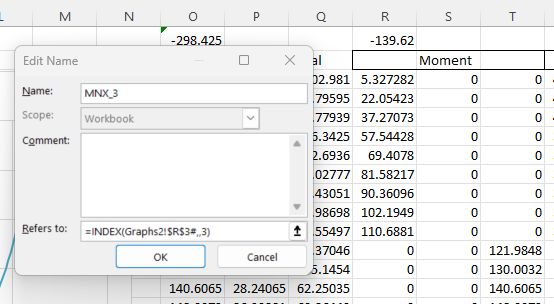
To define the ranges for plotting, each column must be given a range name defined with an index function:

Note that the row number argument is left blank, so the function returns the whole column.

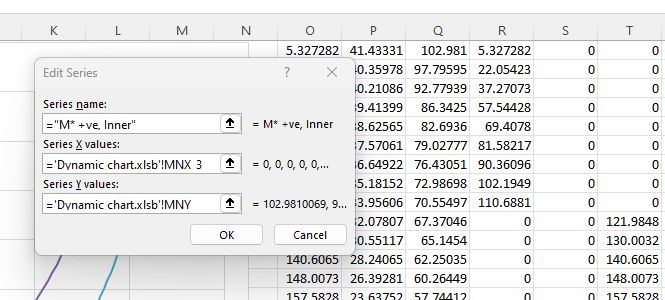
The index function can be used for all six columns returned by the UDF, but the axial loads are to the left of the UDF, and cannot be accessed using Index. For this column the Offset function must be used, with a negative row offset:

The named ranges can then be used to define the graph ranges:

Posted in Charts, Charts, Concrete, Excel, UDFs | Tagged , , , , , | Leave a comment

Simplified bi-axial bending

This post summarises my responses to a question at Eng-Tips.

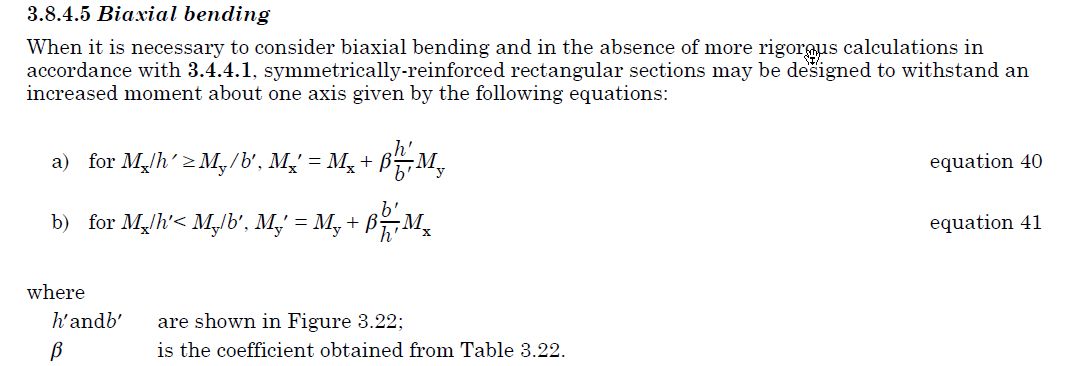
The UK concrete standard in use before Eurocode 2 (BS 8110) has a simple procedure for designing columns subject to bending about both principal axes:

This allows the column to be designed to resist a factored moment about one axis.

Eurocode 2 has a different approach:

AS 3600 follows the same approach as Eurocode 2, but with slightly different exponent factors:

The Eurocode/AS 3600 procedure requires the section capacity to be checked about both axes, but it’s actually quite easy to derive an equation for the minimum resistance moment for the axis with the larger moment, similar to the BS8110 one:

For applied moment Me and moment resistance Mr, if Me/Mr is equal about the two axes then Equation 5.39 reduces to:

2(Me/Mr)^a <= 1.0

So for minimum Mr: (Me/Mr)^a = 0.5

Me/Mr = 0.5^(1/a)

Mr = Me/(0.5^(1/a))

In the graph below I have plotted 1/(0.5^(1/a)) with 1 + Beta from BS8110, the equivalent factor from the Australian code (AS 3600), and the factor derived from the biaxial analysis of a square section with equal moments about both axes, for a range of axial loads:

The factor is applied to the design bending moment, so a higher factor is more conservative.

The graph below shows the ULS bending capacity about one axis for a square section with equal applied moment about both axes. The section details were:

  • Dimensions: 600 x 600
  • Reinforcement; 4 N20 bars each face, yield strength = 500 MPa
  • Concrete: 40 MPa, cover 40 mm

Increasing the steel diameter to 40 mm has a significant effect on the results, with the simplified methods being much less conservative under high axial loads, and very unconservative under very high axial loads:

Posted in Excel | Leave a comment