Composite Concrete Beam Analysis

Composite concrete beams are widely used in both building and bridge structures; typically precast pretensioned beams are combined with an in-situ reinforced concrete slab to provide structures that are both efficient in use of materials and fast and easy to construct.

If pre-stressed beams are used for the first stage, and if the section remains uncracked under all stages of loading, then analysis is straightforward since each stage may be analysed separately and linearly combined.  On the other hand if the section is cracked at any stage the bending behaviour becomes non-linear, and the closed form solutions presented previously in the Beam Design Functions spreadsheet, are no longer applicable.

In this post I will describe an iterative procedure for this analysis, and in the following post I will cover a spreadsheet to carry out the analysis using a VBA User Defined Function (UDF).

The section below shows a simple reinforced concrete composite beam consisting of a first stage rectangular section of 800 deep x 300 wide, with a second stage slab of 200 deep x 1000 wide.
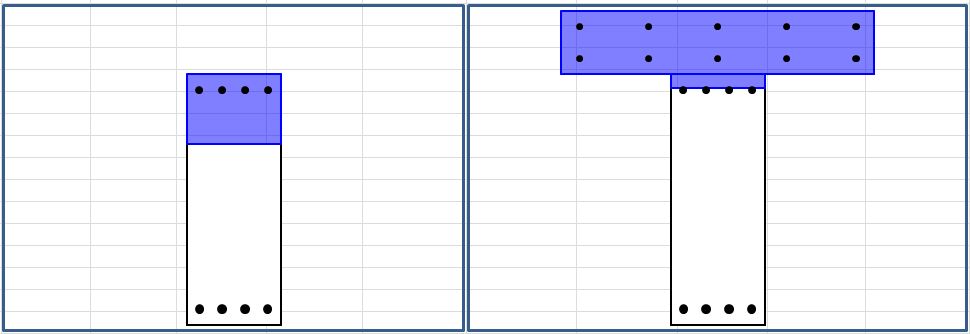
Stage 1 and Composite Section

Analysis of the first stage is straightforward, allowing for the self weight of the beam, the weight of the in-situ top slab wet concrete, plus any permanent formwork and any other loads applied at the time of  pouring the second stage concrete.  This can be done with the Beam Design Functions spreadsheet (link above), or for a rectangular section the RC Design Functions spreadsheet can be used.

The graph below shows the strain distribution at each stage:

  • Self-weight plus wet in-situ concrete load on Stage 1 (blue line).
  • The incremental strain due to the additional Stage 2 load on the composite section (green line).
  • The combined strain due to the total load (red line)

Strain Distribution

The procedure used to generate these strain diagrams was:

  1. Find the Neutral Axis depth and section curvature (top face strain/depth of NA) using one of the closed form solutions linked above.
  2. For a first estimate of the strain increment due to the Stage 2 loads on the composite section apply the incremental load to the composite section using one of the closed form solutions.  Note that this will not give the correct final result unless the section is uncracked at both stages of loading.
  3. Adjust the Neutral Axis depth and section curvature for the Stage 2 loading so that the total stress distribution in the composite section is in equilibrium with the total applied loading.

The next post will provide an Excel UDF that will perform this analysis for a Stage 1 beam of any cross section, with or without prestress, and for any combination of applied moment and axial load.

Posted in Concrete, Newton | Tagged , , | 4 Comments

Altan – Blackwaterside, and more from Anne Briggs

Another version of Blackwaterside from Irish Group Altan followed by two Anne Briggs songs accompanied by very nice home made videos.

Official video for the song, Blackwaterside, from the album ‘Blackwater’ (1996)

Photos taken around Shanklin on the Isle of Wight Music by Anne Briggs

The Snow it Melts the Soonest by Anne Briggs


And I’ve just found this version by Sting:

Posted in Bach | Tagged , , | Leave a comment

Geometry for Joiners

A question came up on the ABC Self-Service-Science Forum, asking for a solution to find the dimensions of a diagonal brace looking like the diagram below:

The solution is not as simple as it might look because the angle of the brace is not equal to the angle of the diagonal. The solution I came up with is shown below:

The length of the diagonal of the brace is equal to the diagonal of the opening it fits in. The side length of the brace, before cutting is then found by pythagoras:

(Diagonal^2 – Brace Width^2)^0.5

The end of the brace is then at the intersection of a circle centred at the bottom left corner, with radius equal to the brace length, and a circle centred at the top right corner, with radius equal to the brace width (green lines in the diagram).  I already had a User-Defined Function (UDF) to find the intersection point  of two circles, so it was a simple matter to copy the code into a new spreadsheet, and set up the required input and length calculations.

Having found the coordinates of this point the position of the skew cuts can be found by simple proportion.

The spreadsheet (including open source code) can be downloaded from FrameBrace.xlsb, and the UDF to find the circles intersection point (along with many other geometrical and interpolation functions) can be downloaded from IP2.Zip

Posted in Coordinate Geometry, Excel, Newton, UDFs, VBA | Tagged , , , , , , | 1 Comment

Another Post About Everything

We had a post about everything from xkcd before, but this one is a bit more sophisticated.  You can zoom in from this:

The Universe

down to this:

A tiny little bit of the Universe

and everything in between, at HTwins.net (if you get an ad for a game, click on the skip-ad button).

Posted in Newton | Tagged , | Leave a comment

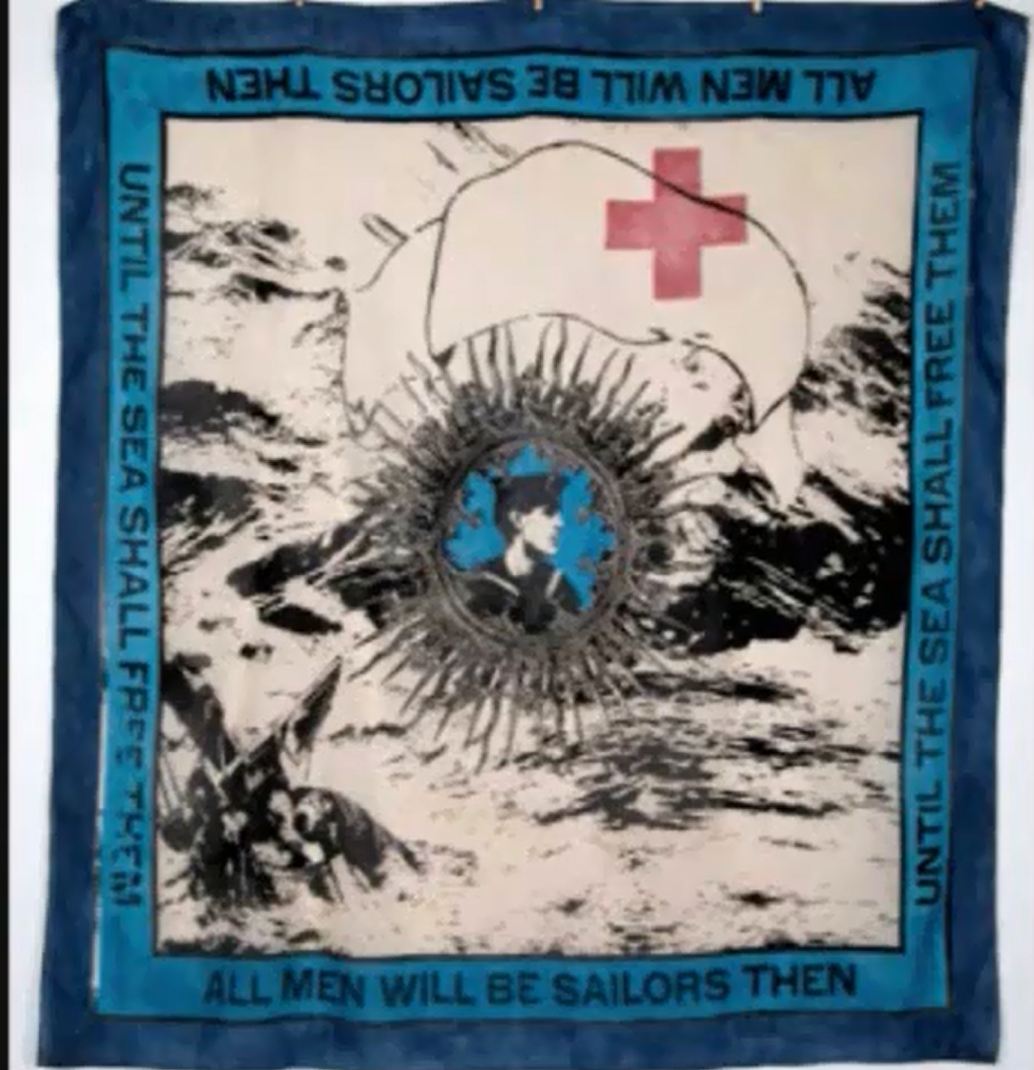
All men will be sailors then, until the sea shall free them

The YouTube video of A Sailor’s Life by the Fairport Convention contains the image shown below:

I have just discovered that the words are taken from the Leornard Cohen song Suzanne, but of the origin of the image I have no idea. If anyone recognises it, please leave a comment.

Here’s the original, from 1970 or threabouts:

And a live version from 2008:

Suzanne takes you down to her place near the river
You can hear the boats go by
You can spend the night beside her
And you know that she’s half crazy
But that’s why you want to be there
And she feeds you tea and oranges
That come all the way from China
And just when you mean to tell her
That you have no love to give her
Then she gets you on her wavelength
And she lets the river answer
That you’ve always been her lover
And you want to travel with her
And you want to travel blind
And you know that she will trust you
For you’ve touched her perfect body with your mind.
And Jesus was a sailor
When he walked upon the water
And he spent a long time watching
From his lonely wooden tower
And when he knew for certain
Only drowning men could see him
He said “All men will be sailors then
Until the sea shall free them”
But he himself was broken
Long before the sky would open
Forsaken, almost human
He sank beneath your wisdom like a stone
And you want to travel with him
And you want to travel blind
And you think maybe you’ll trust him
For he’s touched your perfect body with his mind.

Now Suzanne takes your hand
And she leads you to the river
She is wearing rags and feathers
From Salvation Army counters
And the sun pours down like honey
On our lady of the harbour
And she shows you where to look
Among the garbage and the flowers
There are heroes in the seaweed
There are children in the morning
They are leaning out for love
And they will lean that way forever
While Suzanne holds the mirror
And you want to travel with her
And you want to travel blind
And you know that you can trust her
For she’s touched your perfect body with her mind.


Update 23 April 2012: I have just found a new version of this song recently uploaded on Youtube by Coffeescup:


Update 27 March 2012: Debra Dalgleish (from the Contextures Blog) sent me an e-mail identifying the source of the image. It comes from Jason Kinney and can be seen here: http://www.coolhunting.com/style/pauper-voile-sc.php

After realizing scarves by covetable designers such as Alexander McQueen or Hermes were out of reach, Portland-based photographer Jason Kinney decided to apply his medium to silk. Pauper Voile is the upshot, with Kinney explaining that his interest in scarves made him “curious about how to put an image on fabric.” Starting out with wood-block prints before teaching himself how to screen print, he refined his skill to an obsessive degree for a line of scarves that exude Gothic sophistication.

… “The Sail” design is composed of elements from Victorian paintings and an old photograph of a sailor in profile.

Posted in Bach | Tagged , , , , , | 1 Comment