Climate change and political opportunism

Senator Steve Fielding is the leader of a small political party in Australia and a member of the the Federal Senate (the Australian upper house).  For some reason he sends me occasional e-mails, which usually go straight in the bin, but on this occaision he was dealing with the subject of action on climate change, an issue that he (as one of the small group of Senate members outside the two major parties) has a disproportionate influence on.  The relevant part of his e-mail was:

CLIMATE CHANGE – Are you sure carbon dioxide (CO2) is the problem?
Check it out for yourself – see what I presented to Minister Wong and Australia’s Chief Scientist after I returned from a self-funded trip to Washington, and see their response. Read more
here…

and here is my response:

Dear Senator Fielding

 I’m not sure why you keep sending me e-mails, but since you ask, no I’m not absolutely certain that human sourced CO2 emissions (and other greenhouse gasses) are the primary source of climate change, but what we can say is:

  1.  On the balance of probabilities the scientific evidence suggests that the costs of likely climate change will far exceed the cost of reducing emissions.
  2. The probability of climate change having disastrous consequences for countries with large heavily populated low lying regions is unacceptably high.
  3. There is a small, but certainly not negligible possibility of still more extreme consequences, such as that climate change will have a catastrophic effect on world agricultural output, leading to mass starvation.

In summary I believe that seeking to slow down or stop action on reduction of emissions of greenhouse gasses because the science is not “certain” is grossly irresponsible, and smacks of political opportunism.

On the subject of political opportunism, using a “cherry picked” graph of temperatures against emissions to support your arguments is ignorant at best, and most likely outright dishonest.

I hope that answers your question.
Posted in Climate, Newton | Tagged , | 3 Comments

From the Ridiculous to the Sublime

Our previous musical interlude featured a positively Pythonic Wizz Jones battling the Newquay Urban District Council, but now for something completely different.

On Sunday the cellists Emma-Jane Murphy and Daniel Yeadon treated us to performances of Bach’s 1st and 5th Suites for Solo Cello, at the Utzon Room of the Sydney Opera House.  I can’t find any on-line Bach performances by either of the two performers, but this rendition of the Prelude to Bach’s Cello Suite No 1 by Yo-Yo Ma (accompanied by Salvador Dali paintings) makes a very acceptable alternative.

Posted in Bach | Tagged , , | 2 Comments

Using Goal Seek on Multiple Cells

The Excel “goal seek” function is useful and powerful, but the procedure for using it on multiple cells is painfully slow.

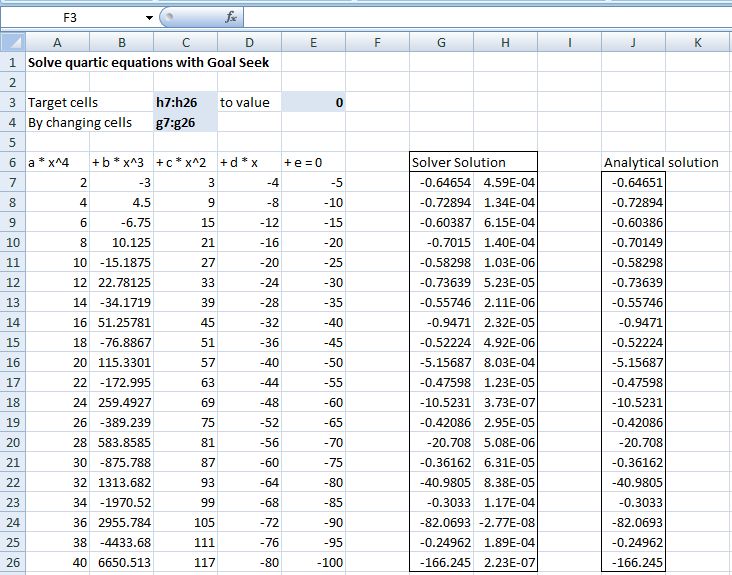
The spreadsheet GSeek.xls provides a simple macro to allow Goal Seek to be automatically applied to a range of cells, arranged in either a column or row.  As usual,  it includes open source code for all sub-routines and functions.

The spreadsheet includes an example finding the first root of 20 quartic equations, compared with the analytic solutions using the User Defined Function Quartic().

GSeek Output

GSeek Output

Posted in Excel, Maths, VBA | Tagged , , , | 17 Comments

Changing Environment Variables

I’m occasionally using a beta program that requires me to change the search path.  The procedure for doing this in Vista seems to be something that Microsoft do not wish to talk about, and I have to search the web to remind myself how to do it; so I’m going to post the procedure here and maybe I’ll remember it.

Click on the “Start” button and select “Computer”

Right click and select “properties”

Select “Advanced System Settings” from the left

It should display the “Advanced” tab; Click on the “Environment Variables” button

Find the “Path” variable on the “System Variables” list.

Click the “Edit” button

Edit the path, and click OK three times

Re-boot

Posted in Computing - general | Tagged , | 2 Comments

Should undergraduates be taught Fortran? …

… is an interesting question being discused at the Eng-Tips Forum.

I particulary liked this response:

“I can think of about 10 things that undergrad engineers should learn instead of Fortran.

1) How to spell
2) How to make an outline of a report before starting to type
3) How to use Excel the way it’s designed
4) How to turn off MSN while at work
5) How things in their field of interest are manufactured
6) How their employers actually generate income and profit
7) How and where to find which design loads to use
8) What “design requirements” are.
9) How to work with others
10) How to talk to clients

Come to think of it, I have about 15 more, but I need to get to work.”

Needless to say, I heartily endorse Number 3.

Posted in Computing - general | Tagged , , | Leave a comment