Bach’s Music and Newtonian Science:
A Composer in Search of the Foundations of
His Art
CHRISTOPH WOLFFhttp://www.bachnetwork.co.uk/ub2/wolff.pdf

Bach’s Music and Newtonian Science:
A Composer in Search of the Foundations of
His Art
CHRISTOPH WOLFFhttp://www.bachnetwork.co.uk/ub2/wolff.pdf
Found whilst browsing:


 The following articles, reprinted by agreement with IOP Publishing Ltd, formed a regular diary column in Scientific Computing World magazine betweeen September 1997 and February 2000.Difference of Opinion was co-written by Ray Girvan and Felix Grant under the pen names Babbage and Lovelace. The two personae do not represent the two authors; every diary entry was jointly written by us both, as a team. Rather, they represent different aspects of the computing world: loosely, Babbage is interested in hardware, and Lovelace in software and philosophical aspects.
Increased yield strengths of reinforcing steels have increased the importance of the Serviceability Limit State in reinforced concrete design, with SLS reinforcement stresses, crack widths, or deflections often controlling the design.
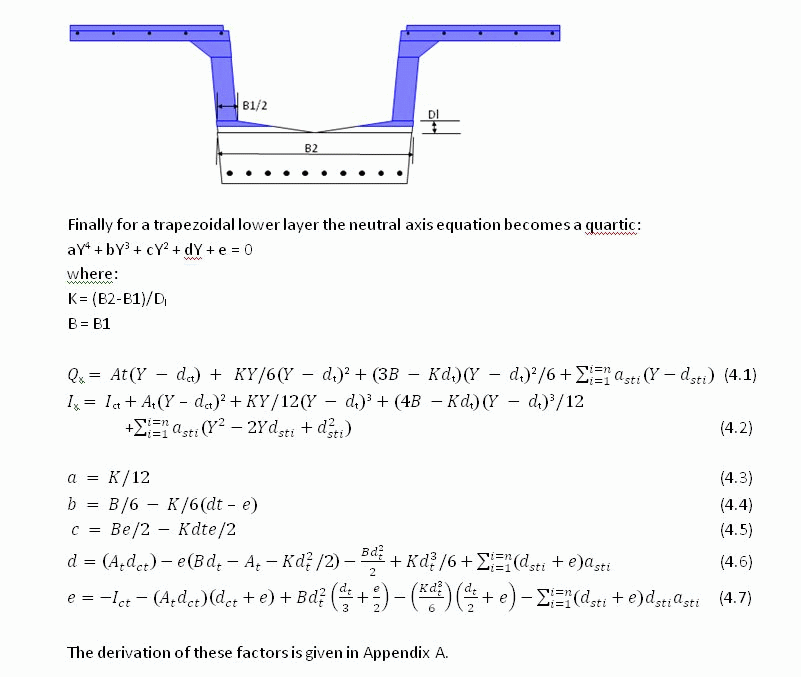
Elastic analysis of a rectangular section under pure bending can be solved easily with a quadratic equation, but for more complex shapes or combined bending and axial load an iterative process is normally used to determine the position of the neutral axis and section strains and stresses.
Click on: RC NA Depth for a paper presenting closed form solutions for any symmetrical reinforced concrete section, with any number of layers of reinforcement, under combined bending and axial load.
An extract from the paper is shown below:
Future posts will describe how these equations can be conveniently solved in an Excel VBA UDF, including calculation of concrete and reinforcement strains and stresses.
Download section properties spreadsheet from:
http://www.interactiveds.com.au/software/Section%20Properties03.zip
http://www.interactiveds.com.au/software/Section%20Properties07.zip
Screen shots:


An alternative to finding the section properties of irregular polygons from the coordinates of the corners is to divide the shape into rectangular or trapezoidal layers. The properties of the shape may then be found by simply summing the properties of each layer about a common axis. The applicable equations for rectangular and trapezoidal layers are:





 Newton Excel Bach, not (just) an Excel Blog