
Secondary (or hyperstatic) bending moments occur in prestressed beams that are continuous over internal supports, or have other redundant support conditions. Any eccentric prestress force will cause a beam to deflect, and if these deflections are restrained at internal supports, this will generate additional bending moments, known as secondary or hyperstatic moments. This post looks at alternative ways of modelling these effects in an FEA program (Strand7), and compares the results with simpler beam analysis procedures. The example used is taken from the book Concrete Structures by Warner, Rangan, Hall and Faulkes.
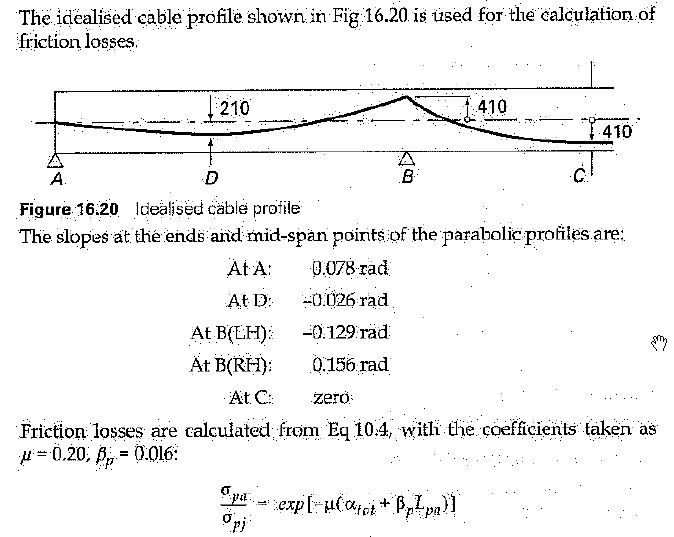
The beam consists of 3 spans, with lengths of 16 m, 21 m, and 16 m, and with post-tensioned reinforcement with parabolic profiles as shown above. The cable is assumed to be stressed at both ends, with an applied force of 1494 kN. The variation of force along the cable, calculated to AS 3600 friction losses, is shown in the graphs below.
The following methods were used to find the bending moments along the beam due to the prestress force, including secondary moments:
- 1: Apply prestress loads directly to beam; apply friction losses to AS 3600
a: Apply vertical loads to nodes on prestress cable profile, connected to beam with rigid link.
b: As a) + horizontal loads.
c: Apply point moments to beam at mid-segment locations.
d: As c) but apply moments at segment ends. - 2: Include prestress cable in the model, apply preload to the cable.
a: Connect cable to beam with rigid links, apply prestress as uniform average load, cable modelled as string group of truss elements.
b: As a) except include friction losses to AS 3600
c: As b) except no string group. Apply prestress as 3 uniform loads based on average load for each span.
d: As c) except cable modelled with beam elements.
e: As d) except links modelled with beam elements
f: As c: except prestress applied with friction losses to AS 3600 - 3: Include prestress cable, apply loads to the end of the cable. Cable modelled as beam elements, connected with friction contact elements.
a:) End loads applied as pre-strain applied to “jack elements”.
b:) End loads applied as point loads applied to the cable ends and equal and opposite loads to the beam ends.
The analysis results shown below were generated with the Strand7 FEA program. Note that other programs may return significantly different results, especially for models including “string groups” or friction elements. The graphs below show the axial force along the prestress cable, compared with the calculated forces applied to the Type 1 beams. Results are shown for the left hand half of the beams, which are symmetrical about the mid-length.

The force distribution for all the Type 1 beams was calculated according to AS 3600. The step in the diagram is due to the deviation in the cable profile at the internal supports. A revised example with a more realistic profile will be examined in a later post, but for now the simplified profile has been maintained for consistency with the book calculation.
For beams 2a and 2b the prestressing cable was modelled as a string group, which behaves as a cable passing over frictionless pulleys, so any applied forces are equally distributed over the length of the cable. For beam 2a the average force from the AS 3600 distribution was applied over the full length. For beam 2b each beam segment in the model was assigned a different force, but these have been averaged over the string group, resulting in a slightly higher average force than my calculation.
For beam 2c the cable was not modelled as a string group, but as a series of truss elements, connected to the beam with rigid links. The cable in each span was allocated the average force for that span. The interaction of the prestressed cable with the beam concrete resulted in the line shown above.

Beams 2d and 2e were similar to 2c, except they were modelled with beam elements, rather than truss elements, and 2e was connected to the main beam with beam elements rather than rigid links. All 3 generated very similar loads along the cable.
Beam 2f was the same as 2c, except that a different prestress force was allocated to each segment. This has resulted in a profile following the trend of the AS 3600 line quite closely, but with a reduced force. In a later post the applied prestress force will be adjusted to allow for the distribution of the prestress force into the concrete.
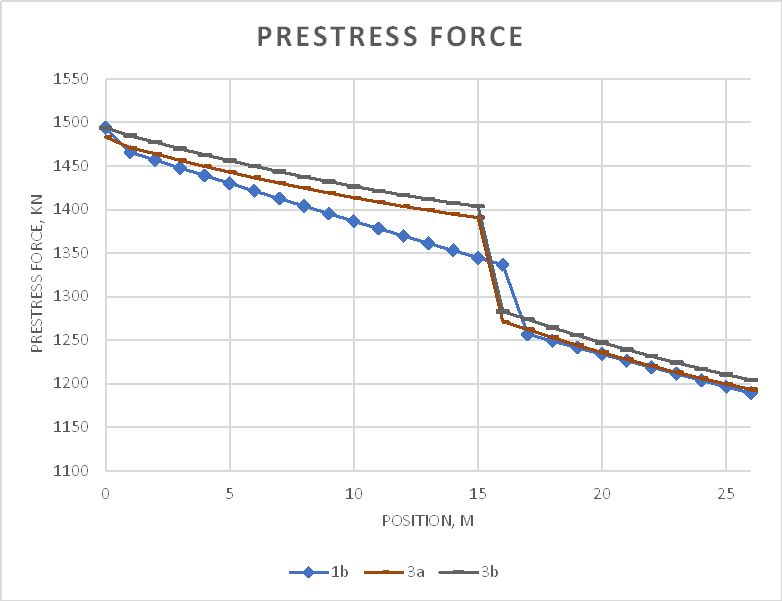
Beams 3a and 3b were both modelled with beam elements connected to the main beam with friction elements and rigid links. The prestress force was applied to the ends of the cables, through a pre-strain applied to beam elements representing the stressing jacks for Beam 3a, and with direct axial forces applied to the ends of the cable for Beam 3b, with equal and opposite forces applied to the ends of the main beam. In both cases there were significantly reduced prestress losses in the end spans, compared with AS 3600, but the loss at the support was greater, and forces for the middle span were well matched. It should be possible to get a closer match to the AS 3600 forces by adjusting the friction element parameters. This will be examined in a later post.
The results for all beams are summarised below, showing the calculated prestress force at mid outer and internal spans, and bending moments due to the prestress at mid-spans and at the internal piers. The beams were also analysed with no internal supports, and the difference between these two values is the secondary moment.

Of the four models where prestress actions were applied directly to the main beam, 1b is the most accurate since this included the effects of horizontal loads. Comparing the other models with 1b:
- The models using a string group for the prestress cable (2a and 2b) had exactly equal prestress force over the beam length, even when the applied force was varied along the length. This results in significantly different behaviour, the main difference in this case being higher bending moments in the central span.
- The three models without string groups, but where the prestress was applied as the average load over each span (2c, 2d, 2e) gave better results, but the prestress distribution was still significantly different from model 1b, which may result in significant errors in some cases.
- For model 2f the prestress was applied as a different load for each segment. The resulting load followed the trend of loads calculated with AS 3600 friction losses, but was significantly lower over the full length, resulting in significantly lower bending moments at each section, compared with 1b. In future analyses the prestress load will be adjusted for this case, so that loads are equal to the required values after transfer.
- Models 3a and 3b had friction contact elements connecting to the main beam, with prestress loads applied as a strain in an element representing the stressing jack, or as applied end forces. In this case the end loads were adjusted so that they matched the required force at the beam ends, but the parameters used for the contact elements resulted in lower friction losses over the end spans.
In the next post in the series models 2f, 3a and 3b will be investigated in more detail to provide a better fit of the cable forces to that found using AS 3600 friction losses. The cable profile will also be modified over the internal supports to follow a realistic profile for a continuous cable.





 Newton Excel Bach, not (just) an Excel Blog