
The reinforced concrete biaxial bending spreadsheet has now been updated:
- Stress block and capacity reduction factors updated for AS 3600-2018
- ACI factors for US customary units used when stress is entered in ksi or psi units
- Example data updated
The revised spreadsheet is included in the file:
ULS Design Functions.zip
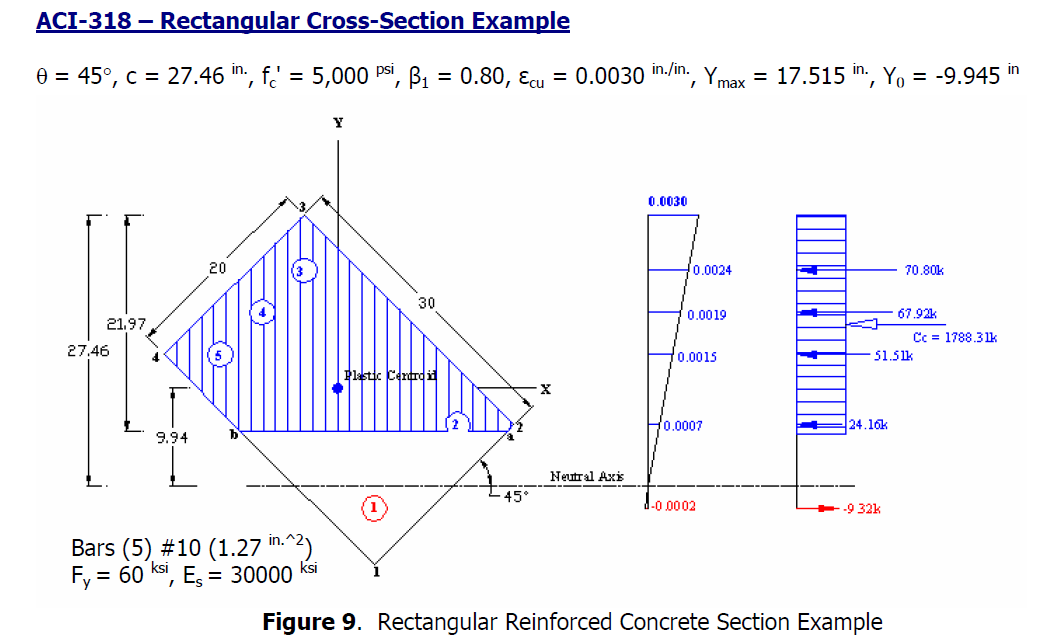
I have checked the spreadsheet results against a paper published by Enercalc:
Reinforced Concrete Columns in Biaxial Bending
Enercalc results:
ULS Design Functions-biax results:
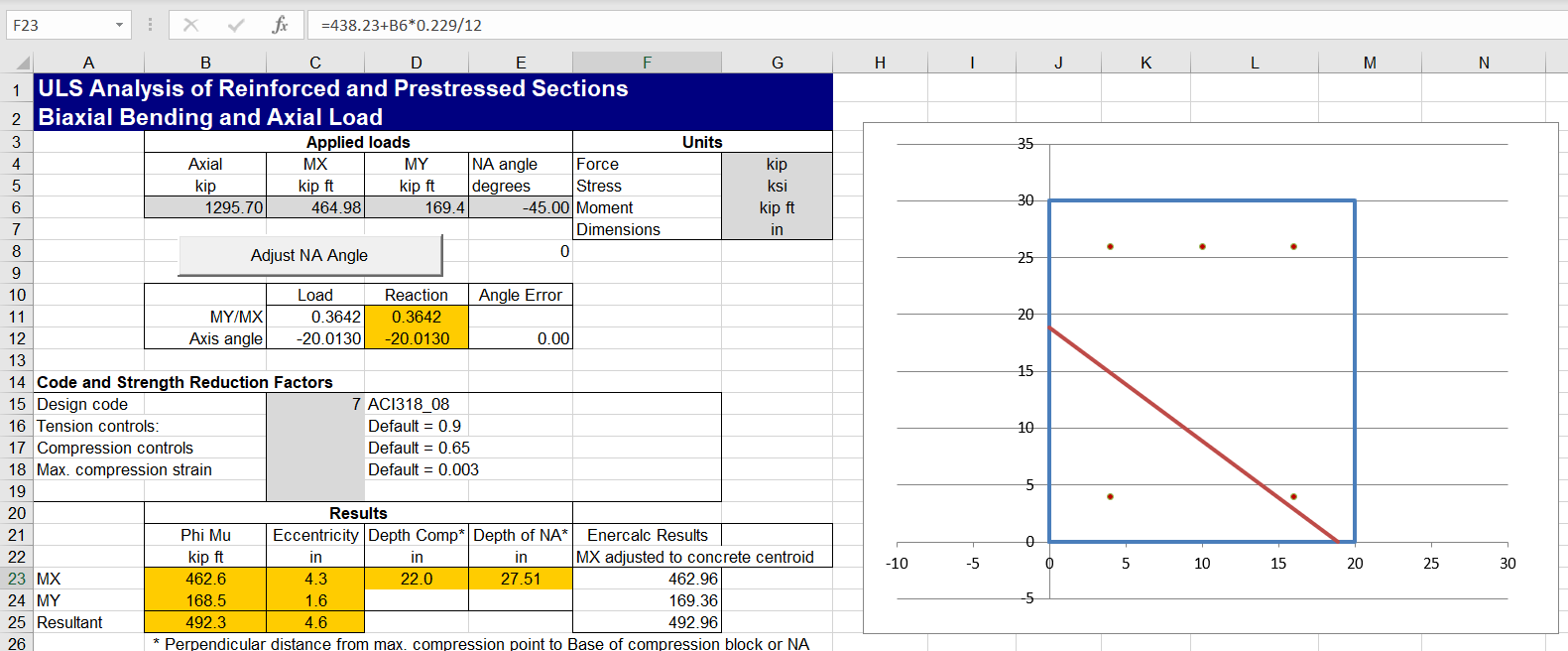
After adjusting the Enercalc moments to the centroid of the uncracked concrete section, the results are in near exact agreement.
The results below compare the spreadsheet results with the simplified procedures given in AS 3600 and Eurocode 2, using a rectangular section and plotting moment capacity results under different axial loads:

The AS 3600 and Eurocode provisions for biaxial bending take exactly the same form:
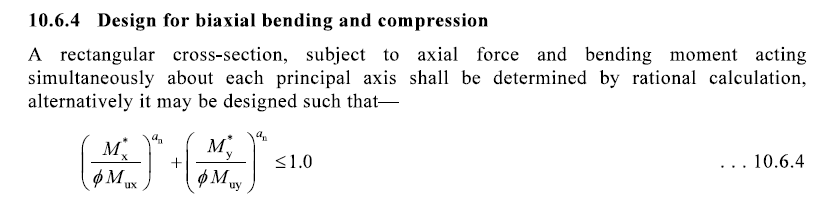 The two codes give significantly different results however because:
- In AS 3600 the Phi factor is defined as 0.65 for all axial loads, whereas the Eurocode uses the design Mux and Muy values for the applied axial load.
- The definition of the exponent alpha is different, resulting in AS 3600 having a lower value for low axial loads, but a higher value for high axial loads.
For the purposes of comparison, the Eurocode Mx and My values used the design moment capacities under the applicable axial load to the AS 3600 rules.
For an axial load well below the balance load both codes have an alpha value of 1, resulting in conservative capacity values under biaxial loading. The AS 3600 requirement to use a Phi factor of 0.65 results in a further substantial conservatism:
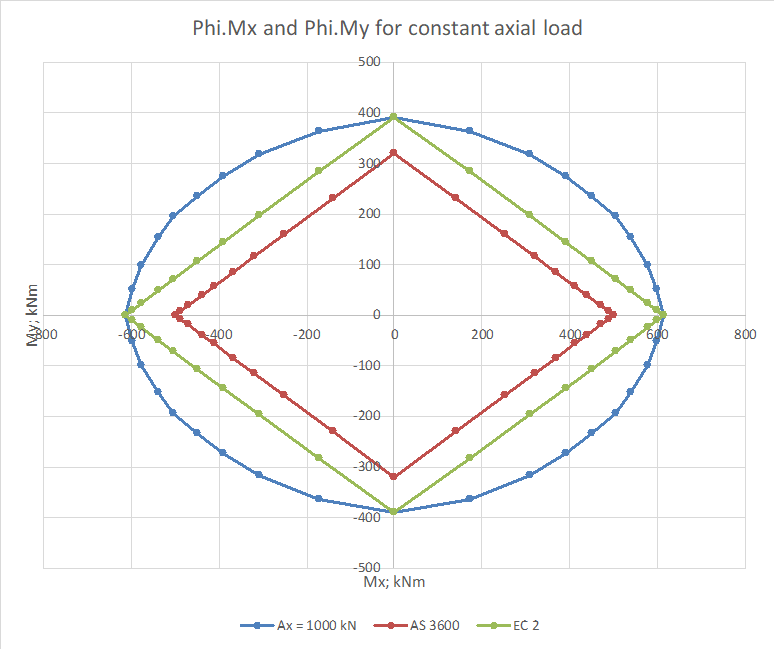
Increasing the axial load to close to the balance load increases the alpha values above 1, and brings the AS 3600 Phi factor down close to 0.65, reducing the conservatism of the simplified approach:

A further increase in the axial load increases the alpha value for AS 3600 to close to 2, so that the AS 3600 results are no longer conservative. The Eurocode alpha value is lower, and it is still conservative:

A further increase in the axial load shows the same trend, with the AS 3600 results increasingly unconservative, and the Eurocode results closer to the detailed calculation, but still conservative:
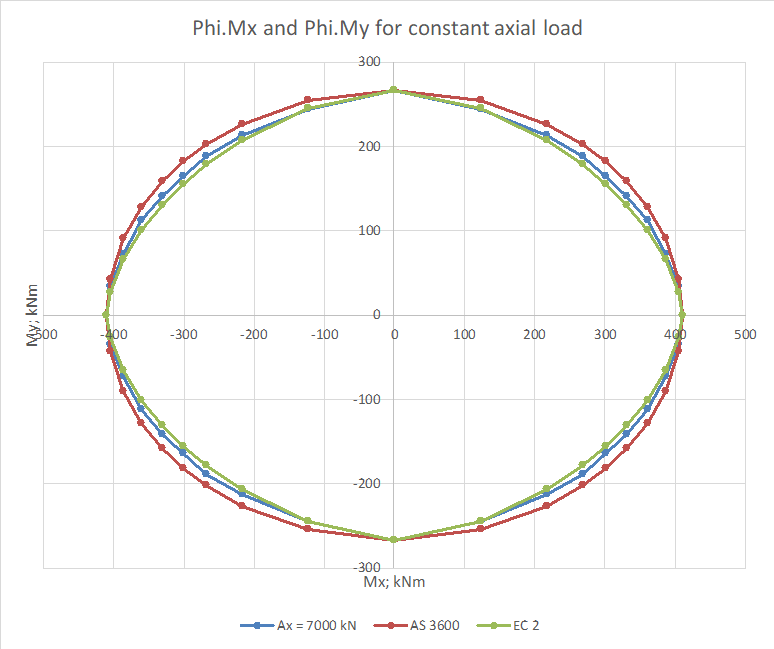
For very high axial loads, where the base of the rectangular stress block is outside the concrete section, there is a large reduction in the moment capacity from the detailed calculation. This is not reflected in the simplified method from either code, which both have an alpha value of 2 at these loads:

Further complications arise with non-rectangular sections:
In this case the simplified method from both codes gives results that are highly unconservative for some moment combinations, even for axial loads well below the design limit: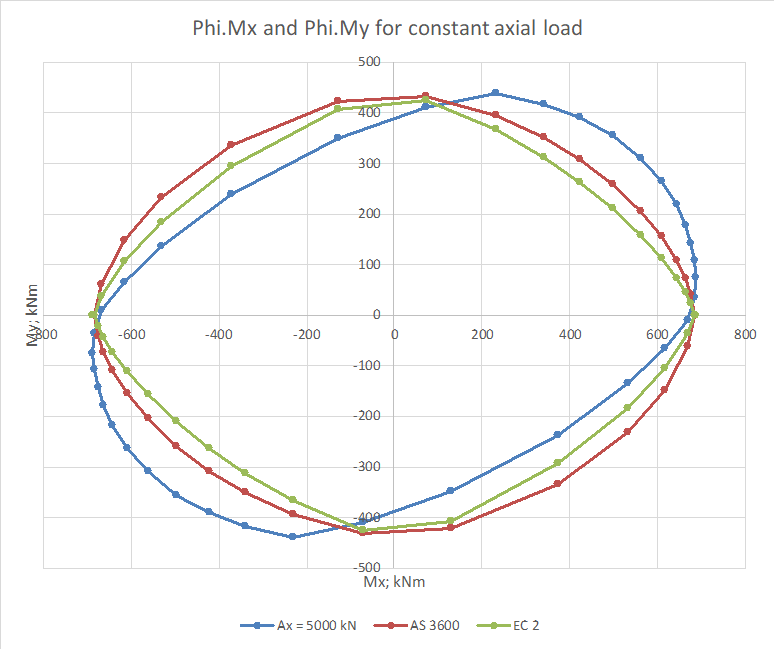
It should be noted that all calculations assumed a rectangular stress block to the AS 3600 code. Use of a parabolic linear stress block would result in further significant reductions in the design moment capacity when the concrete compression zone was triangular.



 Newton Excel Bach, not (just) an Excel Blog