Buckling of Tubes – 2

Following on from yesterday’s post, today we’ll look at the buckling of the cylindrical tubes:

The tube in this analysis was defined to have a small (0.01 mm) asymmetric bulge at mid height, to initiate buckling.  The video shows that the vertical stress is almost uniform around the tube, until it reaches a stress of 1.75 MPa, when the top of the tube starts to buckle inwards, then the buckling deformations increase rapidly, and the tube collapses.  This stress will result in a force of 27.5 N in the 50 mm diameter cylinder analysed, or a total force of 110 N (about 11.2 kg force) in four tubes, or nearly 5 times the buckling load of the square tubes, which ties in well with the relative strengths seen in the Surfing Scientist video.

Finding the exact buckling load of a thin-walled cylinder is surprisingly difficult.  A linear buckling analysis in Strand7 finds a minimum buckling load of 1.96 MPa:
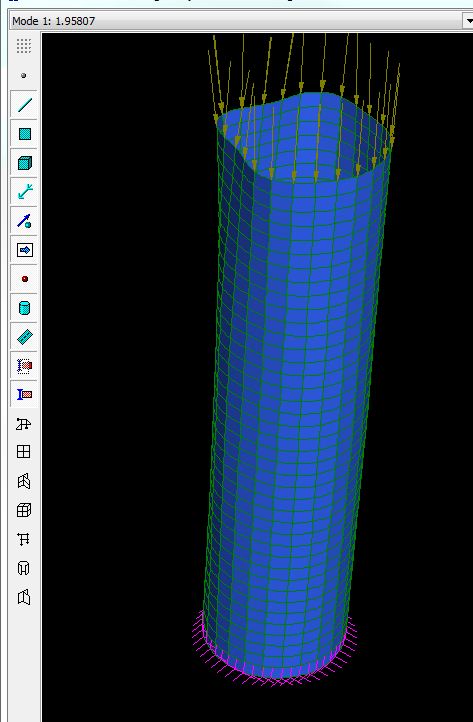
First buckling mode of a thin walled cylinder

The standard formula given by Timoshenko (and also in Roarke’s Formulas for Stress and Strain) gives a buckling stress of 4.7 MPa, but this is based on concentric buckling of the tube, rather than transverse buckling of the top.

Closer approximations to the value found in the non-linear analysis are given in Formulas for Stress, Strain, and Structural Matrices, by Walter D. Pilkey.  Table 20-15-9 of this book gives a series of empirical formulas for different ratios of radius/thickness.  The closest ratio is 500 (compared with 250 in the analysis), which gives a buckling stress of 1.57 MPa.  The table also gives a theoretical formula, giving a buckling stress of 4.21 MPa, but the basis of this formula is not stated.

Perhaps the differences between the theoretical, analytical, and empirical results is not so surprising, because as the link below shows, actually it is rocket science:

NASA’s Successful ‘Can Crush’ Will Aid Heavy-Lift Rocket Design
Posted in Newton | Tagged , , , | Leave a comment

Buckling of Tubes

The video here

The Surfing Scientist

shows a rough and ready experiment demonstrating the superior strength under axial load of cylindrical tubes, compared with square tubes (skip to 1:30 if you are not interested in the chat).

The conclusion about the greater strength of the cylindrical tubes is fair enough, but I wasn’t convinced by the explanation that the early collapse of the square tubes was due to the stress concentrations at the corners, so I did a finite element analysis of an axially loaded paper tube:

The contours show axial stress in the vertical direction.  It can be seen that the stress is uniform for the first few stages, until it reaches about 0.02 MPa, when the sides start to buckle inwards and outwards in a series of waves.  As these waves increase in amplitude there is indeed a transfer of stress from the centre of the plates to the corners, until the maximum stress reaches about 3 MPa, when the corners start to buckle, but the initial change from a uniform stress distribution was the result of the deflections of the plates, rather than the corners causing a stress concentration.

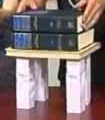
The total reaction force at the base at the final initiation of buckling was  5.8 N (an average stress of  0.29 MPa), which would give a total failure load of  23.2 N (about  2.3 kg force) for four tubes, tying in pretty well with the failure load of something less than 2 heavy books in the video.

The next post will look at the failure mechanisms of cylindrical tubes.

Update 7th July 2011:

Stills from the Surfing Scientist video, showing the square columns at the point of buckling, provided by Georg (see comment below):


Strand7 data files and avi files of the animations may be downloaded here:
Square section
Circular section
The data files need a licenced copy of Strand7 to run, but may be viewed with the free Strand7 Viewer.  The avi files can be viewed with a standard video viewer, and are much higher resolution than the Youtube videos.

Posted in Finite Element Analysis, Newton | Tagged , , , , | 4 Comments

The Rough Island Band

Some more from John Elliot (who appeared under the name “the little unsaid” in the previous post), here performing with an aptly named group from the Scilly Isles called The Rough Island Band.  First performing Paul Simon’s “Call me Al”, outside in a North Atlantic gale in the middle of winter:

Then a more traditional piece (a bit restrained at first, but give them a chance):

Read more about The Rough Island Band

And buy their albums : The Cornish Music Portal

Posted in Bach | Tagged , , | 1 Comment

Fine as a Bee’s wing

Beeswing is song by Richard Thompson, said to be about, or at least inspired by Anne Briggs.  Here is what the man himself says about it:

“RICHARD THOMPSON: I wrote the song Beeswing kind of about her. There
was a thing in the 60s where people dropped out to live in the country and get
their heads together. People like Vashti Bunyan and Annie Briggs: these wild,
free spirited women. They were quite inspirational. Anne was great. I saw her a
couple of times in folk clubs, but the only times I only actually ever met her
she had drunk herself into unconsciousness.”

Taken from: Anne Briggs at 65, a very nice article on the life and times of the singer, finishing with this message: “Whatever she chooses to do next, it will be firmly on her own terms. Aged 62,  she seems as wary as ever of the glare of the spotlight, but is happy that her timeless music hasn’t been forgotten. And this most private and pleasant of
women has one last message to the world: “Say I’m OK,” she smiles. “You tell
them that.””

Further browsing took me to this lengthy discussion: She was a rare thing…, including song lyrics, and a link to this song:

… which surely provided the inspiration for another Richard Thompson song, from his time with Fairport Convention:

As for “the little unsaid”, all I can tell you is that he is a little unsung, but deserves not to be.  More here: the little unsaid

Posted in Bach | Tagged , , , | 3 Comments

Rotating Hypercubes

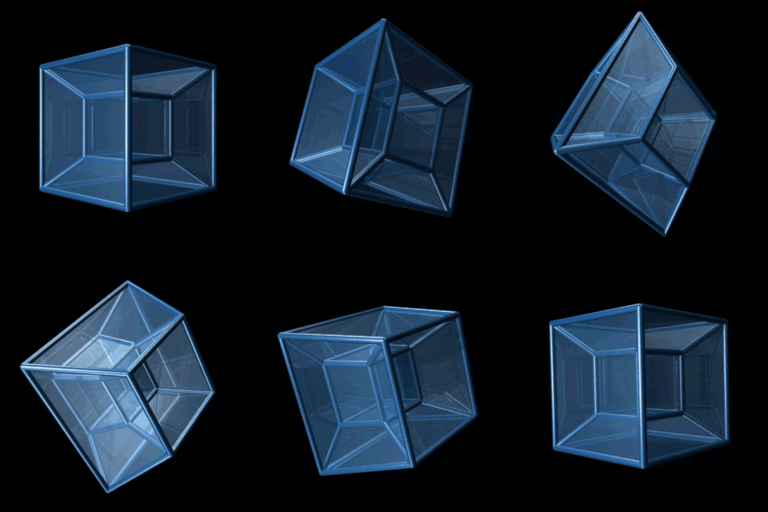
The discussion of dancing pendulums in javascript at SSSF led onto Rotating Hypercubes, which resulted in this javascript animation by forum regular mollwollfumble:

4D Rotations (click to view in a new window, right click to download javascript file)

See the SSSF thread for discussion on how to do these things in javascript.

Also see:

Background on the geometry of hypercubes (contains animated applets, but they don’t seem to work in IE9)

John Baez on the geometer H.S.M. Coxeter

First 31 pages of Coxeter’s Regular Polytopes 

And a nice animated gif from http://www.123opticalillusions.com/:

Update 27-Jun-11:

As noted in the comments, we had covered rotating 4D hypercubes here before (in a spreadsheet provided by Lori Miller), and I’d forgotten all about it!  The video link below shows what it looks like, but for a good look at the workings, click on the link: Hypercube.xlsx, then download the file, and have a look at the range names.

Posted in Animation, Maths, Newton | Tagged , , , | 5 Comments