13th July 2006.
Click on thumbnail, then click on image to see full size.
Recent Comments

13th July 2006.
Click on thumbnail, then click on image to see full size.


This is a the first of a series of posts describing how to produce scale drawings in Excel, based on a list of coordinates. This post will cover the use of XY graphs, or scatter charts as Microsoft likes to call them. Later posts will cover the use of the various line and shape objects, using VBA to automate the process.
Using XY graphs for line drawings has a number of disadvantages: the drawing is likely to be distorted because of the automatic scaling to fill the chart area; there is no provision for adding shading; adding text is difficult; and there is no provision for generation of shapes such as circles, ellipses and arcs, other than plotting lines as a series of straights. There are however two big advantages: it’s quick and easy, and the graph automatically updates to reflect the underlying data.
For these reasons the use of an XY graph can be a good option for many purposes, and this post provides two alternatives for automatic scaling. A cross-section drawing of an Australian “Super-T” bridge girder is used for illustration purposes. The two figures below show the results of plotting the cross section using auto scaling. The edge coordinates have been plotted using one XY range (with point markers hidden), and the reinforcement and prestressing strands have been plotted from coordinates in a second range, hiding the connector lines, and choosing the point marker symbol closest to a circle. It can be seen that both images are distorted to fill the available space.


The simplest way to get approximately equal scaling in the X and Y directions is to ensure that the plot range is square, then plot an additional line so that the smaller range is stretched to match the larger one. This line is allocated its own data range, and has both the line and data markers hidden.
The coordinates of the ends of the scale line are calculated as follows:
XLength = MAX(xrange) – MIN(xrange)
YLength = MAX(yrange) – MIN(yrange)
AddX = MAX((YLength – XLength)/2, 0)
AddY = MAX((XLength – YLength)/2, 0)
Scale Line Coordinates:
Start: MIN(xrange) – AddX, MIN(yrange) – AddY
End: MAX(xrange) + AddX, MAX(yrange) + AddY
The results of adding the scale line are shown in the two figures below. Advantages of this method are that scaling is carried out automatically, and that no VBA is required. The main disadvantage is that if the plot area shape is changed from square the resulting image will be distorted.


The second method is to use VBA to adjust the range of the graph scales, so that the drawing will have the same scale in both directions regardless of the range of X and Y values, and the shape of the plot area. I have taken the macro to perform this task from Jon Peltier’s site:
http://peltiertech.com/Excel/Charts/SquareGrid.html
The code below has been slightly modified to plot the graph in the centre of the plot area, rather than to one side, or towards the bottom:
Sub MakePlotGridSquareOfActiveChart()

MakePlotGridSquare2 ActiveChart

End Sub
Sub MakePlotGridSquare2(myChart As Chart, Optional bEquiTic As Boolean = False)
‘ Code from http://peltiertech.com/Excel/Charts/SquareGrid.html
‘ Modified DAJ 31 May 08
Dim plotInHt As Integer, plotInWd As Integer
Dim Ymax As Double, Ymin As Double, Ydel As Double, YMid As Double, YHWidth As Double
Dim Xmax As Double, Xmin As Double, Xdel As Double, XMid As Double, XHWidth As Double
Dim Ypix As Double, Xpix As Double
With myChart
‘ get plot size
With .PlotArea
plotInHt = .InsideHeight
plotInWd = .InsideWidth
End With
‘ Set axes to auto
With .Axes(xlValue)
.MaximumScaleIsAuto = True
.MinimumScaleIsAuto = True
‘ .MajorUnitIsAuto = True
End With
With .Axes(xlCategory)
.MaximumScaleIsAuto = True
.MinimumScaleIsAuto = True
‘ .MajorUnitIsAuto = True
End With
Do
‘ Get axis scale parameters and lock scales
With .Axes(xlValue)
Ymax = .MaximumScale
Ymin = .MinimumScale
Ydel = .MajorUnit
.MaximumScaleIsAuto = False
.MinimumScaleIsAuto = False
.MajorUnitIsAuto = False
End With
With .Axes(xlCategory)
Xmax = .MaximumScale
Xmin = .MinimumScale
Xdel = .MajorUnit
.MaximumScaleIsAuto = False
.MinimumScaleIsAuto = False
.MajorUnitIsAuto = False
End With
If bEquiTic Then
‘ Set tick spacings to same value
Xdel = WorksheetFunction.Max(Xdel, Ydel)
Ydel = Xdel
.Axes(xlCategory).MajorUnit = Xdel
.Axes(xlValue).MajorUnit = Ydel
End If
‘ Pixels per unit
Ypix = plotInHt * Ydel / (Ymax – Ymin)
Xpix = plotInWd * Xdel / (Xmax – Xmin)
‘ Keep plot size as is, adjust scale width
If Xpix > Ypix Then
XMid = (Xmax + Xmin) / 2
XHWidth = (plotInWd * Xdel / Ypix) / 2
.Axes(xlCategory).MaximumScale = XMid + XHWidth
.Axes(xlCategory).MinimumScale = XMid – XHWidth
Else
YMid = (Ymax + Ymin) / 2
YHWidth = (plotInHt * Ydel / Xpix) / 2
.Axes(xlValue).MaximumScale = YMid + YHWidth
.Axes(xlValue).MinimumScale = YMid – YHWidth
End If
‘ Repeat if “something” else changed to distort chart axes
‘ Don’t repeat if we’re within 1%
Loop While Abs(Log(Xpix / Ypix)) > 0.01
End With
End Sub
The results of applying this code are shown below:


The advantage of this method is that it will work for any shape plot area, and will still work if the plot area is changed. The main disadvantage is that the macro needs to be re-run every time the graph data changes, but this could be accomplished by triggering the scale routine with a worksheetchange event.
This code was found via the Eng-tips forum (http://www.eng-tips.com/viewthread.cfm?qid=141275), where there are also some modified versions which switch on the axes display, then return them to their original state. I found that the original works works (at least in Excel 2007) whether the axes are displayed or not, so there did not seem to be any advantage in this refinement.
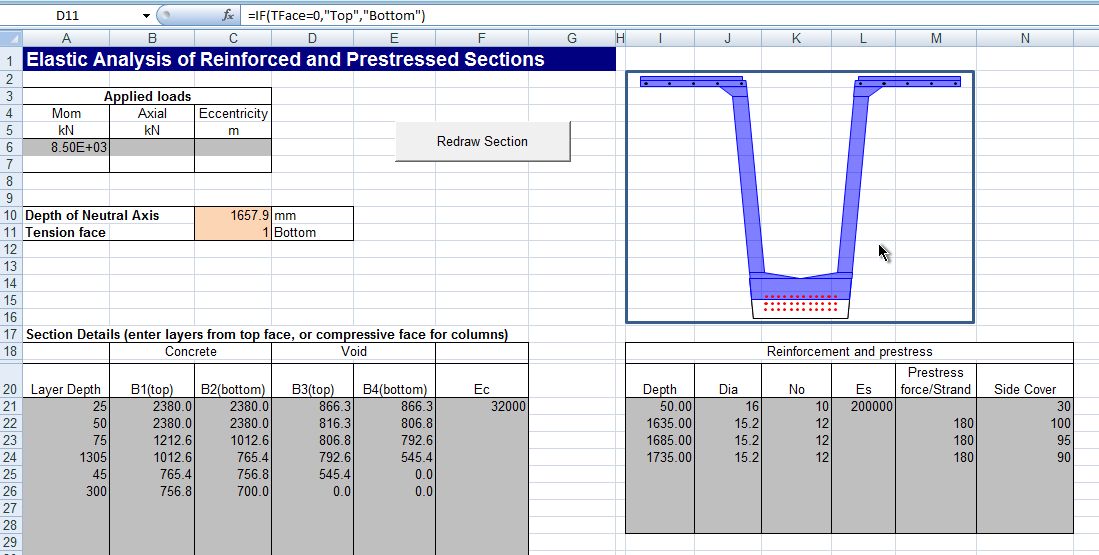
The theory presented in the previous 2 posts in this series has been incorporated into an Excel UDF, allowing concrete and reinforcement stresses and strains to be evaluated quickly and easily for reinforced and prestressed members of complex cross-section, subject to combined bending and axial load.
The Excel file also includes UDFs for solution of polynomial equations up to quartic, and routines for plotting the cross section shape.
Beam Design Functions Download

I have recently made my first Wikipedia edit.
The article on the Pantheon in Rome made the following claim:
“The exact composition of the Roman concrete used in the dome remains a mystery. An unreinforced dome in these proportions made of modern concrete would hardly stand the load of its own weight, since concrete has very low tensile strength, yet the Pantheon has stood for centuries. It is known from Roman sources that their concrete is made up of a pasty Calcium hydroxide|hydrate of lime, with pozzolanic ash (Latin ”pulvis puteolanum”) and lightweight pumice from a nearby volcano, and fist-sized pieces of rock. In this, it is very similar to modern concrete. The high tensile strength appears to come from the way the concrete was applied in very small amounts and then was tamped down after every application to remove excess water and trapped air bubbles. This appears to have increased its strength enormously.”
Some quick research on the Internet found no evidence for the Roman concrete having particularly high strength, and this article: The Pantheon by David Moore quoted research showing that the maximum flexural tensile stresses were very low.
My edit was as follows:
It is known from Roman sources that their concrete is made up of a pasty hydrate of lime, with pozzolanic ash (Latin pulvis puteolanum) and lightweight pumice from a nearby volcano, and fist-sized pieces of rock. In this, it is very similar to modern concrete.[3] No tensile test results are available on the concrete used in the Pantheon; however Cowan discussed tests on ancient concrete from Roman ruins in Libya which gave a compressive strength of 2.8 ksi (20 MPa). An empirical relationship gives a tensile strength of 213 psi (1.5 MPa) for this specimen.[4] Finite element analysis of the structure by Mark and Hutchison[5] found a maximum tensile stress of only 18.5 psi (0.13 MPa) at the point where the dome joins the raised outer wall.[6] The stresses in the dome were found to be substantially reduced by the use of successively less dense concrete in higher layers of the dome. Mark and Hutchison estimated that if normal weight concrete had been used throughout the stresses in the arch would have been some 80% higher.
4. H. W. Cowan, The Master Builders. John Wiley and Son, New York, 1977, p. 56
5. R. Mark and P. Hutchinson, “On the Structure of the Pantheon”, Art Bulletin. March 1986
6. Moore, David, “The Pantheon”, http://www.romanconcrete.com/docs/chapt01/chapt01.htm, 1999
In a recent post at microsoft.public.excel.programming Charles Williams (Decision Models) found that a VBA User Defined Funcion (UDF) searching through a defined range for a specified number was very much slower than simply using .worksheetfunction.match as below:
Function VBAMatch2(arg As Double, XRange As Variant) As Long
VBAMatch2 = Application.WorksheetFunction.Match(arg, XRange, 1)
End Function
I found this strange, since in the past I had found the exact opposite, and repeating the comparison I again found that searching through the data within VBA was some 400 times faster than calling worksheetfunction.match.
It turns out that there is a logical explanation for these different results, which is that I was calling the functions from a VBA subroutine, whereas Charles was using them as UDFs on the spreadsheet. The result was that the transfer of data between the spreadsheet and VBA (the bit that takes all the time) occurred once for my VBA search routine, but 10,000 times when I used .worksheetfunction.match, calling the function from the VBA sub. On the other hand when the functions were called from the spreadsheet the opposite situation occurred. To quote Charles:
”
Your timing routine has as its first executable statement:
datarange=Range(“a1:A10000”)
This converts the range to a variant array of values before doing any
timing, and then passes datarange to the UDFs as a variant array rather than
a range.
So for your timing run of VBAMatch there is no data transfer between Excel
and VBA or VBA and Excel at all, but for VBAMATCH2 the whole array gets
passed from VBA to Excel 10000 times.
Since the vast majority of the execution time is taken by the data transfer
that explains the differences.
Conclusion:
If you want to develop a MATCH routine to process a sorted VBA array then a
VBA binary search routine (or your equivalent) will be fast because the data
is already in VBA, but if you want to develop a UDF MATCH routine to use as
a worksheet UDF function its better to use Worksheetfunction.MATCH because
then the data never has to be passed from Excel to VBA. “


 Newton Excel Bach, not (just) an Excel Blog