Recent changes to how Python treats comparing a Numpy array to an empty list have resulted in some of my functions returning errors and I am in the process of updating them. Specifically, when an optional argument to a function might return a NumPy array or an empty list, I have used the line: if optarg == [] : but if the argument is a non-empty array, this now returns an error, so has been replaced with: if len(optarg) == 0:
Updated code for the 3DFrame-py program, and associated spreadsheets can be downloaded from:
Robbie van Leeuwen’s SectionProperties program, (last featured here) has recently been updated to Release 3 with some major changes to the code, including:
New, unambiguous section property retrieval with get()methods, see an example here.
Improved stress plotting options (new colorbar features, mesh opacity, plot selected materials), see an example here.
Note that the new spreadsheet is not backwards compatible with previous versions of SectionProperties. The spreadsheet requires pyxll to be installed, to connect from Excel to the Python code.
Note that the current version of the spreadsheet is a work in progress, and has had minimal testing. Please let me know of any problems, or suggestions for new features.
Typical output, section properties and stress results for a composite pre-stressed bridge girder:
The book “Developments in Structural Form” by Rowland Mainstone is a history of the development of structural design over thousands of years. The very first 20th Century building structure appearing in that book is the Sydney Opera House, which was opened on 20th October 1973.
To mark the occasion here is a music video featuring Tim Minchin:
… and an interview with Peter Thompson, who worked on the construction of the project, produced by Engineers Australia:
In the post RC Design Functions 9.03; compression strut angle adjustment I recommended that when finding the longitudinal force due to shear according to AS 5100.5 (Amendment 1), the effect of increased vertical shear reinforcement should be limited in accordance with the Canadian code requirements; i.e. Phi.Vus < V*. The spreadsheets RC Design Functions and py_UMom have now been updated with an option to apply this limit. The updated spreadsheets can be downloaded from:
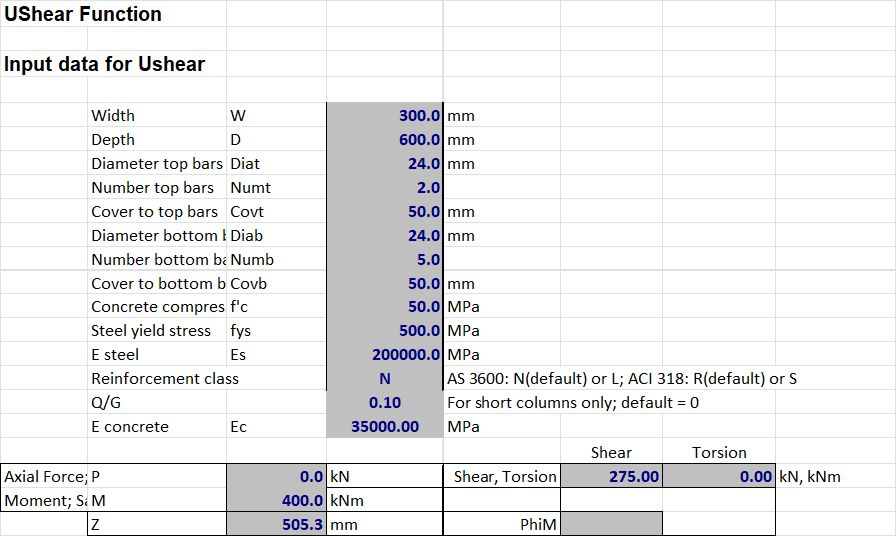
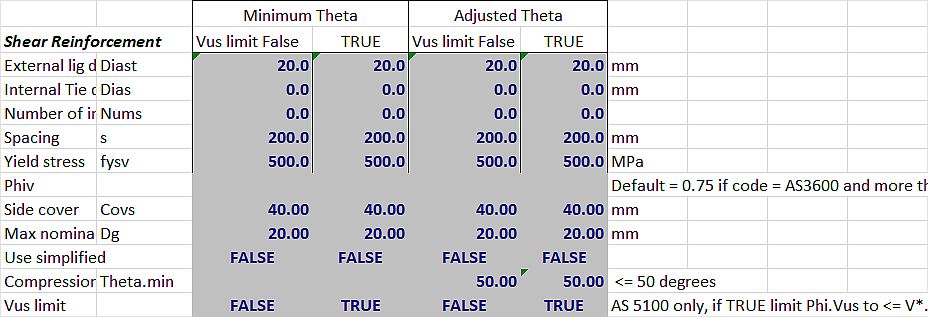
I have also updated the graphs showing bending moment capacity variation with increased shear steel. The input data used is shown below:
Cross section and longitudinal reinforcement:
Shear reinforcement:
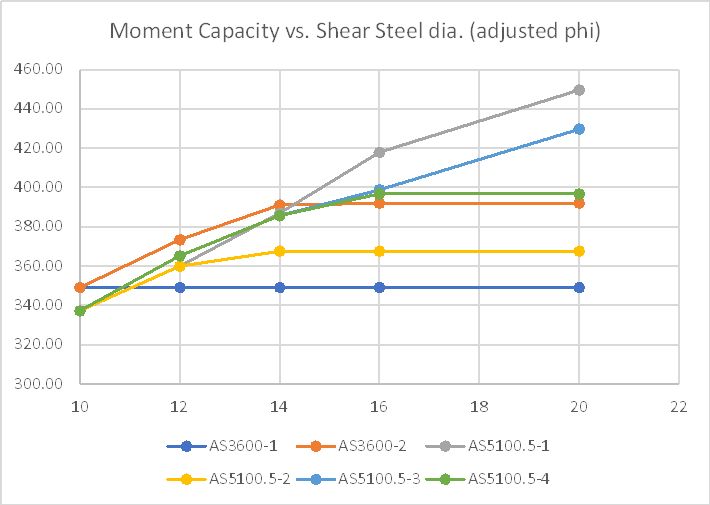
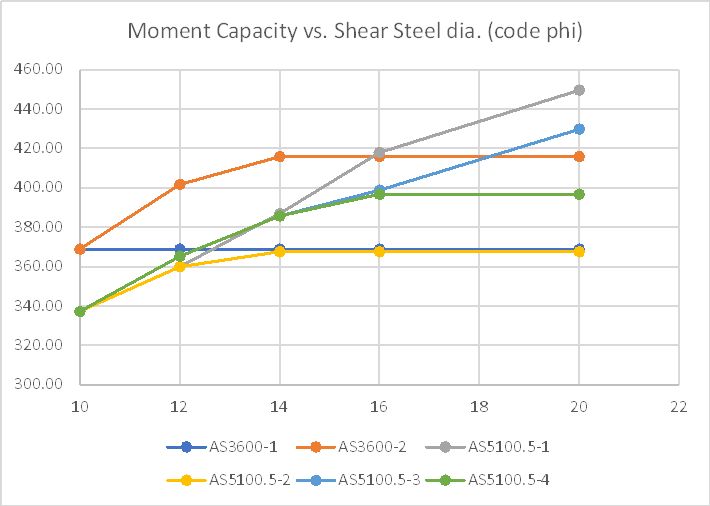
Results are plotted for the following cases:
AS3600-1: Longitudinal force due to shear to AS 3600 with Theta values set to minimum.
AS3600-2: As above with Theta adjusted so that shear capacity = applied shear, up to a maximum of 50 degrees.
AS5100-1: Longitudinal force due to shear to AS 5100.5, with Theta set to minimum value and no limit on Vus.
AS 5100-2: As above but phi.Vus set with a maximum value of V*.
AS 5100-3: As ASS5100-1, but with Theta adjusted.
AS5100-4: As AS5100-2 with Theta adjusted.
Results were initially calculated with the reduction factor for bending set to 0.8 for both codes, and for shear set to 0.75. This was done so that the difference in the results was entirely due to the different procedures for calculating the longitudinal force due to shear:
With 10 mm reinforcement the section shear capacity is very close to the applied shear force, and the two AS 3600 methods give the same results. The AS 5100 results for 10 mm reinforcement are lower because the code requires the area of steel required for the longitudinal force due to shear to be calculated using a reduction factor of 0.7, rather than 0.8 (Equation 8.2.7(3)).
Applying the limit to Vus the AS 5100 moment capacity reaches a maximum about 20 kNm higher than AS 3600 with 14 mm diameter shear reinforcement when the minimum Theta value is used. With adjustment of Theta the maximum capacities from AS 3600 and AS 5100 are very close.
Results with the reduction values set to the values specified in the codes:
Applying the AS 5100 reduction factor for bending (0.8) the maximum AS 5100 results with minimum theta are very close to the equivalent results from AS 3600. With adjustment of Theta the AS 5100 maximum results are about 20kNm lower than the equivalent AS 3600 results.
“This country is my home. This beautiful country, unique in all the world,” Kelly wrote in his statement on why he’s voting Yes earlier this week. “Our First Australians looked after it and shaped it for over 60,000 years and, in doing so, developed a rich and complex culture that is a gift to us all.”
“Recognition is not achieved with fine-sounding words and feel-good statements but by promising to listen,” Kelly added. “There is a huge and stubborn gap in health, education and opportunities between Indigenous and non-Indigenous Australians.” He called the gap “unfair” and said it “diminishes us all”.
It’s a splinter in the mind, a whisper in the heart A feeling something’s missing, some crucial little part It’s business that’s unfinished, a reckoning that’s due If not now, then when? If not us, then who?
It’s a simple proposition to join the new and old A chance to make our country larger in its soul It’s an invitation offered to set our course anew If not now, then when? If not us, then who?
[Chorus] How long can we keep walking with this stone in our shoe? If not now, then when? If not us, then who? We may never get another chance like this again If not us, thеn who? If not now, then when?
Too many falling far behind, shut out of thе deal If you called and no-one heard you, imagine how you’d feel This land was never given, it was taken and then sold But its ancient songs and stories are a gift greater than gold
[Chorus] Oh, the status quo is busted, let’s stop kicking that old can If not us, then who? If not now, then when? It’s business that’s unfinished, high time to see it through If not now, then when? If not us, then who?