Four Forgotten Female Folkies

Barbara Dane

In her speech to the GI Movement of the Vietnam War Era (whose text can be found in the booklet that’s included in Paredon Records’ FTA! Songs of the GI Resistance vinyl album of 1970), Barbara Dane said, “I was too stubborn to hire one of the greed-head managers, probably because I’m a woman who likes to speak for herself. I always made my own deals and contracts, and after figuring out the economics of it, I was free to choose when and where I worked, able to spend lots more time with my three children and doing political work, and even brought home more money in the end, by not going for the ‘bigtime.’ I did make some really nice records, because I was able to choose and work with wonderfully gifted musicians.”[7]

Tia Blake

Tia Blake was the stage name of Christiana Elizabeth Wallman (1952-2015), an American writer and singer…

Wallman was born in Columbus, Georgia, in 1952, and grew up in North Carolina.[1] In 1970 she worked for Farrar, Straus and Giroux in New York for six months, before moving to Paris.[1] In Paris she recorded an album of folk songs at Ossian Studio in 1971. This was released in February 1972 by Société Française de Productions Phonographiques (SFPP) under the title Folk Songs and Ballads: Tia Blake and Her Folk-group.[1]

Bridget St John

Bridget St John (born Bridget Anne Hobbs; 4 October 1946 in Surrey, England)[1] is an English singer-songwriter and guitarist, best known for the three albums she recorded between 1969 and 1972 for John Peel‘s Dandelion record label. Peel produced her debut album Ask Me No Questions. She also recorded a large number of BBC Radio and Peel sessions and toured regularly on the British college and festival circuit. St John appeared at leading folk venues in the UK, along with other folk and pop luminaries of the time such as Nick DrakePaul Simon, and David Bowie, among others.[2] In 1974 she was voted fifth most popular female singer in that year’s Melody Maker readers poll.[3] Blessed with a “rich cello-like”[4] vocal style, she is also an accomplished guitar player who credits John Martyn and Michael Chapman as her “musical brothers”.[5]

Vashti Bunyan

Vashti Bunyan (born Jennifer Vashti Bunyan[2] in 1945[3]) is an English singer-songwriter.

Bunyan released her debut album, Just Another Diamond Day, in 1970. The album sold very few copies and Bunyan, discouraged, abandoned her musical career. By 2000, her album had acquired a cult following; it was re-released and Bunyan recorded more songs, initiating the second phase of her musical career after a gap of thirty years.[4] She subsequently released two albums: Lookaftering in 2005, and Heartleap in 2014.

Posted in Bach | Tagged , , , | 2 Comments

Newton-Raphson and Brent’s Method – Solver examples

I recently discovered the Computing Skillset site (via open-struct-engineer), which has good information on the basis and use of the Newton-Raphson method:

The Newton Raphson method explained, details, pictures, python code

Highly instructive examples for the Newton Raphson method

I have added an example from these papers to my ItSolve spreadsheet, illustrating some advantages of Brent’s Method for problems that may be difficult to solve using the Newton-Raphson method. The updated spreadsheet (including full open-source code) may be downloaded from:

ItSolve.zip

The example finds solutions to the function shown below:

Using the Newton-Raphson Method a solution may not be found:

The screen-shots below show all four solutions between -7 and 7 using Brent’s method:

Note that:

  • The values specified for the search range must return a positive and negative function result. If both are positive, or both negative an error message is returned.
  • The Quadbrent function works with functions entered as text on the spreadsheet as shown, or (by default) will call a named VBA function. The QuadbrentT function is a front-end for Quadbrent with defaults set to use text on the spreadsheet, as shown above.
  • The text function must be entered in a format recognisable by Excel, for instance the value Pi is entered as Pi().
Posted in Excel, Maths, Newton, UDFs, VBA | Tagged , , , , , | 1 Comment

Numerical Integration With Tanh-Sinh Quadrature v 5.0

Graeme Dennes has updated his Tanh-Sinh Quadrature spreadsheet to V 5.0. The new version (including full open source code) may be downloaded from:

Tanh-Sinh Quadrature

Graeme’s summary of the new features in the spreadsheet:

The Tanh-Sinh quadrature workbook has been enhanced as follows:

The Tanh-Sinh integrator in the workbook is the fastest and simplest finite-interval integrator on the planet!! It’s the new benchmark for Tanh-Sinh integrator performance!

The speed of the Tanh-Sinh, DE1, DE2 and DE3 programs has been increased through using recent (2017) programs provided by César Rodríguez. The programs are simpler and faster than those used previously. The state-of-the-art in Tanh-Sinh integration has been moved forward.

A fast finite interval program TINT has been added. It runs at over twice the speed of the Gauss-Kronrod program.

The speed of the Gauss-Kronrod program has been improved through modifications developed by Berntsen, Espelid and Sorevik.

The Romberg integrator, written by the author, may be the fastest and most accurate Romberg integrator on the planet!!

Now includes over 1200 test integrals with true results. This may be the largest set of diverse test integrals available at no cost. It includes several of the “standard” sets of test integrals in wide use.

The Plotter worksheet now shows two plots: the plot of the selected function over the finite interval (a,b), and the plot of the selected function after being transformed by the Tanh-Sinh function.

My on-sheet demonstration of the workings of the Tanh-Sinh code has now also been added to the spreadsheet (see Numerical integration with on-sheet calculations for background and sample screen-shots).

The WP 34s version of the code by César Rodríguez is available from :

https://www.hpmuseum.org/forum/thread-8021-page-2.html

See the Copyright tab of the download spreadsheet for many other links.

Update: 7th Nov 2020:

Graeme has made a minor correction to the double-exponential limit constant (now set to 6.56) in the 2 x T-S and 3 x DE programs. This is the figure for which exp(exp(6.56)) remains (just) under the 1.79 x 10^308 max figure as set by IEEE 754.

The version number is now 5.01, and the new version may be downloaded from the link at the top of this post.

Posted in Excel, Maths, Newton, Numerical integration, UDFs, VBA | Tagged , , , , | 13 Comments

Open Source FEA Code Links

There have been many posts here based on code from the book Programming The Finite Element Method, with the Fortran code either translated to VBA, or with VBA links to compiled Fortran Code. I recently discovered:

The “Programming the Finite Element Method” toolkit

This Julia package currently contains the programs in chapters 4, 5 and early sections of 6 as described in “Programming the Finite Element Method” by I M Smith, D V Griffiths and L. Margetts (PtFEM).

Another recent Github site with open source (Python based) FEA code is:

PyNite

PyNite is a library for structural engineering that creates and analyzes 3D finite element models of frames, trusses, and beams. For information on how to get started with PyNite please visit the other pages in this wiki! You can also have a look at the “Examples” folder for examples of how to use PyNite.

Both sites are works in progress, but already contain much valuable open source code.

Posted in Computing - general, Excel, Finite Element Analysis, Fortran, Frame Analysis, Link to Python | Tagged , , , , | 1 Comment

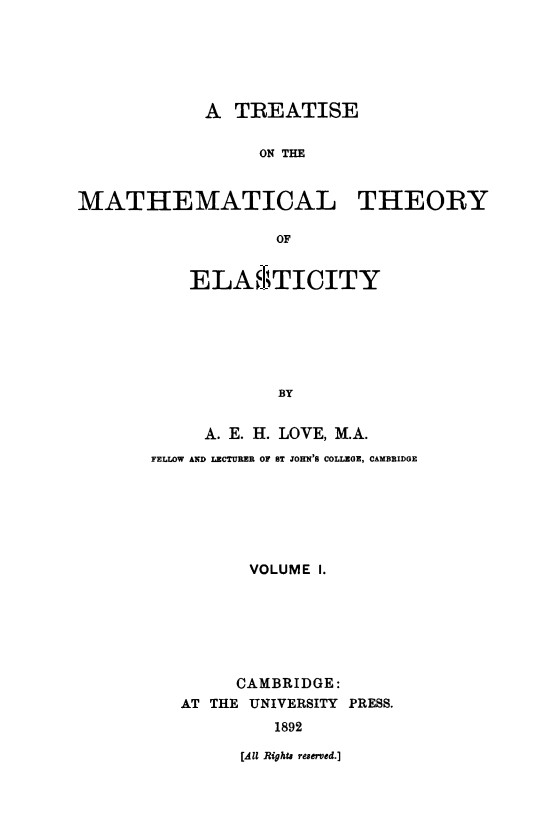
A Treatise on the Mathematical Theory of Elasticity

The book The Man Who Knew Infinity by Robert Kanigel describes the life of the Indian mathematician  Srinivasa Ramanujan, and also his Cambridge mentor G.H. Hardy. It mentions that Hardy was influenced by reading “A Treatise on the Mathematical Theory of Elasticity”, by Augustus Love.

Looking for a copy of this book, the first search results led to:

The Internet Archive, with a download available from Google Books. Unfortunately this was a poor quality non-searchable scanned document, with some pages that were totally unreadable.

Much better quality documents were found at:

HAL Archives

and

B-OK Global

Posted in Beam Bending, Maths, Newton | Tagged , , , , | Leave a comment