We are so familiar with the formula for the area enclosed by a circle that we tend not to think much about how it was derived, at least I don’t.
The proofs of the formula are in fact many and varied; the first one found by Google is at:
http://www.artofproblemsolving.com/LaTeX/Examples/AreaOfACircle.pdf
Don’t worry, that’s not the elegant one.
There are many proofs that don’t (directly) involve the use of calculus, and Wikipedia gives a good sample of them:
http://en.wikipedia.org/wiki/Area_of_a_disk
of which the rearrangement proof is perhaps the most elegant. Another presentation of this proof is given here (along with Archimedes’ equally elegant derivation of the volume of a sphere):
http://www.mathreference.com/geo,circle.html
Yesterday I came across an approach that to me seems even simpler, based on a post at:
http://foxmath.wordpress.com/2008/06/24/perimeter-area/
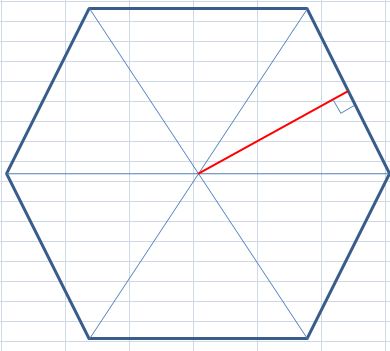 This shows that for any regular polygon with an area equal to its circumference, the length of the apothem (the red line in the diagram to the left) is 2. This is immediately obvious from the fact that the area of each individual triangle is equal to the base length, when the height equals 2.
In the limit as the number of sides of a regular polygon tends to infinity the polygon approaches a circle, and the length of the apothem approaches the radius of the enclosing circle. It therefore follows that the area of a circle of radius 2 is equal to its circumference; i.e. 4.pi.
A circle of radius R may be scaled to radius 2 by multiplying the radius by 2/R. The radius of this circle is then 4pi x (R/2)^2 = pi.R^2.
Finally a “wordless” proof provided by the people at SSSF: