Based on the true story of an unknown Australian soldier.
1919: Watch on i-view

I recently noticed that in the RC Design Functions spreadsheet the TimeCurve function had stopped working. The function calculates the development of reinforced concrete section curvature over time, and was previously presented in Reinforced Concrete Moment-Curvature – 3; Restrained Shrinkage and Creep and Reinforced Concrete Moment-Curvature – 4; Development of curvature over time.
In the course of fixing the problem I took the opportunity to add some further refinements:
The updated spreadsheet (including full open-source code) may be downloaded from:
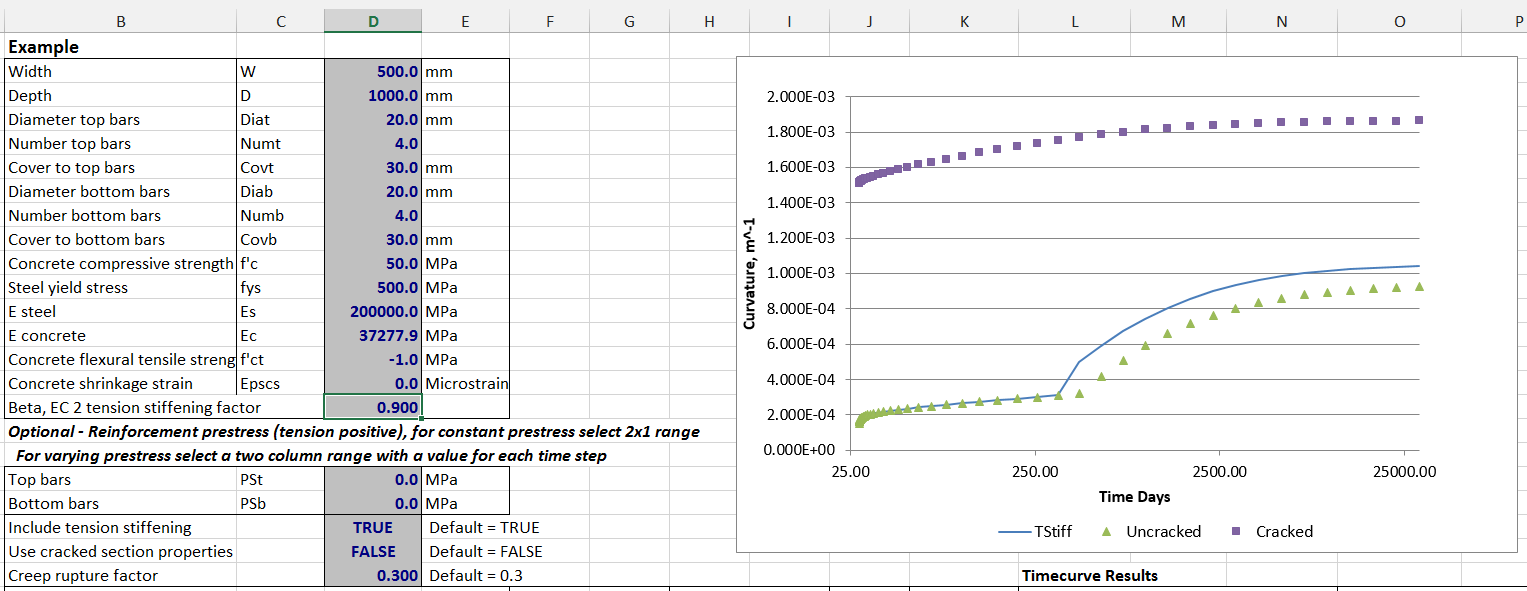
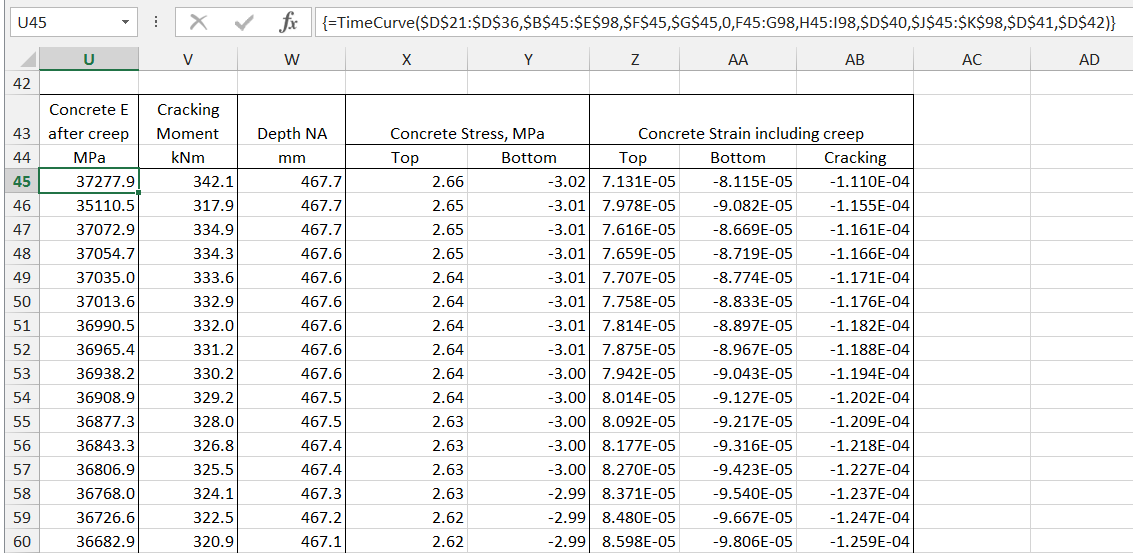
Examples of the function results, compared with experimental data, will be included in the next post on this subject. The screen-shots below show input and results for a typical beam loaded to just below the cracking moment, with cracking occurring as a result of the combined action of shrinkage and creep. Click any image for a full-size version:
Function input documentation:

Typical section properties input and output graph:
Time related data input:
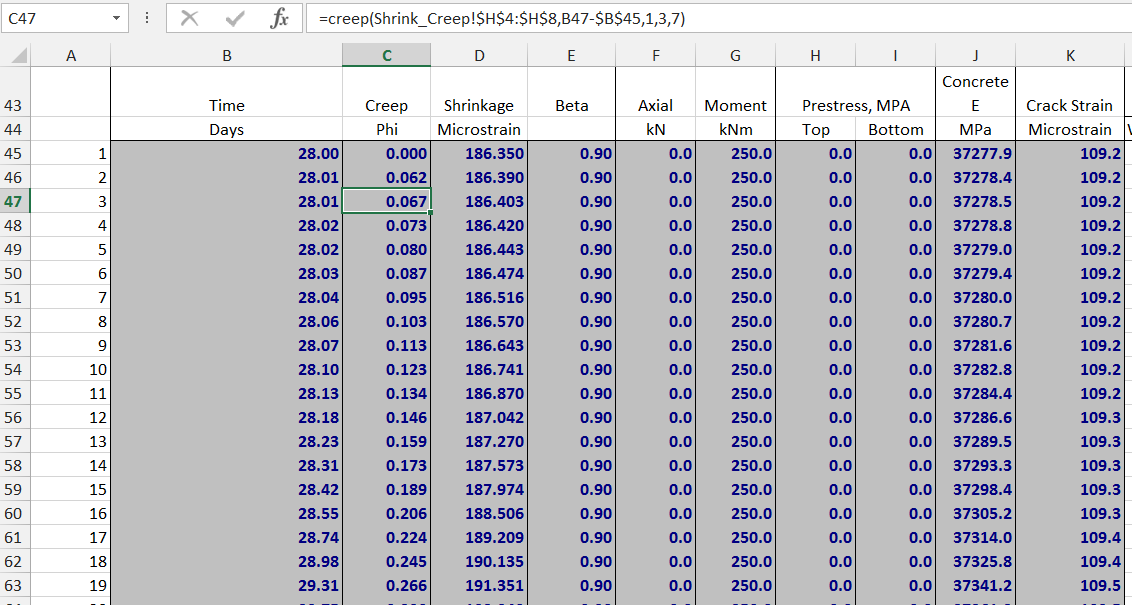
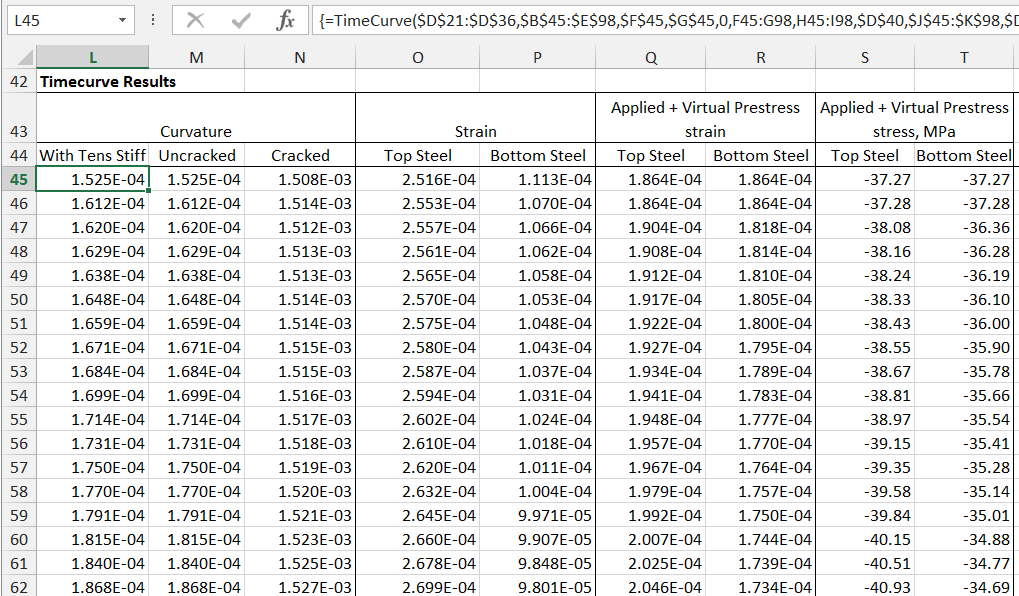
Note that the function may be used anywhere in the spreadsheet. To display all the results it must be entered as an array function, using Ctrl-Shift-Enter. See Using Array Functions and UDFs for details.
Output results columns 1 to 9:
Output results columns 10 to 17:
Douglas H on having no head (where H = both Harding and Hofstadter):
The Incredible String Band on Douglas Traherne Harding:
(Douglas Harding’s middle name was not really Traherne, it was Edison)
For some reason Doug Glancy’s Excel Blog has escaped my attention up till now, but having a browse today, I discovered this loopy animation:

which would not have been out of place in Douglas Hofstadter’s “I am a Strange Loop”
I really should have sent Doug G. a copy of this letter: A Tail of Two Letters …
But anyway, the Blog Roll now includes Sumbuddy.
And three more links from Alfred Vachris:
My latest (and final) President’s column from the Concrete in Australia Magazine:
Some responsibilities of engineers are universally recognised. Everyone accepts that we have a duty to carry out design and construction so that structures will be serviceable, strong and stable, and will be safe at all stages of construction and throughout their life. There may be debate about how this end is best achieved, indeed I will be discussing this question at the Concrete 2015 Conference in September, but there is no argument about the basic principles.
Then there is sustainability. Too often this is seen as not real engineers’ business. Something that we will incorporate if we can, to keep the architect happy, or to provide the client with some PR material, but not something that should be allowed to interfere with good engineering design. In my opinion this approach fails to recognise that using and providing sustainable products is as fundamental a part of an engineer’s responsibilities as any other. In 1828 Thomas Tredgold, one of the founders of the profession of Civil Engineering, described it as “the art of directing the great sources of power in Nature for the use and convenience of man”. Implicit in this statement is the requirement that we should consider the effects of what we do on all humanity, including future generations. If we recognise that the use of materials cannot be sustained in the long term, or that our current practices may have a significant adverse effect on the environment, now or in the future, then we have a duty to do what we can to change these practices. Far from being antithetical to a good engineering approach, a consideration for the future effects of what we do simply requires a process of design optimisation, but one that includes allowance for hidden and future costs.
Fortunately, there is plenty of scope for changing the way we do things. New materials and new design and construction techniques provide great opportunities for innovation. These will combine with changing financial and political pressures to result in widespread changes to current standard practice. Future commercial success will demand a readiness to accept change on a wide scale. Examples of innovation of this sort that will be illustrated at the Concrete 2015 Conference include the use of ultra-high strength concrete in bridge structures, the use of geo-polymer concrete in buildings and airport pavements, and the extension of the life of old structures through remediation and strengthening. These innovations, and many others, demand the transition from academic research into industrial application. This is the theme of this year’s Concrete Conference, and I recommend attendance to all interested in maximising their future opportunities.


 Newton Excel Bach, not (just) an Excel Blog