LatPilePY 1.04

Following comments from Stephen on LatPile 1.03 I have modified the code so that if the specified Soil Properties range includes lines 8 and 9 (for specified effective depths at the top of each layer), but these lines are blank, the effective depths are calculated by the program, rather than being set to zero.  The revised files may be downloaded from LatPilePY.zip, including full open source code.

The spreadsheet provides User Defined Functions to carry out the analysis of vertical piles under lateral load, following the methods described in the COM624 Manual.  See LatPilePY 1.02 for more details of the spreadsheet content and background.

Posted in Excel, Geotechnical Engineering, Newton, UDFs, VBA | Tagged , , , , , | 15 Comments

Have you found this site useful?

Here’s your chance to say thanks!

My daughter needs support for her crowd funded film project; Just click http://www.indiegogo.com/DancingInFilm?a=553266 and have a look.

Hey guys,

So I’m emailing you all about a dance short film called ‘Emergence’ that I’ve been working on for the last six months and hoping you might be able to help spread the word in order to get this project made!

Emergence is about  a young man who hears a scream for help, but on investigating, finds his own life at risk from a haunting spirit.

It’s a modern day ghost story.

We’ve got a great team on board, have cast two dancers and found our location, and while we’ve raised some money and in kind support already, there’s a still a way to go in order to get this project made. So today we’re launching a crowdfunding campaign in the hopes of raising $3,000 to pay for the costs of insurance, lighting equipment and post production expenses.

INDIEGOGO CROWDFUNDING PAGE:

http://www.indiegogo.com/DancingInFilm?a=553266

We want to give back as much to the people who invest as we can, whether it’s in sharing the experience online or in actual conversations and access to the process. You can read more about our ‘rewards’ on the indiegogo site – but the main incentives are a chance to have coffee with the creatives and watch part of the shoot and edit, or if dance is more your focus then a chance to join a class led by our Choreographer Graeme Spencer at the Sydney Dance Company and a coffee afterwards to pick his brain on choreography, dancing and this project.

We feel like there hasn’t been enough projects that successfully bring together dance and story, and hope that we can make something that stands out form the crowd. We know there are others who want to see this kind of project and with crowdfunding believe that’s possible.

To read more about the journey you can at:

www.dancinginfilm.wordpress.com.

Honestly – any help would be greatly appreciated, whether it’s financial or just sharing this link to your friends. The more hits we get, the more chance our site will stay on the crowdfunding’s site’s main page and get seen by even more people and that chance to find its real audience.

Cheers all for reading and thanks in advance for spreading the word.

Keri x

Posted in Bach, Films | Tagged , , | Leave a comment

The Daily Mail Song

This has been around a long time, but I like it:

Today’s count has 1,380,017 views, 16,914 likes, 208 dislikes.

From this I deduce that either the overlap of the set of Daily Mail readers and the set of You Tube viewers is very small, or that most Daily Mail readers don’t actually like the thing very much either.

Posted in Bach | Tagged , | 1 Comment

The Dome of Santa Maria del Fiore – Dimensions

This post is a continuation from The Dome of Santa Maria del Fiore in Florence
Different sources give a wide variety of different dimensions for the dome, but there seems to be reasonable agreement that the “across flats” diameter of the base of the structure is 42 metres.  Using this as a basis I have determined the dimensions of both shells of the dome by scaling from the section shown below, using the DigitGraph spreadsheet:
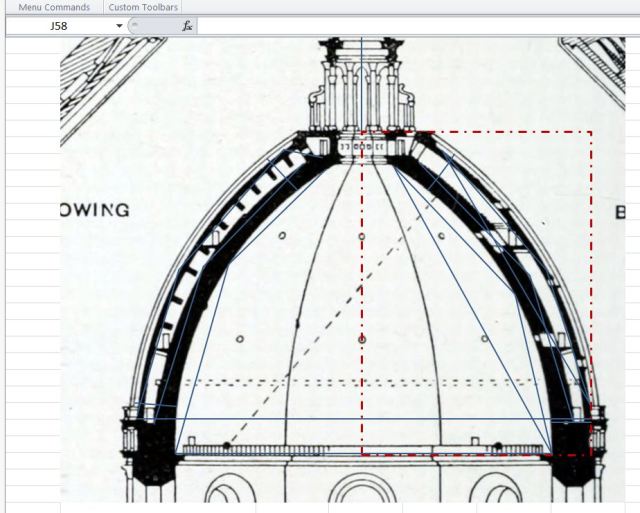
Dome cross section

The method of use of the spreadsheet is:

  • Insert the image to be scaled on the spreadsheet.
  • Move and stretch the “axes” shape so the bottom left and top right corners are over points separated by known horizontal and vertical dimensions
  • Draw freeform shapes with nodes over each point to be scaled.
  • The User Defined Function (UDF) can then be used to find the coordinates of each node of the inserted shapes.

See the spreadsheet and How to digitise a scanned image for more details.

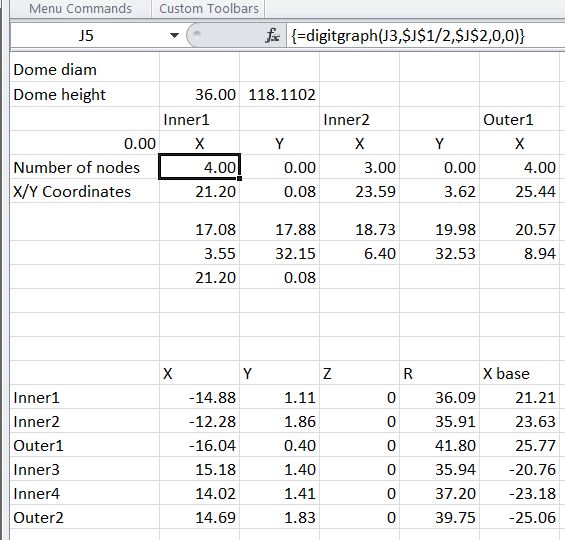
In this case I have found the coordinates of three points on each face of the inner shell, and the outer face of the outer shell, using the centre point of the base of the dome as the origin.  This yielded the data shown below:

Dome shell face coordinates, and derived dimensions and radii

Having found the coordinates of three points on each surface the UDF ArcCenP3, from the IP2 spreadsheet, was used to find the centre and radius of the arc passing through these points.  The thickness of each shell was also checked from the DigitGraph sheet, and the results were cross-checked against a similar analysis using a photograph of the exterior of the dome:
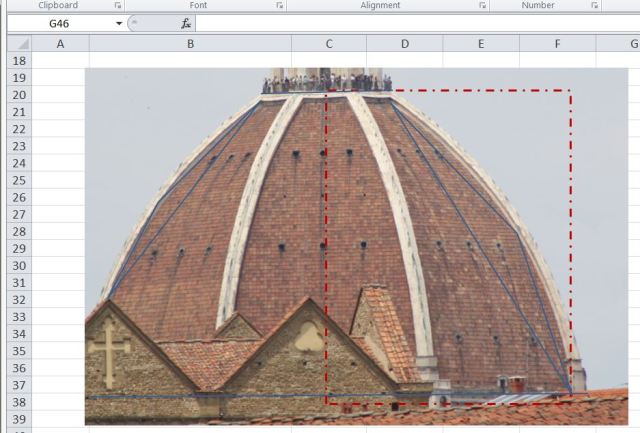
DigitGraph analysis of the outer shell

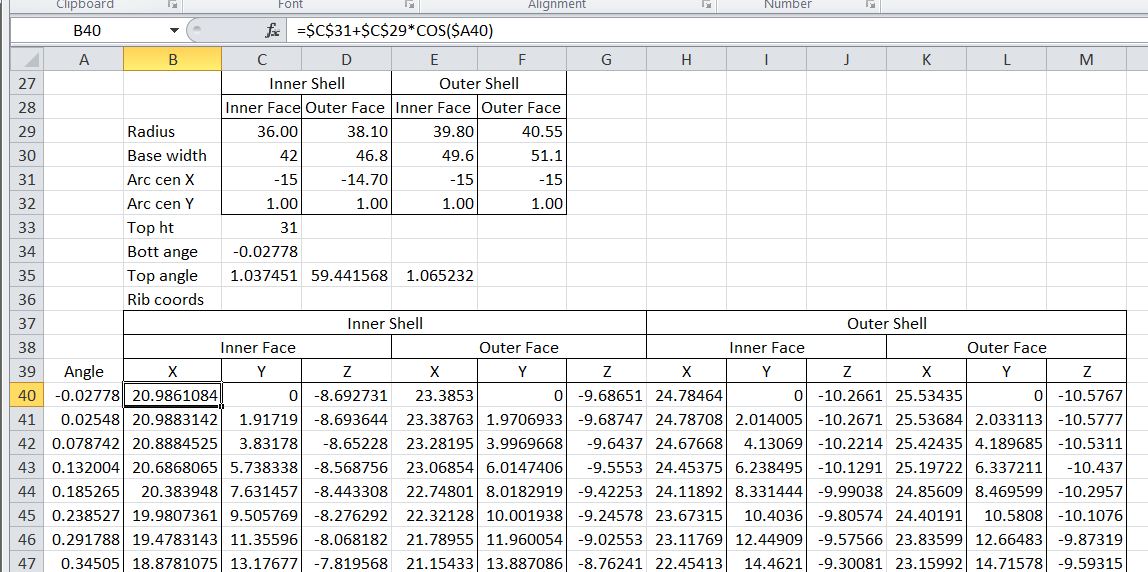
This data was used to determine the arc centre and radius data shown below, which was in turn used to generate the 3D coordinates of 21 points along the edge of a segment of the dome:
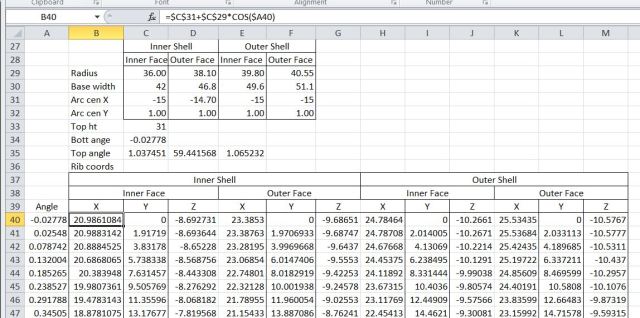
Generated coordinates along the edge of an arch segmet.

The final stages were:

  • Generate the 3D coordinates of an additional 20 points at each level across the full width of each face of one segment of the dome, and assign node numbers to these points.
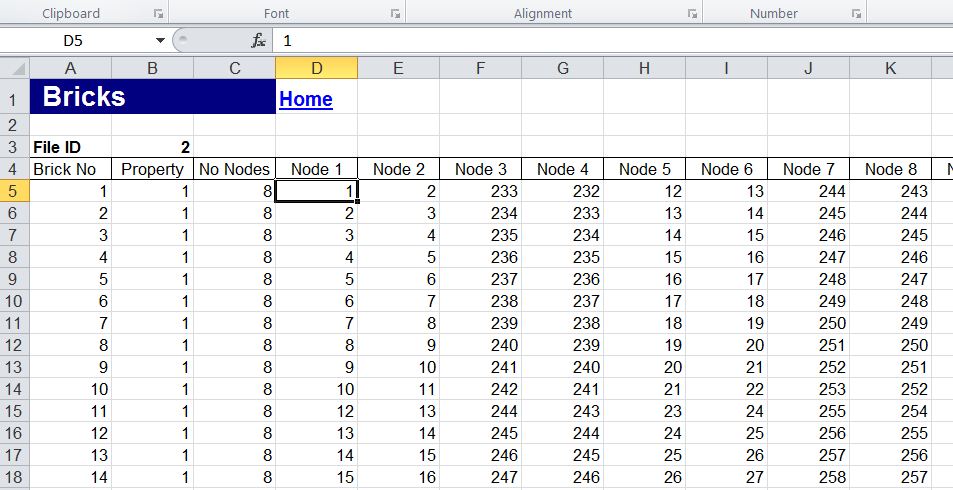
  • Generate the node numbers defining “brick elements” forming the inner and outer shells, and also four ribs connecting the shells.
  • Transfer the node and brick data into a finite element program (Strand 7), forming a model of one segment of the dome.  This was done using the Strand7 Applications Programming Interface (API), and the spreadsheet S7 API Tools, which allows Strand7 models to be generated automatically from spreadsheet data.
  • Assign appropriate boundary restraints to the base of the segment, and assign materials properties.
  • Make four contiguous copies of the segment, each rotated by 45 degrees.
  • Trim the ends of the end segments, leaving a half dome with a vertical plane cut face, and assign symmetry restraint conditions to this face.
  • The model is now ready for analysis.

This process is shown in the screenshots below:
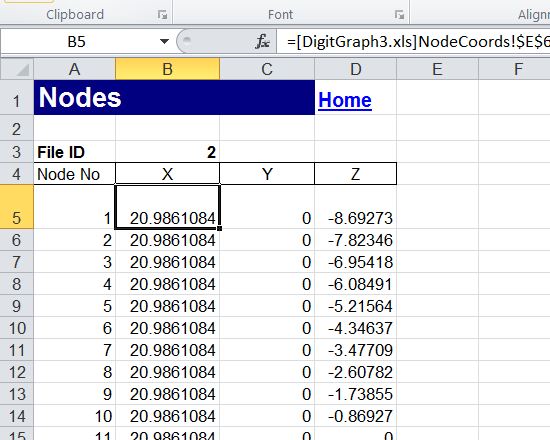
Node List in S7 API Tools spreadsheet
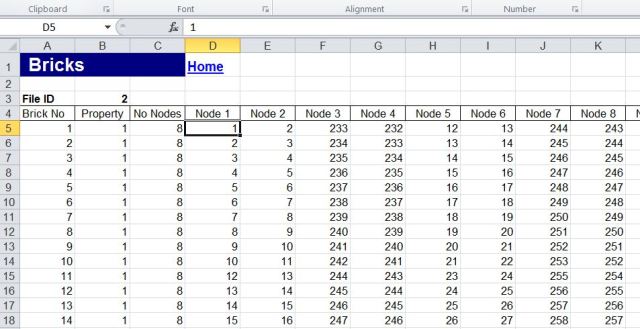
Brick element list in S7 API Tools spreadsheet

Arch segment generated from spreadsheet data
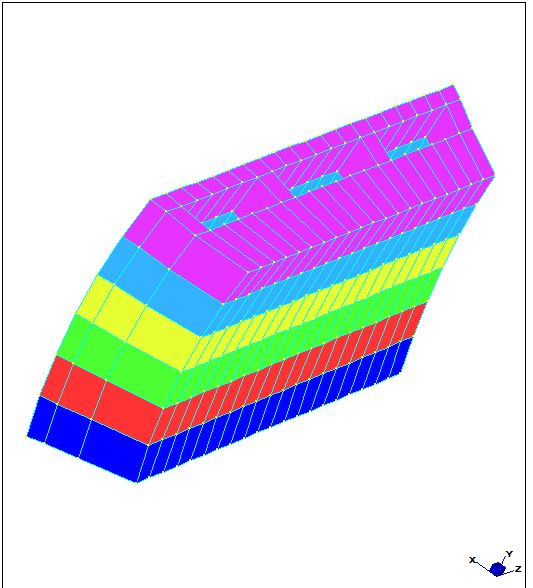
Segment cut to show connecting ribs between inner and outer shell
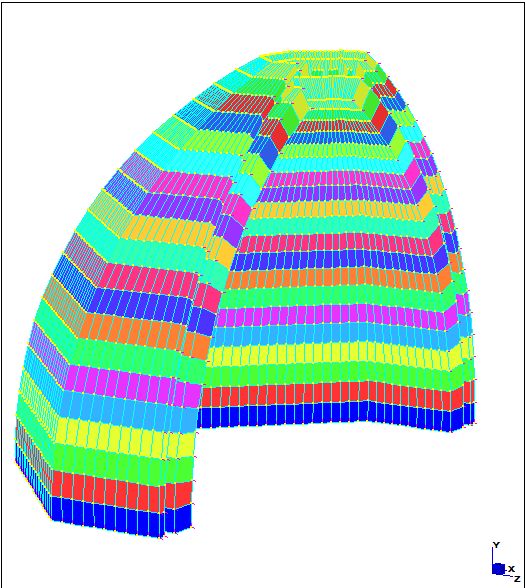
Completed model of half dome, ready for analysis

Posted in Dome Structures, Excel, Finite Element Analysis, Newton, Strand7, UDFs, VBA | Tagged , , , , , , , , | 2 Comments

Interpolation Update

This post was prompted by a question at Eng-Tips.  The question was looking for ways to plot stress contours under a footing, which requires interpolation to find the depth where the stress is at the contour values, given stresses calculated on a regular grid.

The simplest way is using linear interpolation, which can be done using the IP2 spreadsheet.  In the example shown below the data to be interpolated is in B19:C19, and the lines representing the contour stress levels are in B42:C51.  Note that the contour stress levels are entered as a continuous line covering the full extent of the stress data (X = 0 to X = 10).

IP Function Input (click for full size view)

IP Function, linear interpolation results

The main problem with this approach is that linear interpolation will not always pick up peaks in the data, for instance at stress levels near 100, at X = 3.

Better results are given by the SolveSplineA function, which can be found in the CSpline2 spreadsheet.  This function has been revised to return multiple interpolation values, rather than just the first in the specified range.  In this case the stress data is entered in A72:B92, and the contour values are simply listed in order in D72:D76.  It can be seen below that the function has found an additional 2 intersection points for the 100 contour, close to X = 3.

Reverse Cubic Interpolation with the SolveSplineA Function

The spreadsheets described above (including full open source code) may be downloaded from:

IP2

CSpline2

Posted in Excel, UDFs, VBA | Tagged , , , , , , | 1 Comment