In my previous post about numerical integration I mentioned that I would be writing about another lesser known method providing better speed and/or accuracy in many cases. The method is known as Tanh-Sinh quadrature, and has been implemented in Excel by a reader of this blog, Graeme Dennes. Graeme has incorporated a Tanh-Sinh function along with functions for the Gauss-Kronrod method and the Romberg method, and compared their performance at calculating the integrals of 55 different functions.
The spreadsheet (including full open source code and extensive notes) may be downloaded from: Tanh-Sinh.zip.
Graeme’s notes on the origins of the method and its advantages are given below, together with some screen shots of the output.
TANH-SINH, GAUSS-KRONROD AND ROMBERG QUADRATURE PROGRAMS
by Graeme Dennes
Introduction:
This Excel VBA workbook provides three single-dimension quadrature programs as User Defined Functions (UDF) for calculating the definite integral of a non-oscillatory analytic function over a finite interval (a,b). The three methods provided are Tanh-Sinh, Gauss-Kronrod, and Romberg.
Key Purposes:
1. To demonstrate and compare the astounding speed and accuracy of the Tanh-Sinh quadrature method in comparison to the Gauss-Kronrod and Romberg methods.
2. To provide a fast, accurate, practical VBA Tanh-Sinh quadrature program with source code.
3. To hopefully inspire others to improve the performance of the Tanh-Sinh program through judicious code tuning.
Refer to the Readme1, Readme2, About, and Copyright worksheets for complete details of the programs and their usage. Extensive notes on the program are also provided in the VBA module README, including the original Fortran code used as the source for the present Tanh-Sinh program.
The Tanh-Sinh Method:
Tanh-Sinh quadrature is a method proposed by Hidetosi Takahasi and Masatake Mori in 1974. It uses the change of variables to transform an integral on (-1, 1) to an integral on the entire real line (-inf, inf). After this transformation, the integrand decays at a double exponential rate, and thus, this method was originally known as the double exponential (DE) formula, although Tanh-Sinh is but one of the D-E formulas. The key reference documents for the Tanh-Sinh method are listed in the About worksheet.
To paraphrase from the document published in 2006 by David H. Bailey titled Tanh-Sinh High-Precision Quadrature, available at http://crd.lbl.gov/~dhbailey/dhbpapers/dhb-tanh-sinh.pdf: “The Tanh-Sinh quadrature scheme is the fastest known high-precision quadrature scheme, especially when the time for computing abscissas and weights is considered. It has been successfully employed for quadrature calculations of up to 20,000-digit precision. It works well for functions with blow-up singularities or infinite derivatives at endpoints, demonstrating one of its strengths.”.
To paraphrase from the document published in 2005 by David H. Bailey, Karthik Jeyabalan, and Xiaoye S. Li titled “A Comparison of Three High-Precision Quadrature Schemes”, available at the web site: http://crd.lbl.gov/~dhbailey/dhbpapers/quadrature-em.pdf, “The Tanh-Sinh and Gaussian quadrature programs have proven their value in a certain domain of quadrature problems. The Gaussian quadrature methods are very fast and accurate for continuous, well-behaved integrands, and where relatively lower precision calculations are used. However, for functions that are not well behaved in the interval, especially near the endpoints, its accuracy is quite poor. Another major drawback of the Gaussian schemes is that their initialisation time (the generation of the abscissas and weights) is many times higher than that of the Tanh-Sinh scheme. On the other hand, the Tanh-Sinh scheme is able to evaluate problems with infinite derivatives and blow-up singularities at the endpoints to the full precision required.”.
Now to Today!
Although 36 years have passed since the Tanh-Sinh scheme was first proposed, the method is still very much unknown outside of a small number of mathematical researchers and research institutions. Even so, much work has been done in recent years researching the speed, accuracy and application of the Tanh-Sinh method by David H. Bailey of the Lawrence Berkeley National Laboratory, California USA, and Jonathan M. Borwein of the University of Newcastle, NSW, Australia, to name but two of the modern day champions of the Tanh-Sinh method. David H. Bailey is probably the most prolific researcher and writer regarding this method, and most of his papers are freely available for download. Further, the method is so relatively new that very little of its subject matter has appeared in mathematical texts to this time. Much of the published information is in authored papers. Try an Internet search on ‘tanh sinh’.
Overall, the Tanh-Sinh scheme appears to be the preferred numerical integration method for the majority of integrand types, and it has excellent accuracy and runtime performance as well, with its initialisation time being less than for Gaussian quadrature. Still, the Gaussian integrator can be quicker than the Tanh-Sinh integrator for some functions which are well behaved in the full interval, yet slower than the Tanh-Sinh method for many types of functions, or where extended precision and accuracy are required.
As the last concluding remark, in the report by D. H. Bailey and X. S. Li in 2003 on a comparison of high-precision quadrature schemes: “Overall, the Tanh-Sinh scheme appears to be the best. It combines uniformly excellent accuracy with fast run times. It is the nearest we have to a truly all-purpose quadrature scheme at the present time.”.
The Present Program:
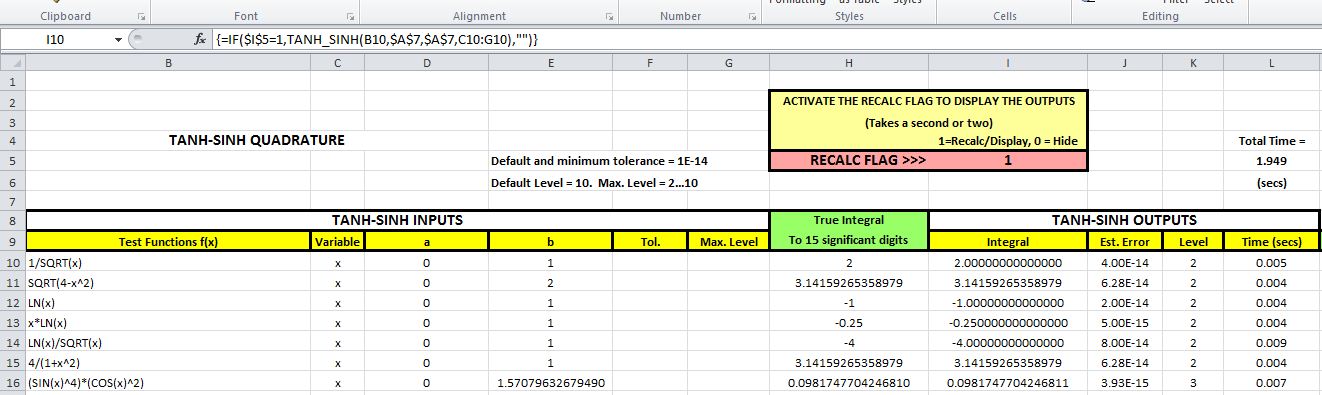
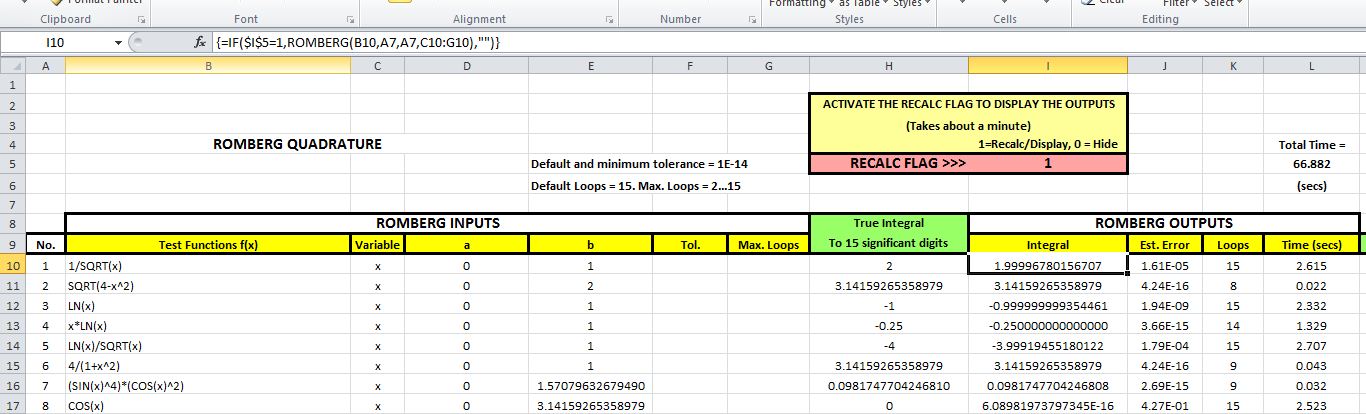
This Excel VBA Tanh-Sinh program combines the fastest speed and highest accuracy of any Excel VBA quadrature program this author has witnessed. A range of test functions is included for integration by the three methods, and the integral results, the calculation times, and the true answers are presented for comparison. The speed of the Tanh-Sinh method in comparison to other methods almost has to be seen to be believed, and its accuracy seems to be almost perfect, and for many of the functions listed, it IS perfect, being accurate to the full 15 significant digits of Excel.
Try these three integration programs, and compare their results (speed and accuracy) with your own integrators. I think you’ll be as impressed as I was with the performance of the Tanh-Sinh method.
As noted at the very start here, I’m hopeful others will apply their programming skills towards enhancing the performance of the Tanh-Sinh routine, and present their refinements for the benefit of all.
In conclusion, this really isn’t about numbers. It’s about insight.
Your comments and suggestions are sought.
Graeme Dennes
September 2010

Tanh-Sinh Function output, click for full size view
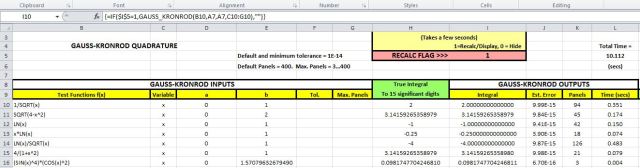
Gauss-Kronrod Function Output
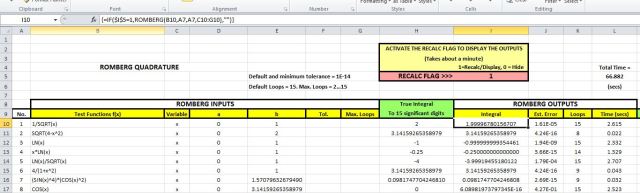
Romberg Function Output









 Newton Excel Bach, not (just) an Excel Blog