Stress blocks in AS 3600

The long awaited update to the Australian Standard for concrete structures (AS 3600 – 2009) provides rules for the design of structures with concrete up to a compressive strength of 100 MPa.  Unfortunately there are a number of significant typographical errors in the new version of the code, one of the most significant being in the definition of the concrete rectangular compressive stress block, for determination of the ultimate bending strength of beams.

The compressive stress block is an approximation to the actual stress distribution in a reinforced concrete member that takes advantage of the fact that the stress-strain curve of low to medium strength concrete has a wide plateau region where the maximum stress is maintained constant with increasing strain.  In high strength concretes this plateau is much narrower, since the maximum stress is developed at a higher strain, and the reduction in stress starts at a lower strain.  For this reason both the depth and the stress in the rectangular block must be adjusted so that the resulting bending capacity is accurate.  In Section 8 of the final public draft of the code the factors to make this adjustment were defined as:

Draft cods stress block factors

where a2 is the factor on the depth of the stress block and g is the factor on the compressive stress.  By the time the code was released this had been changed to:

Stress block factors in code as released.

Meanwhile in Section 10 of the code (design of columns) the stress block factor equations are repeated, and shown exactly as in the draft code!

Code factors in Column Design section

The effect of the erroneous formula in Section 8 is to generate a γ value that is at the maximum end of the allowable range (0.85) for concrete grades up to 50 MPa, at which stress the correct formula gives a value of 0.7.  The Section 8 formula is therefore unconservative, and the column provisions in Section 10 should be used for all flexural members instead.  Another approach is to make use of the code provision that allows the use of any stress-strain curve for concrete “of curvilinear form defined by recognized simplified equations”, subject to the requirement that “the shape of the in-situ uniaxial compressive stress-strain curve shall be modified so that the maximum stress is 0.9f’c“.

Eurocode 2 (EC 2) provides convenient equations for a parabolic-rectangular stress block, which I have added to my spreadsheet for design of rectangular sections.  The revised spreadsheet (including full open-source code) can be downloaded from: RC Design Functions.zip.

The design codes available with the new UMom are listed below:

Codes and stress blocks available in UMom

The two formulations of the parabolic stress block give almost identical results.  The second (Code = 10) returns equivalent rectangular stress block parameters, which can be compared with the values given in AS 3600.

Output from the new Umom function is shown below for the five different stress blocks, and four high strength concrete grades, from 50 MPa to 100 MPa:

Interaction Diagram, F'c = 50 MPa

Interaction Diagram: f'c = 65 MPa

Interaction Diagram: f'c = 80 MPa

Interaction Diagram: f'c = 100 MPa

It can be seen that:

  • At 50 MPa use of Section 10 in the new code gives results very close to those from the old (2001) code.  The Section 8 results are significantly higher, but the parabolic stress block is higher still.
  • At 65 MPa the old code provisions had become unconserative, but the Section 8 provisions in the new code are higher still in the range of the balance moment.  The parabolic stress block now gives more conservative results than any of the AS 3600 rectangular stress blocks.
  • At 80 MPa the old code was no longer applicable.  The Section 8 provisions in the new code are the most unconservative, but the Section 10 results are also significantly higher than the parabolic stress block results.
  • At 100 MPa the Section 10 results are very close to the parabolic stress block, with the Section 8 results being only a little higher.

In summary there are significant differences between the correct (Section 10) rectangular stress block results and those given by the parabolic-rectangular stress blocks.  Since the latter is much closer to the actual stress-strain behaviour of high strength concrete, and since the computation effort for a rectangular section is almost the same, it seems to me sensible to use the parabolic-rectangular stress block as standard.

For non-rectangular sections there is a significant degree of additional computation for the parabolic-rectangular stress block, but since the rectangular stress block introduces a significant degree of error for non-rectangular sections, in my opinion it is better to use the parabolic-rectangular stress block in this case also.

Posted in Concrete, Newton | Tagged , , , , | 3 Comments

Tanh-Sinh Quadrature update

Graeme Dennes has been continuing work on his Tanh-Sinh Quadrature function, and recently sent me a revised version, which can be downloaded from: Tanh-Sinh.zip

The main change is a new automatic tolerance adjustment feature which automatically increases the tolerance for badly behaved functions that will not converge to the default tolerance.  The result is much better performance for a few of the sample functions.  The download file also includes extensive additional notes.

Posted in Excel, Maths, Newton, Numerical integration, UDFs, VBA | Tagged , , , , , , , | 9 Comments

Interactive File List

Microsoft recently introduced the facility to embed a link to a live spreadsheet stored on Windows Skydrive.
This is my first attempt to use this facility.  The spreadsheet below is a list of all the files published on this blog, together with a link to the latest relevent blog post.  You can navigate around the spreadsheet in the usual way, and click on file names to open or download the file, or click on the blog post link to open the related post. Click on the icon on the bottom right to view the spreadsheet full size.  This list is also accessible from the new Downloads page, and will be kept updated as new files are posted.

Posted in Excel, UDFs, VBA | Tagged , , | Leave a comment

Update to Beam1 and Beam2

It has just been pointed out that the single span beam spreadsheet presented at Frame Analysis with Excel 1 does not work for a propped cantilever.  The same applies to the spreadsheet for single span sloping beams at Frame Analysis with Excel 2.

The spreadsheets were really mainly intended for educational purposes, and the continuous beam spreadsheet at Frame Analysis with Excel 3 handles a single span propped cantilever already, but the earlier spreadsheets are handy for the quick analysis of a single span beam, so I have modified them so that they will handle the propped cantilever condition.  The revised spreadsheets cane be downloaded from:

Beam1.zip
Beam2.zip

Beam1 output for propped cantilever


Posted in Beam Bending, Excel, Frame Analysis, Newton | Tagged , , | 3 Comments

Faster Integration with the Tanh-Sinh Method

In my previous post about numerical integration I mentioned that I would be writing about another lesser known method providing better speed and/or accuracy in many cases.  The method is known as Tanh-Sinh quadrature, and has been implemented in Excel by a reader of this blog, Graeme Dennes.  Graeme has incorporated a Tanh-Sinh function along with functions for the Gauss-Kronrod method and the Romberg method, and compared their performance at calculating the integrals of 55 different functions.

The spreadsheet (including full open source code and extensive notes) may be downloaded from: Tanh-Sinh.zip.

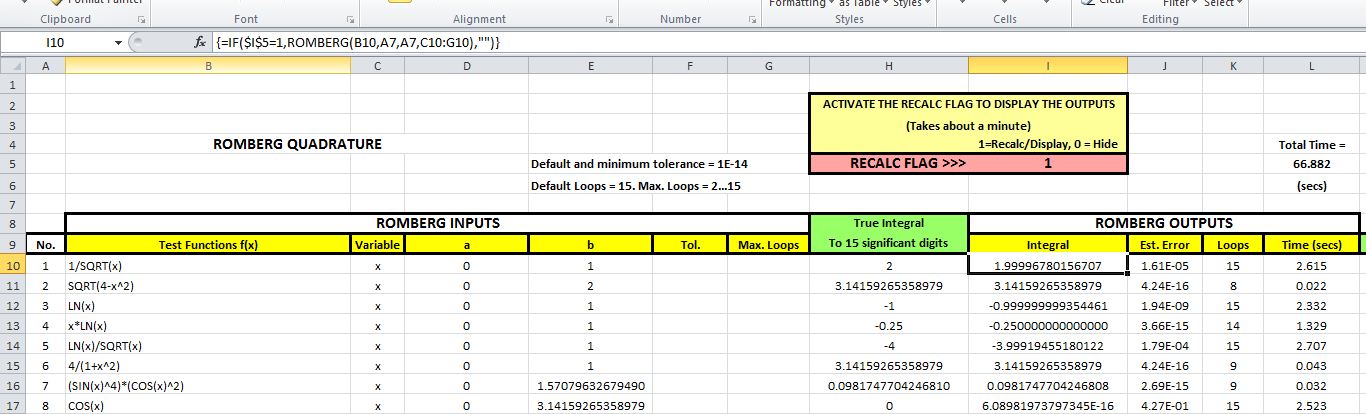
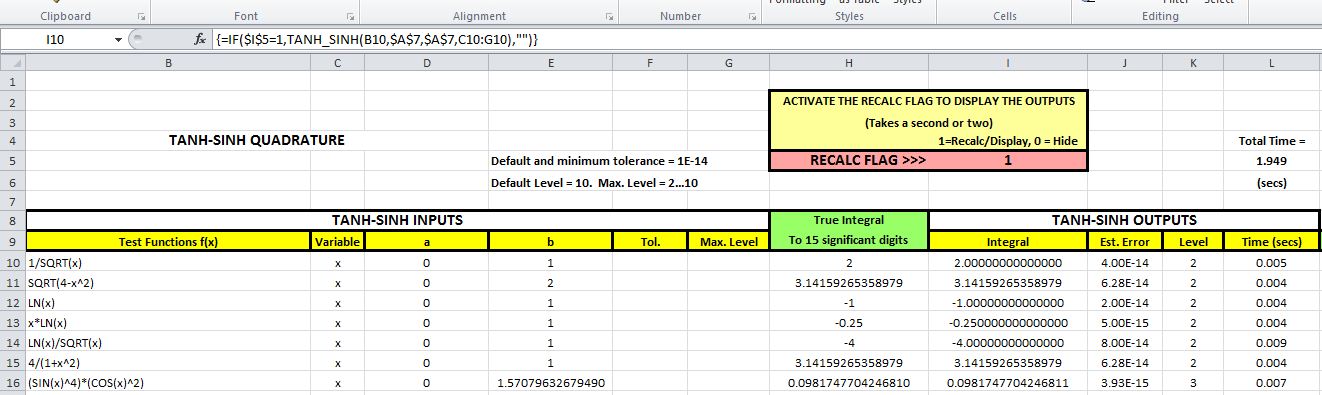
Graeme’s notes on the origins of the method and its advantages are given below, together with some screen shots of the output.

TANH-SINH, GAUSS-KRONROD AND ROMBERG QUADRATURE PROGRAMS

 by Graeme Dennes

 Introduction:

This Excel VBA workbook provides three single-dimension quadrature programs as User Defined Functions (UDF) for calculating the definite integral of a non-oscillatory analytic function over a finite interval (a,b). The three methods provided are Tanh-Sinh, Gauss-Kronrod, and Romberg.

 Key Purposes:

1. To demonstrate and compare the astounding speed and accuracy of the Tanh-Sinh quadrature method in comparison to the Gauss-Kronrod and Romberg methods.

 2. To provide a fast, accurate, practical VBA Tanh-Sinh quadrature program with source code.

 3. To hopefully inspire others to improve the performance of the Tanh-Sinh program through judicious code tuning.

 Refer to the Readme1, Readme2, About, and Copyright worksheets for complete details of the programs and their  usage. Extensive notes on the program are also provided in the VBA module README, including the original Fortran code used as the source for the present Tanh-Sinh program.

 The Tanh-Sinh Method:

Tanh-Sinh quadrature is a method proposed by Hidetosi Takahasi and Masatake Mori in 1974. It uses the change of variables to transform an integral on (-1, 1) to an integral on the entire real line (-inf, inf). After this transformation, the integrand decays at a double exponential rate, and thus, this method was originally known as the double exponential (DE) formula, although Tanh-Sinh is but one of the D-E formulas. The key reference documents for the Tanh-Sinh method are listed in the About worksheet.

 To paraphrase from the document published in 2006 by David H. Bailey titled Tanh-Sinh High-Precision Quadrature, available at http://crd.lbl.gov/~dhbailey/dhbpapers/dhb-tanh-sinh.pdf: “The Tanh-Sinh quadrature scheme is the fastest known high-precision quadrature scheme, especially when the time for computing abscissas and weights is considered. It has been successfully employed for quadrature calculations of up to 20,000-digit precision. It works well for functions with blow-up singularities or infinite derivatives at endpoints, demonstrating one of its strengths.”.

 To paraphrase from the document published in 2005 by David H. Bailey, Karthik Jeyabalan, and Xiaoye S. Li titled “A Comparison of Three High-Precision Quadrature Schemes”, available at the web site: http://crd.lbl.gov/~dhbailey/dhbpapers/quadrature-em.pdf, “The Tanh-Sinh and Gaussian quadrature programs have proven their value in a certain domain of quadrature problems. The Gaussian quadrature methods are very fast and accurate for continuous, well-behaved integrands, and where relatively lower precision calculations are used. However, for functions that are not well behaved in the interval, especially near the endpoints, its accuracy is quite poor. Another major drawback of the Gaussian schemes is that their initialisation time (the generation of the abscissas and weights) is many times higher than that of the Tanh-Sinh scheme. On the other hand, the Tanh-Sinh scheme is able to evaluate problems with infinite derivatives and blow-up singularities at the endpoints to the full precision required.”.

 Now to Today!

Although 36 years have passed since the Tanh-Sinh scheme was first proposed, the method is still very much unknown outside of a small number of mathematical researchers and research institutions. Even so, much work has been done in recent years researching the speed, accuracy and application of the Tanh-Sinh method by David H. Bailey of the Lawrence Berkeley National Laboratory, California USA, and Jonathan M. Borwein of the University of Newcastle, NSW, Australia, to name but two of the modern day champions of the Tanh-Sinh method. David H. Bailey is probably the most prolific researcher and writer regarding this method, and most of his papers are freely available for download. Further, the method is so relatively new that very little of its subject matter has appeared in mathematical texts to this time. Much of the published information is in authored papers. Try an Internet search on ‘tanh sinh’.

 Overall, the Tanh-Sinh scheme appears to be the preferred numerical integration method for the majority of integrand types, and it has excellent accuracy and runtime performance as well, with its initialisation time being less than for Gaussian quadrature. Still, the Gaussian integrator can be quicker than the Tanh-Sinh integrator for some functions which are well behaved in the full interval, yet slower than the Tanh-Sinh method for many types of functions, or where extended precision and accuracy are required.

 As the last concluding remark, in the report by D. H. Bailey and X. S. Li in 2003 on a comparison of high-precision quadrature schemes: “Overall, the Tanh-Sinh scheme appears to be the best. It combines uniformly excellent accuracy with fast run times. It is the nearest we have to a truly all-purpose quadrature scheme at the present time.”.

 The Present Program:

This Excel VBA Tanh-Sinh program combines the fastest speed and highest accuracy of any Excel VBA quadrature program this author has witnessed. A range of test functions is included for integration by the three methods, and the integral results, the calculation times, and the true answers are presented for comparison. The speed of the Tanh-Sinh method in comparison to other methods almost has to be seen to be believed, and its accuracy seems to be almost perfect, and for many of the functions listed, it IS perfect, being accurate to the full 15 significant digits of Excel.

 Try these three integration programs, and compare their results (speed and accuracy) with your own integrators. I think you’ll be as impressed as I was with the performance of the Tanh-Sinh method.

 As noted at the very start here, I’m hopeful others will apply their programming skills towards enhancing the performance of the Tanh-Sinh routine, and present their refinements for the benefit of all.

 In conclusion, this really isn’t about numbers. It’s about insight.

 Your comments and suggestions are sought.

 Graeme Dennes

September 2010

Tanh-Sinh Function output, click for full size view

Gauss-Kronrod Function Output

Romberg Function Output

Posted in Excel, Maths, Numerical integration, UDFs, VBA | Tagged , , , , , , , | 3 Comments